health
25+ Pathways to Healing
Evidence-Based Altered States of Consciousness Modalities Mapped to All 7 Domains of Human Suffering Prof. Luis Miguel Gallardo | World Happiness Foundation | April 2026 PhD Scholar, Shoolini University | Clinical & Transpersonal Hypnotherapist | ICF PCC Coach Introduction Traditional mental health
May 13, 2026·Luis Miguel Gallardo·6 min read
AI insights
Evidence-Based Altered States of Consciousness Modalities
Mapped to All 7 Domains of Human Suffering
Prof. Luis Miguel Gallardo | World Happiness Foundation | April 2026
PhD Scholar, Shoolini University | Clinical & Transpersonal Hypnotherapist | ICF PCC Coach
Introduction
Traditional mental health systems address only one of seven dimensions of human suffering. The Global Pain & Trauma Map (GPTM V4.9), developed by the World Happiness Foundation, reveals that six additional domains — relational, collective, structural, existential, somatic, and environmental — generate equal or greater suffering than the psychological domain alone. These invisible dimensions affect billions of people worldwide, yet remain largely unmeasured and untreated by conventional approaches.
This article presents a comprehensive catalogue of 25+ Altered States of Consciousness (ASC) modalities that have been mapped to all seven GPTM domains. The evidence reveals a striking finding: despite their apparent diversity — from clinical EMDR to community drumming, from psilocybin-assisted therapy to forest bathing — all ASC modalities share seven common neurobiological mechanisms. They all target the same structure: the subconscious mind, which emerges as the universal therapeutic target.
The Seven Domains of Human Suffering
To understand why 25+ different healing modalities are needed, we must first understand the seven dimensions of suffering they address. Each domain requires different interventions because each operates through different mechanisms of pain:
Domain 1 — Psychological: Depression, anxiety, PTSD, shame, emotional dysregulation. Over 1 billion people affected. This is the only domain conventional mental health systems address.
Domain 2 — Relational: Loneliness, attachment wounds, social isolation. 33% of adults globally. The loneliness epidemic has mortality effects comparable to smoking 15 cigarettes per day.
Domain 3 — Collective: War trauma, intergenerational grief, cultural erasure. 2 billion in conflict zones. Transmits across generations through epigenetics and narrative.
Domain 4 — Structural: Poverty, discrimination, institutional betrayal. 700 million in extreme poverty. Suffering that appears individual but has systemic roots.
Domain 5 — Existential: Meaninglessness, death anxiety, purposelessness. 40% of adults. Invisible to all conventional metrics yet drives much of the mental health burden.
Domain 6 — Somatic: Chronic pain, addiction, burnout, nervous system dysregulation. 1.5 billion with chronic pain. The body stores trauma the mind cannot access.
Domain 7 — Environmental: Climate anxiety, eco-grief, nature deficit, species grief. 75% of youth report climate anxiety. Background existential dread that compounds all other domains.
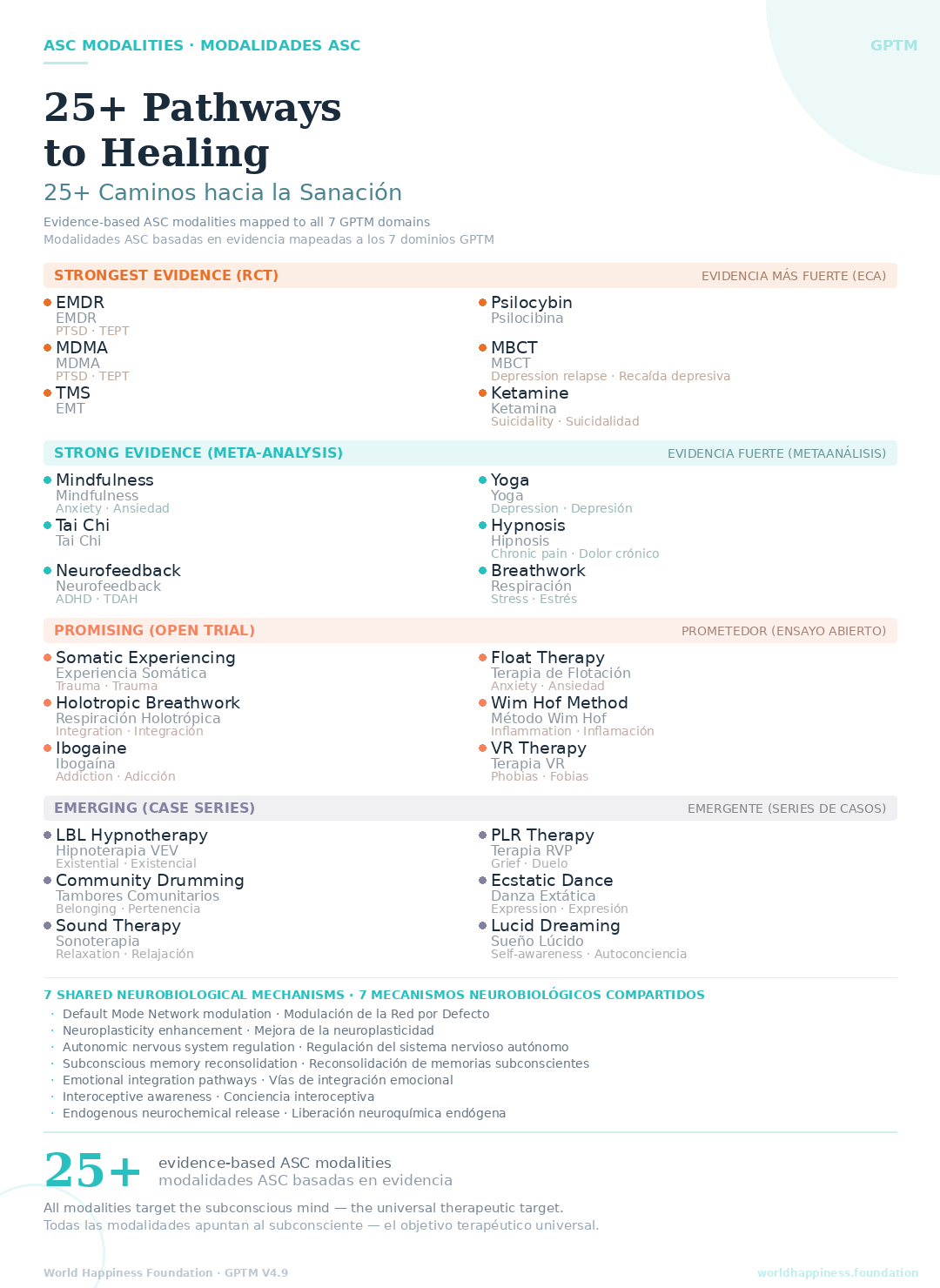
25+ ASC Modalities: Evidence-Based Catalogue
The following catalogue organises all mapped modalities by strength of evidence, from Randomised Controlled Trials (RCTs) to emerging case series. Each modality has been assessed for its primary clinical application and mapped to the GPTM domains it most directly addresses.
| Modality | Primary Application | GPTM Domains |
| STRONGEST EVIDENCE (RCT) | EVIDENCIA MÁS FUERTE (ECA) | ||
| EMDREMDR | PTSD, trauma processing TEPT, procesamiento de trauma | D1, D3, D6 |
| PsilocybinPsilocibina | Treatment-resistant depression Depresión resistente al tratamiento | D1, D5 |
| MDMA-ATMDMA-AT | Complex PTSD TEPT complejo | D1, D2, D3 |
| MBCTMBCT | Depression relapse prevention Prevención de recaída depresiva | D1, D5 |
| TMSEMT | Treatment-resistant depression Depresión resistente al tratamiento | D1 |
| KetamineKetamina | Acute suicidality Suicidalidad aguda | D1 |
| STRONG EVIDENCE (META-ANALYSIS) | EVIDENCIA FUERTE (METAANÁLISIS) | ||
| MindfulnessMindfulness | Anxiety, rumination Ansiedad, rumiación | D1, D5, D6 |
| YogaYoga | Depression, somatic tension Depresión, tensión somática | D1, D6 |
| Tai ChiTai Chi | Elderly well-being, balance Bienestar adultos mayores | D6, D2 |
| HypnosisHipnosis | Chronic pain, phobias Dolor crónico, fobias | D1, D6 |
| NeurofeedbackNeurofeedback | ADHD, anxiety TDAH, ansiedad | D1 |
| BreathworkRespiración consciente | Stress, autonomic regulation Estrés, regulación autonómica | D1, D6 |
| PROMISING (OPEN TRIAL) | PROMETEDOR (ENSAYO ABIERTO) | ||
| Somatic ExperiencingExperiencia Somática | Developmental trauma Trauma del desarrollo | D1, D6 |
| Float TherapyTerapia de Flotación | Anxiety, sensory overload Ansiedad, sobrecarga sensorial | D1, D6 |
| Holotropic BreathworkRespiración Holotrópica | Psycho-spiritual integration Integración psicoespiritual | D5, D1 |
| Wim Hof MethodMétodo Wim Hof | Inflammation, resilience Inflamación, resiliencia | D6, D1 |
| IbogaineIbogaína | Substance addiction Adicción a sustancias | D1, D6 |
| VR TherapyTerapia VR | Phobias, exposure therapy Fobias, terapia de exposición | D1 |
| EMERGING (CASE SERIES) | EMERGENTE (SERIES DE CASOS) | ||
| LBL HypnotherapyHipnoterapia Vida Entre Vidas | Existential anxiety, purpose Ansiedad existencial, propósito | D5 |
| PLR TherapyTerapia de Regresión | Grief, unresolved loss Duelo, pérdida no resuelta | D5, D2 |
| Community DrummingTambores Comunitarios | Social isolation, belonging Aislamiento social, pertenencia | D2, D3 |
| Ecstatic DanceDanza Extática | Somatic expression, release Expresión somática, liberación | D6, D2 |
| Sound TherapySonoterapia | Stress, nervous system reset Estrés, reinicio sistema nervioso | D6, D1 |
| Lucid DreamingSueño Lúcido | Self-awareness, integration Autoconciencia, integración | D5, D1 |
The Seven Shared Neurobiological Mechanisms
Perhaps the most significant finding of the GPTM’s ASC analysis is that all 25+ modalities, despite their apparent diversity, share seven common neurobiological mechanisms. This convergence suggests that the subconscious mind is the universal therapeutic target — and that different modalities are simply different doors into the same room.
1. Default Mode Network (DMN) Modulation. All ASC modalities reduce hyperactivity in the brain’s default mode network, the neural substrate of the narrative self. When the DMN quiets, rumination decreases and direct experience replaces self-referential thinking.
2. Neuroplasticity Enhancement. ASC states create windows of heightened neuroplasticity, allowing the brain to form new neural pathways and break rigid patterns of thought, emotion, and behaviour.
3. Autonomic Nervous System Regulation. From breathwork to EMDR, all modalities shift the autonomic nervous system from sympathetic (fight/flight) to parasympathetic (rest/digest) dominance, restoring the body’s capacity for self-regulation.
4. Subconscious Memory Reconsolidation. ASC states access memories stored below conscious awareness and allow them to be reconsolidated — updated with new emotional and cognitive information — without the need for explicit recall.
5. Emotional Integration Pathways. Rather than suppressing or avoiding difficult emotions, ASC modalities facilitate their integration into conscious awareness, transforming shadow material into accessible psychological resource.
6. Interoceptive Awareness. All modalities enhance the ability to perceive internal bodily signals, reconnecting the mind-body system and allowing somatic trauma to be processed through awareness rather than avoided.
7. Endogenous Neurochemical Release. ASC states trigger release of endogenous healing compounds — endorphins, oxytocin, endocannabinoids, DMT — that support emotional bonding, pain relief, and states of well-being.
Implementation: The Cost of Healing
The five most scalable well-being interventions cost under $20 per person per year. School-based mindfulness programmes cost $2–5 per student. Gratitude interventions cost $1–5. Community drumming circles cost $3–10. Breathwork programmes cost $5–15. Meanwhile, violence alone costs the global economy $16.5 trillion annually. A redirection of just 1% of that expenditure could fund well-being programmes for 8 billion people.
The GPTM’s policy recommendations span three governance levels. At the city level, following the Pinecrest model: appoint a Chief Well-Being Officer, integrate mindfulness in all schools, deploy EMDR in every health centre, build contemplative public spaces, and measure all nine spheres of the Wheel of Happiness. At the national level: adopt the GPTM as a complementary mental health framework, fund ASC clinical trials, train 10,000 practitioners in five ASC clusters, and create regulatory pathways for psychedelic therapy. At the international level: adopt the GPTM as complementary to the WHO Global Burden of Disease framework, fund global ASC evidence synthesis through Cochrane, and deploy low-cost modalities in refugee settings.
Conclusion: From Shadow to Fundamental Peace
The 25+ ASC modalities catalogued in the GPTM represent more than a clinical toolkit. They represent a paradigm shift in how we understand healing. The convergence of seven neurobiological mechanisms across modalities as diverse as EMDR and ecstatic dance, psilocybin and community drumming, suggests that consciousness itself is the medicine — and that the subconscious mind is where transformation begins.
“Fundamental Peace is not the absence of pain… it is the transmutation of its energy into love and compassion.” — Luis Miguel Gallardo
The healing pathways exist. The evidence is growing. The economics are viable. The only remaining barrier is consciousness itself — and that is precisely what these 25+ modalities are designed to expand.
Join us: worldhappiness.foundation | 10 Billion Free, Conscious & Happy by 2050
…
Explore this topic
Field notes to your inbox
Stay connected to the shift.
Monthly essays from the Observatory, invitations to Fests and Academy cohorts. Written from abundance — never urgency.