Consciousness & Inner Work
Born from the Spring: Ubud, the two dragons of Bali, and the day the water spoke
A first-person essay from Ubud — Tirta Empul, the beringin, the Balinese triads, and what the island returns to us about origin, healing and the ten billion.
July 20, 2026·Luis Miguel Gallardo·11 min read
AI insights
Ubud, the two dragons of Bali, and the day the water spoke.
The heartbeat under the water
There is a pool at Tirta Empul that lies beyond the famous spouts, past the courtyards where pilgrims queue with their offerings, in the quiet of the inner sanctum. It is the source itself: the place where the holy spring — tirta empul, the water that rises from the earth — has been emerging for more than a thousand years.
I stood before it today, still wet from melukat, the Balinese ritual of purification. And I watched the floor of the pool breathe.
The dark sand at the bottom was lifting and falling, lifting and falling, in slow rhythmic pulses — a heart beating under water. Where each pulse rose, water was being born: not poured, not channelled, but born, out of the body of the earth, without effort and without end.
I did not think, how beautiful. For a long moment I did not think at all. What I felt was expansion — as if the boundary I usually call “me” had become as permeable as that sand. As if I were returning to the origin and being born, right there, from that spring. Not remembering birth: undergoing it. The water was talking, as it had been talking all day in the three temples I visited across Ubud, under banyans that stood over the shrines like patient elders. But at the source it stopped speaking in metaphors. It simply said: this is where you begin. Begin again.
This article is my attempt to honour what the water said — through the myths, the triads and the living landscape of Bali, an island that long ago turned hydrology into theology.
A town named medicine
Ubud tells you what it is in its own name. In the eighth century, the sage Rsi Markandeya, travelling from Java, felt a pulsing energy at Campuhan — the confluence where two branches of the Wos River meet — and made it his place of meditation, founding the temple of Pura Gunung Lebah on the small hill above the meeting waters. Along those riverbanks his companions found an abundance of healing plants; the place was named ubad — the Balinese word for medicine — and, in time, ubad became Ubud.
So the spiritual heart of Bali is literally called Medicine, and its founding act was a man sitting still where two waters become one. The tradition Markandeya seeded is known, in its purest form, as Agama Tirtha: the religion of holy water. Not the religion of a book, or of a temple, or even of a god alone — the religion of water. In Bali, the sacred is not an idea. It flows. It has temperature and current. It can be entered.
That is what melukat is: entering. You bow beneath spout after spout — at Tirta Empul there are thirty, carved in stone, each carrying its own quality of blessing — and you let the water take what you no longer need. The myth of the spring says as much. When the tyrant-king Mayadenawa poisoned the waters and, with them, the army of the god Indra, Indra drove his staff into the earth and a spring burst forth — amrita, the water of immortality — reviving the fallen. The first medicine of Ubud’s sacred geography was water given to the poisoned. It still is.
The island held by dragons
To understand why the ground of a spring can beat like a heart, you have to know what the Balinese say lies beneath the ground.
In the Balinese account of the world’s origin, the cosmic serpent Antaboga, in deep meditation, brought forth Bedawang Nala, the great fire-turtle who carries the world on his shell. Coiled around the turtle are two dragons: Naga Anantaboga, serpent of the earth, and Naga Basuki, serpent of the waters. When the turtle stirs — when the deep fire moves — the island trembles. And what do the dragons do? They do not flee, and they do not fight. They tighten their embrace. To this day, when an earthquake shakes Bali, people call out hidup, hidup! — alive, alive! — to rouse the serpents to hold the world more closely.
Read with modern eyes, the image is startlingly exact: Bedawang Nala is the magma at the heart of a volcanic island; Anantaboga is the element earth; Basuki is the element water; and on the padmasana shrines that stand in every temple, a third serpent — Taksaka, naga of air and rain — completes the elemental mandala around the turtle’s fire. Earth, water and air, embracing fire. The base of every Balinese shrine is a diagram of the planet.
And Basuki is not confined to myth. The chronicles give him a body the size of the island. The Babad Pasek tells that Bali once drifted wild upon the sea, so the god Pasupati ordered the turtle and the serpents to carry the peak of Mount Semeru across the water and pin the island down: that peak became Mount Agung, Bali’s holiest mountain, and Basuki — dragon of safety and prosperity — took refuge in its heart. The Mother Temple on Agung’s slopes carries his name: Besakih, from basuki, from the Sanskrit wasuki — sanctuary, well-being. The holiest temple in Bali is the Dragon’s Sanctuary.
More beautiful still: according to the Lontar Prekempa Gunung Agung, the dragon’s head rests at Pura Goa Lawah, the cave temple by the sea, and his tail at Pura Goa Raja, within the Besakih complex on the mountain. Stretch a serpent from the ocean to the volcano and you have drawn the water cycle: the sea rises as vapour, falls as rain upon the heights, and returns through rivers and springs to the sea. The dragon’s body is the hydrological cycle. When I watched the sand pulse at Tirta Empul, I was watching a heartbeat of that immense body — Basuki exhaling through the floor of a pool in the highlands, on water’s long journey home.
“Fundamental Peace is not the absence of pain… it is the transmutation of its energy into love and compassion.”
Bali carved that teaching into the base of every shrine long before I arrived. The dragons do not slay the trembling. They hold it — and their holding is what keeps the island whole.
The tree that roots from the sky
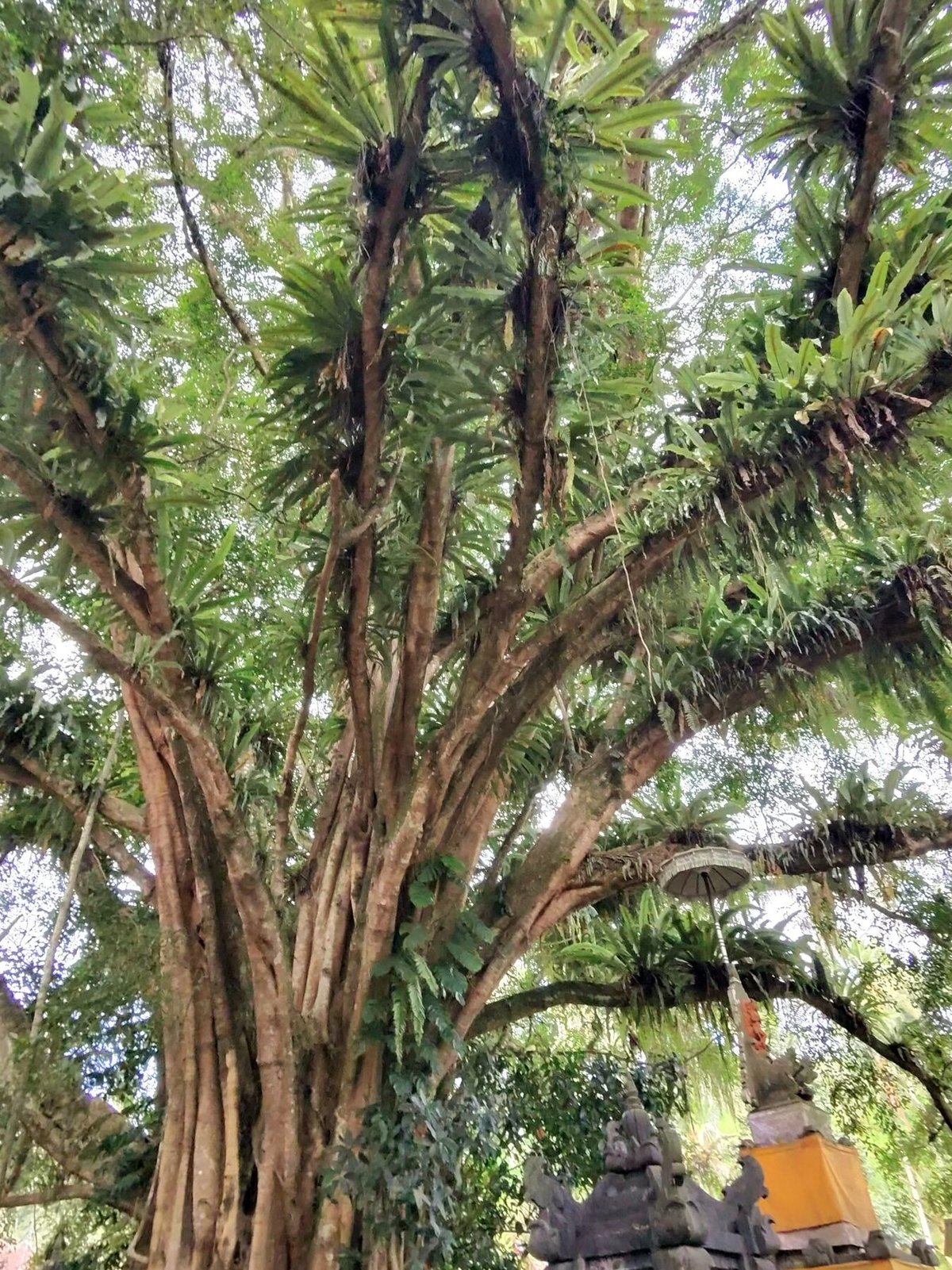
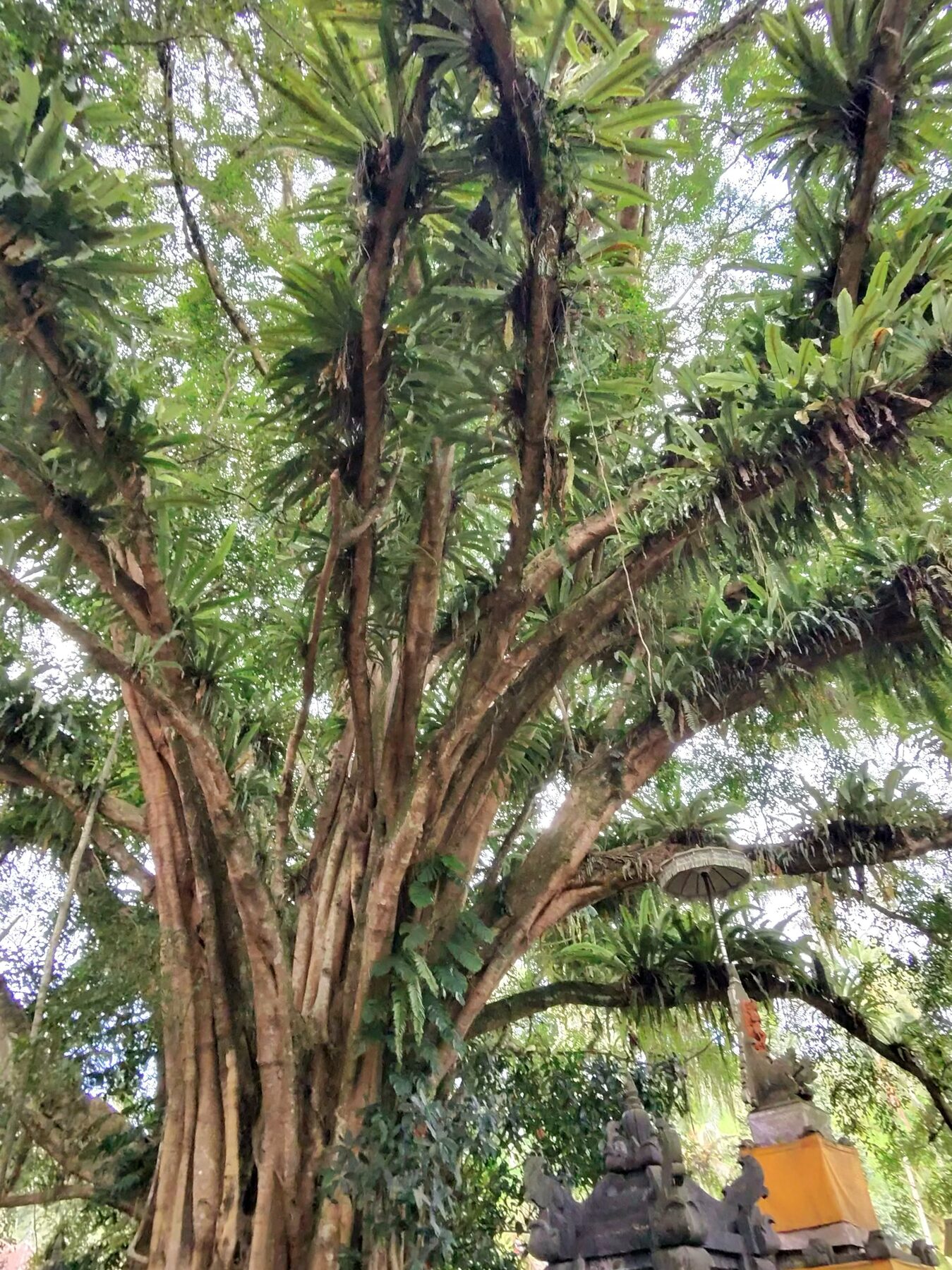
All day, while the water spoke, something else kept a great silence above every temple I entered: the banyan. The Balinese call it beringin, and they dress it as they would dress an elder — a black-and-white poleng cloth tied around its trunk, sometimes a sash, sometimes a small shrine leaning against its bark — because that is what it is here: an elder, an ancestor, a dwelling place of the unseen. Ask where the spirits live, and sooner or later someone will point to a banyan.
Botanically, the banyan does something almost no other being does: it grows downward as much as upward. From its branches it lowers slender aerial roots that reach for the soil, touch it, take hold and thicken into new trunks — until one tree becomes a grove, a colonnade, a temple of its own making. Stand inside an old beringin and you cannot say which trunk was first. The origin has multiplied. Every branch that roots becomes an origin again. The banyan is the phrase the spring spoke — begin again — made wood.
The old scriptures of India speak of a cosmic tree with its roots above and its branches below — spirit rooting downward into the world. Most trees can only symbolise that image. The banyan enacts it: watch its aerial roots descending and you are watching the sky take root in the earth. And its body joins the three worlds of Balinese cosmology — the crown in the upper world of the divine, the trunk in the middle world of human beings, the roots in the underworld where the dragons coil. Basuki runs horizontally, carrying the waters from sea to mountain and home again; the beringin stands vertically, binding heaven, earth and the deep. Where those two axes cross, a human being can stand. Today, that crossing was a pool with a beating floor.
I confess the banyan has long been one of my own symbols: always present, always rooted. It teaches a presence that does not need to move in order to travel; a reach that becomes root; the one that becomes many without ever ceasing to be one. If you want a living image of ten billion human beings, free, conscious and happy — one humanity, many trunks, a single grove — go and sit beneath a banyan.
The grammar of three
Once you notice one triad in Bali — canopy, trunk and root; heaven, world and underworld — you notice them everywhere. It is as if the culture thinks in threes, and there is wisdom in that. Two points make an opposition; a third creates space, relation, balance.
The master triad is Tri Hita Karana, the three causes of well-being: harmony with the divine (parahyangan), harmony among people (pawongan), harmony with nature (palemahan). It is not a doctrine to believe but a balance to maintain — in the household, in the rice field, in the design of a village. When UNESCO inscribed Bali’s cultural landscape as World Heritage, it did so under an extraordinary title: the subak system as a manifestation of the Tri Hita Karana philosophy. A philosophy, recognised as a landscape.
The temple, too, is a triad you walk. Tirta Empul — like Balinese temples generally — unfolds through three courtyards: the outer jaba pisan; the middle jaba tengah, where the purification pools receive you; and the inner jeroan, where offering and communion happen — and where the spring itself beats. Outer, middle, inner: the architecture is a map of the journey of attention, from the world, through purification, to the source. Melukat is that map travelled with the body.
Even conduct is a triad: trikaya parisudha, the three purities — aligned thought, aligned word, aligned deed. And beneath the triads runs the great Balinese dyad that keeps them honest: sekala and niskala, the seen and the unseen, honoured equally, every day, in every small offering of flowers and incense placed on a doorstep — the same two-in-one that the poleng cloth ties around the banyan’s waist.
Divine, human, nature. Outer, middle, inner. Thought, word, deed. Earth, water and air around the fire. The triads are not decoration. They are Bali’s grammar of balance — and they all conjugate the same sentence: keep the relationships whole.
Nature as guide and essence
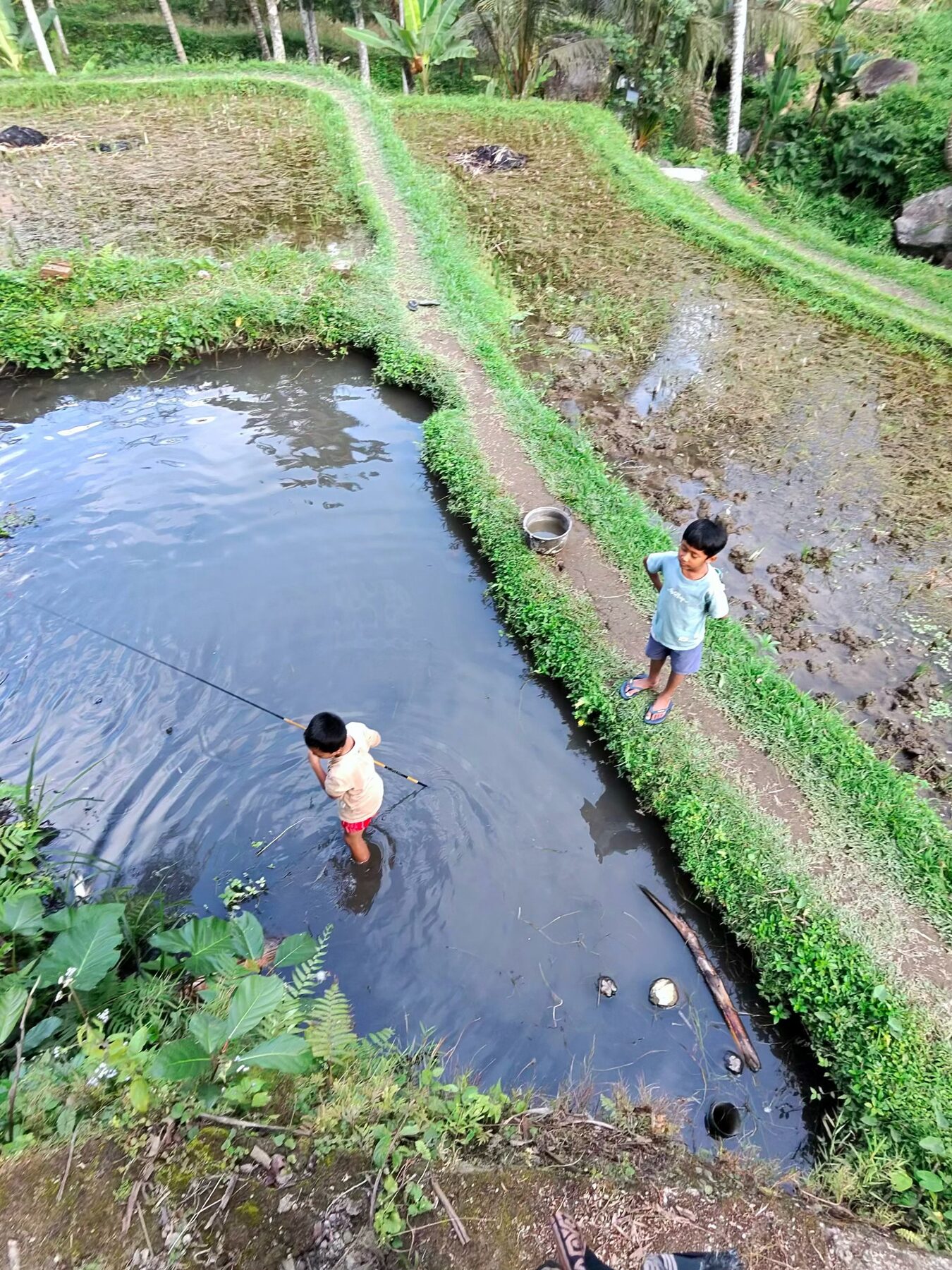
Nowhere is that sentence more fully spoken than in the subak. For over a thousand years, Balinese farmers have organised themselves into self-governing water communities: democratic associations that share the flow from volcanic lakes through temples, weirs and channels, down terrace after terrace of rice. Priests and farmers together read the water and time the plantings; the water temples are the parliament; the ritual calendar is the constitution. It is one of the oldest living water democracies on Earth, and its currency is water.
This is what I mean when I say that in Bali nature is not scenery — it is the syllabus. The island’s oldest communities, the Bali Aga or Bali Mula, the original Balinese, have kept versions of this covenant since before the Majapahit arrived in the fourteenth century, holding their villages, forests and lakes in ancestral trust. The lesson the whole island teaches is the one they never forgot: nature is not the backdrop of our essence. Nature is our essence, extended. The water that pulsed through the sand at Tirta Empul is the water in my blood as I write this sentence. The dragon’s body runs through ours.
Return to origin
I came to Bali to accompany others in returning to their origin — and today the island returned me to mine. That is how transmission works here: the teacher is the territory.
What did the spring actually give me? Not information — a correction of direction. We speak of origins as something behind us: a past to analyse, a wound to archive. The spring says otherwise. The origin is not behind us; it is beneath us, present tense, beating now, offering itself again with every pulse. To return to origin is not to travel backwards. It is to travel inwards, through the three courtyards, until you stand at the pool where your own water is being born — and to let yourself begin again from there.
If you cannot come to a spring in the highlands of Bali, the practice is still within reach. Sit near water — a river, the sea, even a bowl you fill slowly. Place a hand on your chest and find the pulse: your own tirta empul, water rising in the dark. Ask one question and let the water answer in its own language: what wants to be born through me now? Then commit to one small act — a word, a message, a step — that lets it be born today.
This is how an island of dragons, banyans and triads becomes a guide for a species: not by asking us to believe its myths, but by inviting us to live their meaning — to hold what trembles, to keep the three harmonies, to trust the unseen half of the world, and to remember that we are free, conscious and happy not when we conquer nature, but when we recognise ourselves as nature, returning — again and again — to the spring.
Three teachers, one day. The spring said: begin — the origin is now. The dragons said: hold — what trembles is calmed by embrace, not by conquest. The banyan said: stay — reach as far as you like, and let everything you truly reach toward become another root. Beginning, holding, staying: perhaps that is the whole curriculum.
The origin is not behind us. It is beneath us, beating.
Ubud, Bali — July 2026
Sources & further reading
The founding legends of Ubud and Campuhan (Rsi Markandeya and Pura Gunung Lebah); Pura Tirta Empul (est. c. 962 AD, Warmadewa dynasty) and the Indra–Mayadenawa myth; the Bedawang Nala cosmology with the nagas Anantaboga, Basuki and Taksaka; the Babad Pasek and the Lontar Prekempa Gunung Agung on Mount Agung, Besakih, Goa Raja and Goa Lawah; the sacred beringin (banyan), the poleng cloth and rwa bhineda in Balinese temple practice; UNESCO World Heritage List no. 1194, “Cultural Landscape of Bali Province: the Subak System as a Manifestation of the Tri Hita Karana Philosophy” (2012); Thomas Reuter, Custodians of the Sacred Mountains (2002), on the Bali Aga.
…
Field notes to your inbox
Stay connected to the shift.
Monthly essays from the Observatory, invitations to Fests and Academy cohorts. Written from abundance — never urgency.