Research
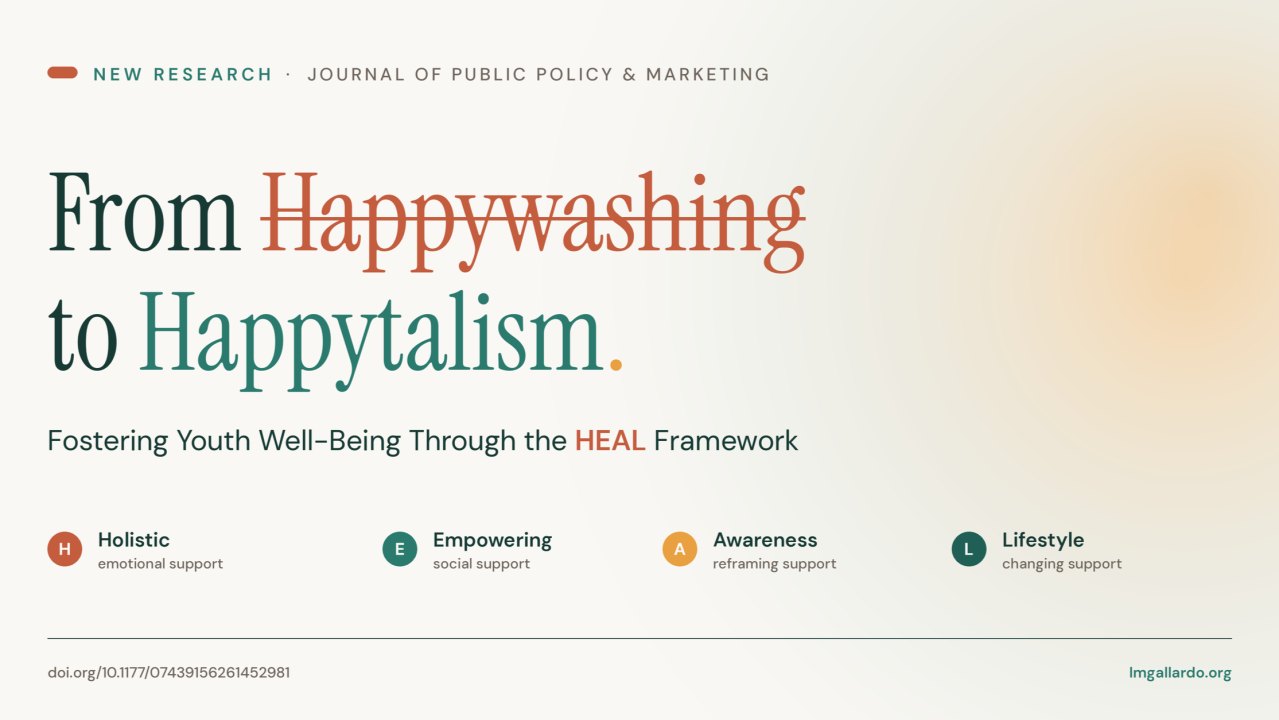
From Happywashing to Happytalism
Introducing the HEAL Framework for Youth Well-Being
June 10, 2026·Luis Miguel GallardoFounder and President, World Happiness Foundation·4 min read
AI insights
Somewhere along the way, happiness stopped being a state we cultivate and became a product we are sold. Scroll through any feed built for young people and you will find the same quiet promise repeated thousands of times a day: the next purchase will finally make you happy. Buy this, and you will belong. Own that, and you will feel whole.
In a new paper just published online in the Journal of Public Policy & Marketing, my colleagues and I give this practice a name — happywashing — and ask a question that consumer research has been slow to confront: what happens to young people when the marketplace appoints itself the gatekeeper of their happiness?
What we mean by happywashing
We define happywashing as misleading marketing communication that exploits the concept of happiness to drive consumption. It is not simply cheerful advertising. It is the systematic framing of products as instruments of well-being — positioning a purchase as the path to joy, belonging, or self-worth.
The problem is what this framing does over time. Repeated exposure to happiness-as-commodity appeals fosters materialism, intensifies social comparison, and ultimately diminishes the very subjective well-being it claims to deliver. The promise is happiness; the residue is restlessness. Each appeal teaches the same lesson — that fulfillment lives one acquisition away — and that lesson, internalized early and often, quietly erodes a young person's capacity to feel enough as they are.
Why youth, and why now
Young people are uniquely exposed on two fronts at once. Developmentally, adolescence and emerging adulthood are formative years for identity, self-concept, and emotional regulation — precisely the period when external messages about worth land hardest. Environmentally, this generation lives immersed in digital spaces engineered for engagement, where commercial appeals are continuous, personalized, and increasingly difficult to distinguish from authentic social life.
That combination — developmental vulnerability meeting algorithmic saturation — is what moves happywashing out of the realm of marketing ethics and into the domain of consumer welfare and public policy. These are not abstract harms to a future cohort. They are pressures shaping how an entire generation learns to measure its own worth.
Happytalism: a different starting point
Naming a harm is only half the work. The paper builds on happytalism — a paradigm that places human and collective well-being, rather than material accumulation, at the center of how we organize value. Happytalism does not ask brands to stop existing or consumers to stop consuming. It asks a more demanding question: what would it look like for an organization to contribute to a young person's flourishing without making that contribution contingent on a transaction?
That question reframes the entire relationship. If happywashing sells happiness as a destination reachable only through purchase, happytalism treats well-being as something brands can genuinely support — independent of whether anything is bought at all.
The HEAL framework
From that foundation, we introduce HEAL, a framework for non-transactional brand engagement grounded in Social Cognitive Theory — Albert Bandura's account of how self-efficacy, observation, and environment shape human behavior. HEAL translates that theory into four forms of support a brand can offer young people:
- H — Holistic emotional support: strengthening emotional regulation and resilience, helping young people meet difficulty without reaching reflexively for consumption as relief.
- E — Empowering social support: building authentic social connection and belonging, the genuine article that commodified happiness only imitates.
- A — Awareness-reframing support: cultivating the critical literacy to recognize manipulative happiness appeals and reframe self-worth on terms that are not for sale.
- L — Lifestyle-changing support: enabling durable, well-being-oriented habits and choices that compound over time.
What unites the four is what they deliberately leave out: the purchase. Each initiative is designed to strengthen self-efficacy, emotional regulation, and social connection independent of any transaction. The brand's contribution is the support itself — not a coupon attached to it.
What this means for marketers and policymakers
By contrasting happywashing with happytalism, the paper contributes to Transformative Consumer Research on three fronts. For theory, it advances our understanding of how commodified happiness shapes — and harms — consumer well-being. For practice, it offers marketers concrete, actionable guidance for moving beyond happiness as a sales lever toward engagement that earns trust by genuinely serving the people it reaches. And for policy, it provides the conceptual foundations regulators need to begin scrutinizing and, where warranted, regulating happiness claims aimed at vulnerable audiences.
Our argument, finally, is one of possibility rather than only critique. Non-transactional engagement models can mitigate the harms of commodified happiness, strengthen youth resilience in digital environments, and reorient marketing toward authentic individual and collective welfare. The marketplace will not stop talking to young people about happiness. The question is whether it will keep selling them a counterfeit — or help them build the real thing.
With gratitude
This work was a deeply collaborative effort, and I am grateful to have shared it with an extraordinary team: Tessa García-Collart, Dr. Kelly Moore, M. Deniz Dalman, Sphurti Sewak, Cheryl-lyn Ngoh, Rodolfo Rodrigues Rocha, Giovanni Latorre, Dr. Wendy T. Gillis, Luciana Freire, and Dr. Miguel Ángel Zúñiga. A special thank-you to Dr. Ellen Campos Sousa for her exceptional leadership in bringing this paper to life.
Fundamental peace is not the absence of pain — it is the transmutation of its energy into love and compassion. Reclaiming happiness from the marketplace, and returning it to the people, is part of that same work.
Read the paper: Campos Sousa, E., García-Collart, T., Moore, K., Dalman, M. D., Sewak, S., Ngoh, C., Rodrigues Rocha, R., Latorre, G., Gillis, W. T., Freire, L., Zúñiga, M. Á., & Gallardo, L. M. (2026). From Happywashing to Happytalism: Fostering Youth Well-Being Through the HEAL Framework. Journal of Public Policy & Marketing. https://doi.org/10.1177/07439156261452981
First published on LinkedIn, in the Co-Creating Happytalism newsletter, on 10 June 2026.
…
Explore this topic
Field notes to your inbox
Stay connected to the shift.
Monthly essays from the Observatory, invitations to Fests and Academy cohorts. Written from abundance — never urgency.