Announcements
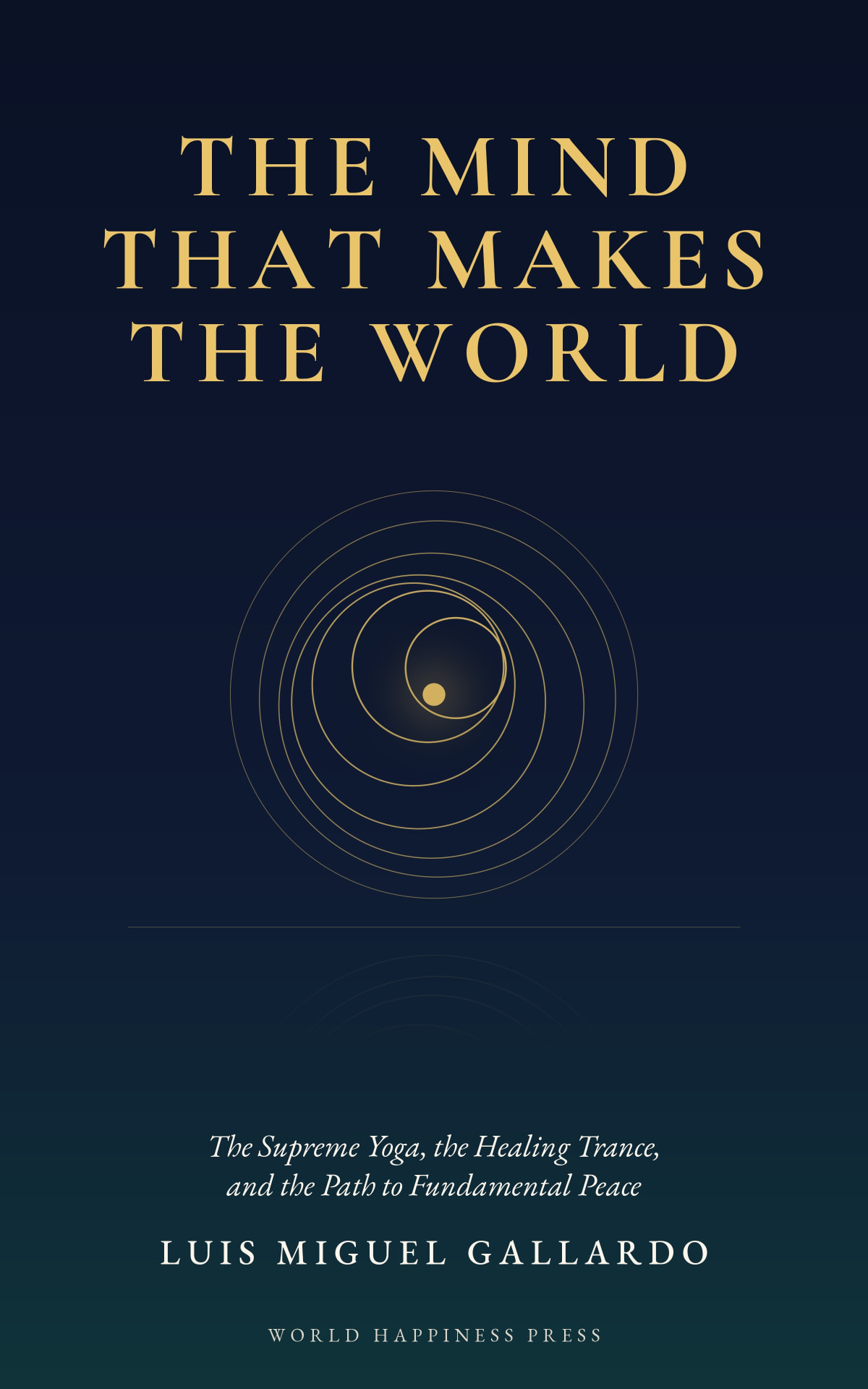
The Mind That Makes the World: a new book on the Supreme Yoga, the healing trance, and the path to Fundamental Peace
A new book from World Happiness Press. Eighteen chapters that walk from the story-worlds of the Yoga Vāsiṣṭha, through what a trance actually is, into a path anyone can practise — and into the YVH Integrative Model published in our Research Lab.
September 10, 2026·Luis Miguel Gallardo·4 min read
AI insights
By Luis Miguel Gallardo · Founder & President, World Happiness Foundation · September 2026
There is a sentence in the Yoga Vāsiṣṭha that I have carried for years, the way one carries a stone from a river: the world is as you see it. Not as a slogan. As a description of mechanics.
I am glad to share a new book, The Mind That Makes the World: The Supreme Yoga, the Healing Trance, and the Path to Fundamental Peace, published by World Happiness Press. It is out now, and it lives on our site with its full contents, its figures, an AI companion that answers only from its own pages, and an ePub and print-ready PDF for members who have measured their own peace.
Why this book, and why now
Two traditions have been describing the same territory without speaking to each other.
One is very old. The Yoga Vāsiṣṭha — the Supreme Yoga — teaches through story-worlds: a queen who becomes her husband’s teacher, a man who lives a whole life inside a moment, a stone that holds universes. Its vocabulary is precise. Vāsanā, the groove a repeated impression wears into a mind. Bhāvanā, the deliberate cultivation of a felt sense. Saṅkalpa, the intention that becomes a world. Jīvanmukta, the one who is free while still alive and still doing the dishes.
The other is modern and clinical. Hypnosis, imagery, absorption, the work of attention and suggestion on a living body. It has data, controls and mechanisms — and, for the most part, no cosmology.
The book puts them in one room. Not to flatten either one, and not to claim that a fifteen-century text anticipated a randomised trial. Rather: when an old text says imagination builds a world, and a modern clinic shows imagination altering pain, healing and habit, it is worth asking carefully what the two are pointing at.
How it is built
Eighteen chapters in three movements.
- The Stories. The Yoga Vāsiṣṭha on its own terms — Cūḍālā and her king, the worlds within worlds, the grammar of vāsanā and saṅkalpa.
- The Trance. What absorption actually is: attention, suggestion, imagery, and the body’s answer. What the evidence supports, and where it stops.
- The Path. Practice. What to do on an ordinary Tuesday. How a state becomes a stage, and how peace stops being an event and becomes a floor you stand on — what I call Fundamental Peace.
A prologue and epilogue hold the whole, and four appendices carry the scaffolding, including the scale readers use to place themselves.
The research behind it
The theoretical core of the book has been through our own editorial review and is published as the first paper of the Journal of Happytalism and Fundamental Peace: the Yoga Vāsiṣṭha Hypnotherapy (YVH) Integrative Model. It is open access, free to read and free to publish in, and its DOI is 10.68220/whf.2026.001 (registration is in progress; until it resolves, read the paper on our own pages).
The book is the human version of that argument. The paper is the accountable one. Both should exist.
How to read it
Three doors, and you can walk through any of them today.
- Read the contents online. Every chapter, its sections and its opening lines, plus the YVH model diagram, are on the book’s page.
- Talk to the book. An AI companion trained on nothing but this book’s own passages. It names the chapter it is drawing from, and when the answer is not in the retrieved pages it says so instead of inventing one. No chapter numbers, quotations or figures are fabricated.
- Take the ePub and the print-ready PDF. These open to signed-in members who have recorded an FP20 or ITM result. That is deliberate. The book asks you to measure where your peace actually rests before it hands you two hundred pages about it; the measurement takes a few minutes and the result is yours.
Print and Kindle editions are on their way, in every format. I will add the links here as soon as the listings are live.
A word of care
Fundamental Peace is described in this work as a state and a construct, and the FP20 as a self-report scale. Neither is a clinical or diagnostic instrument, and nothing in the book replaces qualified care. Trance work opens material. If something opens that needs company, please find company — a professional, and in a crisis, local emergency services.
Beyond that, my invitation is simple. The mind that makes the world is the one reading this sentence. Come and look at it with me.
…
Explore this topic
Field notes to your inbox
Stay connected to the shift.
Monthly essays from the Observatory, invitations to Fests and Academy cohorts. Written from abundance — never urgency.