The body becomes still. The breath grows quieter. Thoughts may continue to appear, but they no longer demand our immediate attention. We are deeply at rest, yet unmistakably awake—present, responsive, and able to choose.
Students of meditation, Yoga Nidra, and therapeutic hypnosis may recognize something of this inner territory. The language used to describe it may differ, but the experience points toward an increasingly important human capacity: the ability to settle without becoming unconscious, to soften habitual mental activity without losing discernment, and to remain at peace without withdrawing from life.
In developing a class for students of Yoga and Happiness at Shoolini University, I returned to a simple question: What becomes possible when we study yoga and hypnotherapy together?
The purpose is not to decide which practice is superior, nor to claim that they are identical. It is to understand how their distinctive methods may cultivate complementary capacities—and how those capacities may converge toward what I call Fundamental Peace.
Fundamental Peace as a practical orientation
Fundamental Peace is a proposed state of bounded interior settling: a temporary and trainable condition in which the body is deeply at rest, awareness remains clear, self-referential thought becomes less rigid, and the person retains agency and responsiveness.
The word bounded is important. Fundamental Peace does not require the disappearance of the self, the suppression of thought, or an extraordinary mystical experience. It is not sleep, sedation, dissociation, passivity, or escape.
Instead, it describes a quieter relationship with experience. Thoughts may still arise, but we are less compelled to follow them. Emotions remain present, but they have more space around them. The nervous system settles while the capacity to witness, respond, and choose remains available.
Fundamental Peace is not the absence of difficulty. It is the ability to meet difficulty without being governed entirely by automatic reaction.
Within this model, yoga and hypnotherapy are pathways. Fundamental Peace is the shared orientation they may help cultivate. Greater wellbeing, emotional regulation, and wiser action are possible consequences of repeatedly accessing such a state, but they should not be treated as automatic or guaranteed outcomes.
The model remains a working neuroexperiential framework—an invitation for practice, dialogue, and further research rather than an established clinical diagnosis or biological standard.
Honoring two distinct traditions
Convergence does not mean equivalence.
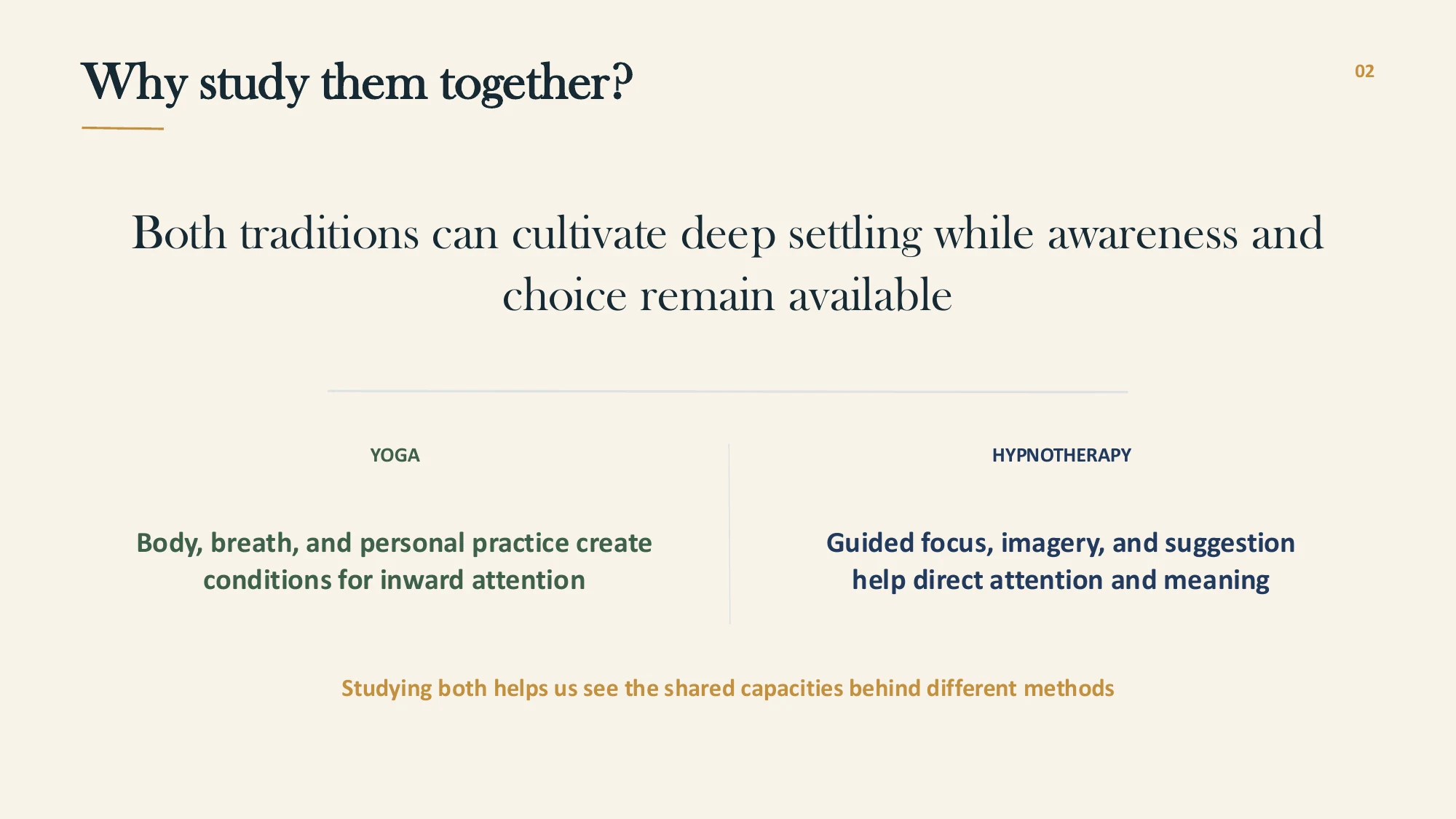
Yoga is a broad philosophical, ethical, somatic, respiratory, and contemplative tradition. Its many pathways may include ethical practice, posture, breath regulation, sensory withdrawal, concentration, meditation, self-inquiry, and the cultivation of witnessing awareness. Its purposes extend far beyond relaxation.
Hypnotherapy developed within a different historical and therapeutic context. It uses consent, focused attention, carefully chosen language, imagery, expectation, suggestion, and structured reorientation to help people explore and transform patterns of experience.
Hypnosis is sometimes misunderstood as a loss of control. In responsible practice, however, it is collaborative. A participant remains capable of accepting, modifying, or rejecting suggestions. Preserved agency is not an obstacle to the process; it is one of its foundations.
Studying these traditions together requires a simple principle: we can compare functions without erasing histories.
Yoga should not be reduced to a relaxation technique, and hypnotherapy should not be described as yoga under another name. Their philosophies, lineages, vocabularies, and goals remain distinct. Their complementarity becomes most visible when we examine what particular practices teach the body and mind to do.
Two doorways into conscious rest
The yogic pathway often begins with embodiment.
Posture establishes grounded presence. Breath regulation influences rhythm and arousal. Pratyahara turns attention away from the constant pull of external stimuli. Dharana stabilizes concentration, while dhyana supports a more continuous meditative awareness. Through this progression, attention moves from the gross toward the subtle while a witnessing capacity remains.
The hypnotherapeutic pathway often begins with relationship and language.
The process starts with consent and orientation. Attention is then focused through a voice, sensation, image, or idea. Progressive relaxation and deepening reduce competing demands. Imagery engages felt meaning, while suggestion directs attention toward a chosen possibility. The session concludes through integration and a deliberate return to ordinary awareness.
One pathway often foregrounds bodily and self-directed training. The other often foregrounds verbal and relational guidance. These are tendencies rather than absolute divisions: yoga may be guided, and hypnotic skills can become increasingly self-directed.
What matters is that both pathways can create conditions in which habitual mental activity becomes quieter while awareness remains available.
Where the pathways converge
When yoga and hypnotherapy are placed in conversation, at least six shared functions become visible.
- Settling arousal
- Posture, breath, stillness, progressive relaxation, and hypnotic deepening can help reduce physiological agitation.
- Turning attention inward
- Pratyahara and focused hypnotic attention temporarily reduce the dominance of external demands.
- Stabilizing focus
- Dharana, guided imagery, and hypnotic absorption help attention become less scattered.
- Sustaining absorption
- Dhyana and maintained hypnotic focus support continuity of experience without requiring unconsciousness.
- Orienting intention
- Sankalpa in yoga and therapeutic suggestion in hypnotherapy can direct an absorbed state toward a chosen quality, meaning, or response.
- Preserving the witness
- Both approaches can cultivate the ability to notice experience while remaining responsive and capable of choice.
Sankalpa and hypnotic suggestion should not be treated as exact equivalents. Each belongs to a different cultural and philosophical context. Yet within this model, they may perform a comparable function: orienting an already settled and receptive state toward a meaningful intention.
The point of convergence is not unconsciousness. It is a quieter form of consciousness with greater room for choice.
Yoga Nidra as a living bridge
Yoga Nidra provides an especially valuable bridge for exploring this complementarity.
A typical practice may involve bodily stillness, attention to a guiding voice, rotation of awareness through the body, breath observation, imagery, sankalpa, silence, witnessing, and a gradual return to ordinary awareness.
Several of these elements have functional parallels in hypnotherapy. Rotation of awareness resembles a structured body scan. The guiding voice stabilizes attention. Imagery deepens absorption. Sankalpa introduces purposeful direction. The deliberate return preserves orientation and responsiveness.
These similarities do not mean that Yoga Nidra is simply hypnosis. Yoga Nidra remains a yogic practice shaped by its own traditions, meanings, and aims. Its value as a bridge lies precisely in its ability to illuminate shared human capacities without making the two disciplines interchangeable.
It allows us to ask a more fruitful question: How can different methods support profound rest, inward attention, intention, and witnessing in complementary ways?
Four windows into Fundamental Peace
The Fundamental Peace model considers convergence through four interconnected dimensions.
- Neural coordination
- Habitual self-focused processing may become less dominant while systems involved in attention and awareness remain organized.
- Brain rhythm
- Changes in alpha and theta activity may accompany relaxed absorption and inwardly focused attention.
- Autonomic regulation
- Breathing, cardiovascular patterns, and physiological arousal may shift in ways consistent with bodily settling.
- Lived experience
- The person reports rest, clarity, emotional coherence, reduced entanglement with thought, and preserved agency.
These are best understood as complementary research lenses. No single brain signal, physiological measurement, or subjective report can fully define peace. Nor should practitioners turn them into achievement scores.
The proposed markers remain under investigation. Their purpose is to help connect subjective experience with observable processes—not to prove that someone has reached a superior state.
A five-minute practice of convergence
The practical heart of the model can be remembered through five words:
Settle. Focus. Intend. Witness. Choose.
- Settle
- Feel the support beneath your body. Allow the posture to become stable without becoming rigid. Let the exhalation lengthen gently, without forcing the breath.
- Focus
- Rest attention on one simple anchor: the breath, a bodily sensation, or a steady sound. When attention wanders, return without criticism.
- Intend
- Silently choose a brief and compassionate direction, such as: “I meet this moment with steadiness,” or “I respond with clarity and care.”
- Witness
- Allow sensations, thoughts, and emotions to arise without suppressing them or immediately following them. Notice that awareness can remain present while experience changes.
- Choose
- Before completing the practice, identify one quality or response you want to carry into the next part of your day.
The eyes may remain open. The posture can be changed. Any instruction may be disregarded, and the practice can be stopped at any time. Choice and responsiveness should remain available throughout.
Afterward, four questions can support reflection:
- What changed in my body?
- What happened to my attention?
- How did my relationship with thought or emotion change?
- Did I remain able to choose and respond?
From inner regulation to world happiness
Fundamental Peace is not valuable only because of what happens during practice. Its deeper significance lies in what becomes possible afterward.
When we can pause before reacting, we may listen more carefully. When self-referential thought becomes less rigid, we may encounter others with greater openness. When the body is less governed by threat and agitation, we may gain more freedom to act with compassion.
This does not mean that inner practice alone can resolve social suffering. Happiness also depends on dignity, justice, belonging, healthy relationships, and supportive institutions. Inner and systemic transformation should not be placed in competition.
Yet the quality of consciousness we bring to collective life matters. Our capacity to regulate attention, remain present with discomfort, and choose rather than merely react shapes families, classrooms, organizations, and communities.
Inner peace is not a retreat from the world when it increases our capacity to meet the world wisely.
Complementarity without collapse
Yoga contributes embodied regulation, disciplined attention, contemplative depth, and witnessing. Hypnotherapy contributes focused language, personalized imagery, suggestion, and relational guidance.
They do not need to become one practice in order to illuminate one another.
By studying their complementarity, educators, practitioners, and researchers gain a richer vocabulary for understanding restful awareness. More importantly, individuals gain multiple doorways through which to cultivate it.
Fundamental Peace may begin as a state encountered during practice, but its value appears in what follows: the thought we no longer have to obey, the reaction we transform into a response, and the person we meet with greater presence.
Two pathways can remain distinct and still help us walk toward that possibility together.
Settle. Focus. Intend. Witness. Choose.