ReviewCC BY 4.0
From Altered States to Fundamental Peace: Taxonomies of Consciousness, Psychedelics and Hypnosis Through the Lens of the Yoga Vāsiṣṭha
Luis Miguel Gallardo1 ORCID 0009-0005-3222-6092
- 1Yogananda School of Spirituality and Happiness, Shoolini University, Solan, Himachal Pradesh, India; World Happiness Foundation
- Published
- October 2026
- Version
- 1.0
- Issue
- Vol. 1, No. 1 (2026)
- Article number
- JHFP-2026-007
- Licence
- CC BY 4.0
- Published by
- World Happiness Foundation Research Lab
Abstract
Background
Psychedelic medicine is approaching regulatory approval, and suggestion alone can now occasion mystical-type experiences in the laboratory. Yet the field still names altered states after their triggers, and nobody can yet show whether the state itself, rather than its context, is what heals.
Objective
This review reads the evidence presented at the 2026 Annual Conference of the Society for Clinical and Experimental Hypnosis (SCEH) through three lenses: the new consensus taxonomy of altered states of consciousness, the Fundamental Peace model of hypnotic emotion regulation, and the Yoga Vāsiṣṭha's map of states and of the knower.
Sources
Six SCEH 2026 contributions (Cardeña's taxonomy keynote; Patterson on hypnosis-induced mysticism and psychedelics; Majeti and Corlett's qualitative analysis of hypnotically occasioned mystical experiences; Hood and Elkins's meta-analysis of psilocybin-assisted psychotherapy for anxiety; the author's Circuits of Fundamental Peace; and the conference programme), the papers behind them, the published commentaries on the taxonomy, and Brudner et al.'s (2025) test of mystical experience as a predictor of response in treatment-resistant depression.
Synthesis
Different triggers converge on the same phenomenological categories (unity, imaginal, detachment, altered identity), so trigger-based labels should give way to phenomenological ones. The intensity of a mystical state predicts benefit at a first psilocybin dose, but repeated mystical states did not bring proportionally more relief, and hypnosis can occasion the state without yet showing comparable clinical change. We argue that the missing variable is the experiencer's stance toward the state, which the Yoga Vāsiṣṭha grades in its seven stages of knowledge (jñāna-bhūmikā), and that Fundamental Peace, with its four components and the FP20 scale, operationalises both that stance in the moment and the capacity that remains afterwards. A network account (default mode, salience and executive control networks) links the two.
Conclusions
We propose a four-layer Context–State–Stance–Trait model, a research agenda in which hypnosis serves as the experimental control psychedelic science has lacked, and testable hypotheses in which Fundamental Peace mediates the path from extraordinary state to lasting change.
Keywords
- altered states of consciousness
- taxonomy
- psychedelics
- psilocybin
- hypnosis
- mystical experience
- Yoga Vāsiṣṭha
- Fundamental Peace
- FP20
- default mode network
- Happytalism
Read the paper
Full text
The complete paper, as registered with its DOI. Section links below jump within this page.
Table of Contents
- Introduction: Why Taxonomy Matters Now
- Sources and Approach
- The Taxonomy Landscape: From Triggers to Phenomenology
- Hypnosis-Induced Mysticism Versus Psychedelics
- The Phenomenology of Hypnotically Occasioned Mystical Experience
- The Clinical Frontier: Psilocybin for Anxiety, and What Hypnosis Adds
- Latest Research: Does the Mystical State Predict Healing?
- Circuits of Fundamental Peace: From Network Change to Lasting Capacity
- The Yoga Vāsiṣṭha Lens: A Taxonomy of the Knower
- Toward an Integrative Taxonomy: Context, State, Stance, Trait
- Implications for Research and Practice
- Limitations
- Conclusion Declarations References
1. Introduction: Why Taxonomy Matters Now
Psychedelic medicine has moved from the fringe to the brink of regulatory approval in under a decade. In July 2026 Compass Pathways reported that its second phase 3 trial of psilocybin for treatment-resistant depression (COMP006, 581 participants) met its primary endpoint, with a new drug application due by the end of 2026 (Compass Pathways, 2026). MDMA-assisted therapy, by contrast, was declined by the US Food and Drug Administration in August 2024 despite large effects in its trials (Wolfgang et al., 2025).
That speed has outrun the vocabulary. The field still calls almost every alteration "trance", or names it after whatever triggered it. Neither habit tells a clinician what the person actually lived through, and neither tells a researcher which part of the experience did the healing.
The 2026 Annual Conference of the Society for Clinical and Experimental Hypnosis (SCEH), held online on 14–18 October under the theme Circuits of Consciousness: Hypnosis, AI, and Psychedelic-Assisted Change, put this problem at its centre (Society for Clinical and Experimental Hypnosis, 2026). Its final day opened with Etzel Cardeña's keynote on a consensus taxonomy of altered states, moved through papers on hypnosis, mysticism and psilocybin, and included the author's presentation, Circuits of Fundamental Peace: Network-Based Mechanisms of Hypnotic Emotion Regulation (Gallardo, 2026b). Amir Raz's keynote on altered consciousness, hallucinogens and health, and Zoltan Kekecs's paper on the suggestibility of large language models, framed the same questions from the sides of placebo and of suggestion itself.
The Yoga Vāsiṣṭha Research Lab of the World Happiness Foundation enters this conversation with a specific claim. The Yoga Vāsiṣṭha (also called the Mokṣopāya) is, among other things, a treatise on how mind constructs experienced worlds, and on how a person moves from being captured by those worlds to seeing through them. Its stories of dreams within dreams, of a king who lives a whole lifetime in a magician's spell, and of a queen who masters subtle states describe the same phenomena the new taxonomy classifies.
What the text adds is a map of the knower, not only of the known. Fundamental Peace, defined as integrated regulatory capacity under changing conditions (Gallardo & Chetri, 2026), adds a measurable account of what that knower gains. This review sets out why both matter for science, and how the maps can be joined. It builds on the Lab's earlier work on the Yoga Vāsiṣṭha and hypnotherapy (Gallardo, 2026a).
2. Sources and Approach
This is a conceptual and integrative review. Its primary sources are six contributions to the SCEH 2026 scientific programme (17–18 October 2026): Cardeña's keynote (Cardeña, 2026); Patterson's comparison of hypnosis-induced mysticism with psychedelics (Patterson, 2026); Majeti and Corlett's qualitative analysis (Majeti & Corlett, 2026), published in full in the American Journal of Clinical Hypnosis (Corlett et al., 2026); Hood and Elkins's systematic review and meta-analysis (Hood & Elkins, 2026); the author's own presentation (Gallardo, 2026b); and the conference programme.
These were read alongside the papers they rest on: the consensus taxonomy (Cardeña et al., 2025) and its published commentaries (Colelli, 2026; Fingelkurts & Fingelkurts, 2026; Kihlstrom, 2025; Piekarski, in press); the Fundamental Peace review (Gallardo & Chetri, 2026); and the most recent clinical test of mystical experience as a predictor of psilocybin response (Brudner et al., 2025). Because conference talks distil larger programmes of work, we also drew on the presenters' published research: Cardeña on the phenomenology of deep and neutral hypnosis (Cardeña, 2005; Cardeña et al., 2013); Patterson and Jensen on hypnotic analgesia (Patterson & Jensen, 2003; Patterson, 2010; Jensen & Patterson, 2014); the Baylor group led by Elkins on the definition of hypnosis, MDMA-assisted therapy and hypnotically facilitated mystical experience (Elkins et al., 2015; Hood et al., 2024; Corlett et al., 2025; Alldredge et al., 2025; Elkins, 2025); Raz on suggestion and placebo (Raz et al., 2005; Olson et al., 2020); and Kekecs on efficacy standards and placebo inductions in hypnosis (Kekecs et al., 2022, 2024). Further sources were added where a claim needed its primary evidence, and every cited figure was checked against the source named beside it. Two of the SCEH contributions (Patterson; Hood and Elkins) are conference presentations, not yet peer-reviewed papers; their figures are reported as presented.
3. The Taxonomy Landscape: From Triggers to Phenomenology
The consensus taxonomy classifies altered states by what is experienced, not by what caused them, and that single move reorganises the field. It was built by sixteen researchers from psychology, psychiatry, anthropology and neuroscience, through a modified Delphi process that ran to seven drafts (Cardeña et al., 2025). Cardeña presented it at SCEH on 18 October 2026.
3.1 Why trigger taxonomies fail
Cardeña (2026) gave four reasons for abandoning trigger-based labels:
- They presume that one technique produces one effect, although neural and experiential changes depend on the specific instructions used.
- They minimise individual differences in traits such as absorption and openness, and in prior experience.
- Different inductions converge: boundaryless states occasioned by hypnosis, drugs or meditation can be phenomenologically very similar.
- Even one person in one context moves through different states over time.
His neurophenomenology of "neutral" hypnosis (a hypnotic induction with no further suggestion) illustrates the last two points (Cardeña et al., 2013). On the Phenomenology of Consciousness Inventory, altered experience rose from baseline to the deepest state by 0.32 points in low-hypnotisable participants, 1.85 in medium and 1.66 in high, and only the medium and high changes were significant (figures as presented in the keynote). The same induction yields different states in different people, and the deepest states arrive in sequence: unusual body sensations, then floating or out-of-body experience, then dreamlike or transcendent experience (Cardeña, 2005).
3.2 The eight categories
The taxonomy follows four principles taken from a classification of meditation (Nash & Newberg, 2023): theoretical foundation, orthogonality, semantic lucidity and utility. It names the main feature of each state, not peripheral ones such as altered time sense. Most categories have both clinical and non-clinical forms, so no pathology is assumed.
Table 1. The eight categories of the consensus taxonomy of altered states (Cardeña et al., 2025).
| # | Category | Subtypes | Examples given by the authors |
|---|---|---|---|
| 1 | Proto and transitional | Auras and prodromes; dizziness or confusion; hypnagogic and hypnopompic states | Epileptic auras; imagery at sleep onset |
| 2 | Delirium | Activated; somnolent (the keynote added mixed) | Disorganised speech, hallucination, unresponsiveness |
| 3 | Minimal or no awareness / disconnected from environment | No awareness; minimal or uncertain awareness; minimal awareness with ongoing experience (non-lucid and lucid dreaming) | Coma, anaesthesia, dreaming |
| 4 | Experiential detachment | Out of the body; estrangement from body, emotion or thought | Near-death experiences, depersonalisation, deep hypnosis, psychedelics |
| 5 | Enhanced physicality | Heightened perception and agility; intense energy or heat | Tumo heat, kuṇḍalinī, the San n/um energy |
| 6 | Altered identity | Alteration without substitution ("trance"); co-consciousness; substitution (possession, channelling) | "I was not dancing: I was danced" |
| 7 | Imaginal / fantasy / visionary | Simple geometric imagery; complex visions | Deep hypnosis, psychedelics |
| 8 | Unity / mystical | Extrovertive (with sensory content); introvertive (pure consciousness) | "The Light became my wholeness"; "for a while I was just total nothing" |
Hypnosis, psychedelics and near-death experiences each appear under several categories (4, 7 and 8). That scattering is the taxonomy's main argument made visible: the trigger does not define the state.
3.3 What the commentaries add
Four published responses already test the scheme, and each points to a gap this review takes up.
- Prototypes, not proper sets. Kihlstrom (2025) argues that mental categories have characteristic rather than defining features, so "orthogonality" is the wrong ideal. He asks that ordinary consciousness be defined first, on two dimensions of awareness and control, and that the scheme add a category for divided consciousness.
- Hypnosis misfiled. Kihlstrom also holds that hypnosis is defined by responses to suggestion and by the felt involuntariness of those responses, not by imagery. This matches the field's own working definition of hypnosis as a state of focused attention and reduced peripheral awareness characterised by an enhanced capacity for response to suggestion (Elkins et al., 2015). On Kihlstrom's reading, the hidden observer and posthypnotic amnesia belong with dissociation.
- Thin versus thick phenomenology. Colelli (2026) notes that many category labels (identity, agency, delirium) come from third-person diagnostic practice, and proposes "thick" experiential profiles for each.
- Description is not explanation. Piekarski (in press) argues that phenomenology cannot say why different inductions converge, and pairs the taxonomy with the REBUS model of relaxed high-level beliefs (Carhart-Harris & Friston, 2019). Fingelkurts and Fingelkurts (2026) reply that the fuzziness of the categories may itself be informative about consciousness.
The authors call the scheme a work in progress, with no empirical validation yet, and plan a dimensional supplement. None of the commentaries asks the question this review puts at the centre: what is the experiencer's stance toward the state, and does that stance change what the state does?
4. Hypnosis-Induced Mysticism Versus Psychedelics
Patterson's (2026) verdict was blunt: hypnosis clearly induces mystical effects, but there is no evidence yet that it matches psychedelics in clinical effect or in enduring cortical change. His talk is the most useful sceptical benchmark among the SCEH contributions, because it lays the pharmacology and the clinical record side by side.
4.1 What the drugs do
Three pharmacological families are usually grouped as "psychedelic medicines".
Table 2. Psychedelic medicines by pharmacological family (after Patterson, 2026).
| Family | Agents | Primary mechanism | Journey length |
|---|---|---|---|
| Classic psychedelics | Psilocybin, LSD, ayahuasca (DMT), 5-MeO-DMT, mescaline | 5-HT2A agonism, plus other serotonin, dopamine and noradrenaline receptors | DMT 10–40 min; psilocybin 2–6 h; LSD 8–12 h |
| Empathogen | MDMA | Reverses serotonin, dopamine and noradrenaline reuptake transporters; not technically a hallucinogen | 4–10 h |
| Dissociative | Ketamine | NMDA glutamate receptor blockade; hallucinogenic at sub-anaesthetic doses | Short |
Two neurobiological findings recur. All three families, like meditation, reduce default mode network (DMN) activity and attenuate amygdala connectivity (Gattuso et al., 2023). Classic psychedelics also cross the cell membrane to activate intracellular 5-HT2A receptors and grow dendritic spines, which serotonin itself cannot do (Vargas et al., 2023).
4.2 What the trials show
- MDMA for PTSD: across two phase 3 trials, 67–71% no longer met PTSD criteria after three sessions, against 32–48% on placebo (Wolfgang et al., 2025). Patterson stressed that the large placebo response shows the psychotherapy component is itself powerful; a critical review from the Baylor group sets out the questions that remain unanswered (Hood et al., 2024).
- Psilocybin for depression: psilocybin did not beat escitalopram on the primary QIDS measure, but did on most secondary measures (Carhart-Harris et al., 2021). At six months it showed greater gains in functioning, psychological connectedness and meaning in life (Erritzoe et al., 2024).
- Ketamine: non-inferior to electroconvulsive therapy for treatment-resistant depression with fewer adverse effects (Anand et al., 2023).
- End of life: a review of 20 studies in 640 seriously ill patients found benefit for psychological and spiritual symptoms, and named the patient–therapist bond as a vital factor (Maia et al., 2022).
4.3 Where hypnosis stands
The hypnosis record is shorter and phenomenological. Lynn and Evans (2017) first showed that suggestion produces mystical-type experiences in the laboratory. Hastings (2006) evoked an MDMA-like experience by posthypnotic suggestion, but with 12 participants and no control group. Lemercier and Terhune (2018) argued that hypnosis and psychedelics share phenomenological and neural features, and that targeted suggestion could enhance psychedelic therapy. Evans and Lynn (2024) have since extended the laboratory work. Alldredge et al. (2025) set out a conceptual framework for the clinical use of mystical experiences, and Elkins (2025) mapped the intersections of psychedelics, mystical experience and hypnosis.
Patterson then named the variables that separate the two. A psychedelic journey can last six hours, a hypnosis session one. Drug sessions use sensory restriction and music for hours. And no study has asked whether hypnosis grows synapses or produces lasting cortical change, as meditation practice has been associated with (Hölzel et al., 2011).
His most important point was conceptual. He found "little difference" between the labels mystical experience and non-ordinary state, yet he separated having a mystical or hallucinatory experience from improving clinically. Hashimoto (2024) asks the same question of ketamine and the classic psychedelics: is the mystical experience essential to the antidepressant effect, or a by-product of receptor activation? This gap between state and outcome is the thread that runs through the rest of the review.
5. The Phenomenology of Hypnotically Occasioned Mystical Experience
In a single hypnosis session, 7 of 10 healthy participants met criteria for a "complete" mystical experience on the MEQ30, and their interviews show the experience was psychedelic-like in texture as well as in score. The parent feasibility trial is Corlett, Alldredge and Elkins (2025); the interviews were analysed for the first time by Majeti and Corlett (2026; Corlett et al., 2026).
5.1 Design
Participants were college students with mid-to-high hypnotisability, no history of bipolar or psychotic disorder, and no prior psychedelic use. The session was staged in a psychedelic-style room, with a breathing-based induction, deepening, and suggestions built from MEQ items such as oneness and joy. Thematic analysis of the semi-structured interviews used one coder, two reviewers and a fourth researcher to settle disagreements.
Table 3. Themes in the interviews (N = 10; themes overlap), from Majeti and Corlett (2026).
| Theme | Participants |
|---|---|
| Hallucination-like phenomena | 6 of 10 |
| Personal impact | 4 of 10 |
| Introspection / insight | 4 of 10 |
| Unity | 4 of 10 |
| Intense emotion | 3 of 10 |
| Love / embrace (not an MEQ item) | 3 of 10 |
| Religious feelings | 2 of 10 |
| Ego-dissolution | 2 of 10 |
5.2 What the participants described
- Imagery and anomaly. A raspberry smell, a friendly Yeti, "fun carpets", coloured squiggles and one apparent synaesthesia. One participant saw scenes of people in his life with details he had not known, which the authors could not classify as hallucination, recovered memory or something clairvoyance-like.
- Insight. One participant hugged himself, felt empty, and concluded he was not loving himself enough, an insight also reported with ayahuasca, MDMA and psilocybin. Another spoke with a small version of himself and watched his parts interact, much as in ego-state therapy or internal family systems.
- Love and unity. "Felt loved by everything", "God's embrace", "everything is connected", and "everyone has a heart/soul like me".
- Ego-dissolution. "Didn't exist anymore"; "wasn't here anymore", echoing the psychedelic "ego death".
5.3 What the standard measure misses
The MEQ items shaped the suggestions, so a high MEQ score is partly built in. Yet the experience most often reported spontaneously, being loved or embraced, is not an MEQ item at all. A religious participant could not follow suggestions about "ultimate reality" until "God" was offered in its place. Both points show that the measuring instrument, the suggestion and the culture of the participant are entangled.
Read against the taxonomy, these ten accounts span at least four categories in one hour: imaginal (7), unity (8), altered identity (6, the conversation with a younger self) and detachment (4, "wasn't here anymore"). That confirms Cardeña's point that an induction is not a state. It also shows why imagery is hard to separate from hallucination in hypnosis, and true insight from false.
Two of the themes the MEQ does not capture, self-love and the felt embrace, are exactly what Fundamental Peace names as compassionate self-awareness (Section 8). The limits are real: ten non-distressed students at a private religious university is a feasibility sample, the session was single, and the moderating role of hypnotisability is untested.
6. The Clinical Frontier: Psilocybin for Anxiety, and What Hypnosis Adds
Psilocybin-assisted psychotherapy reduces anxiety across diagnoses, but once one outlying trial is removed the effect is small to medium, not large. That is the core result of Hood and Elkins's (2026) PRISMA-guided systematic review and meta-analysis.
6.1 The evidence
The review took Johnson, Richards and Griffiths's (2008) definition of the treatment: preparation, a drug session, and integration. It included 25 studies whose primary concern was depression (10), end-of-life adjustment (8), substance use (3) or another condition (4). Ten were randomised controlled trials; the rest were pre-post studies, case reports and other designs, with moderate risk of bias overall.
Table 4. Pooled effects of psilocybin-assisted psychotherapy on anxiety (Hood & Elkins, 2026).
| Analysis | Hedges' g | Size |
|---|---|---|
| All studies, within groups | 0.96 | Large |
| All studies, between groups | 0.73 | Medium |
| Between groups, outlier (Davis et al., 2021) removed | 0.48 | Small |
| Randomised trials only, outlier removed | 0.53 | Medium |
Heterogeneity stayed high after the outlier was removed and moderators were entered. Dose, number of sessions, time to endpoint, type of therapy and anxiety measure did not explain it.
6.2 Mechanism: plasticity or "super-placebo"?
The mechanism remains open. One reading is neuroplastic: 5-HT2A activation opens a window of synaptic growth and relaxed beliefs. The other, from Dupuis and Veissière (2022), is that psychedelics act as "active super-placebos" that amplify context, expectation and meaning. Context alone can go far: in a party-like setting, many participants given an inactive placebo they believed was a psychedelic reported drug-like effects (Olson et al., 2020).
Hood and Elkins point out that both readings run through the same experiential channel. The intensity of the psychedelic experience is reliably associated with clinical improvement (Romeo et al., 2025), and a "complete" mystical experience is among the strongest predictors. Mystical experiences can be induced by hypnosis (Corlett et al., 2025). And hypnosis and psychedelic therapy share well-known mediators of response: a carefully cultivated context, positive expectancy, absorption, and rapport (Jensen et al., 2015). Hypnosis is also an effective treatment for anxiety in its own right (Valentine et al., 2019).
6.3 Five research questions
Hood and Elkins closed with five questions that frame the hypnosis–psychedelic agenda:
- Is a hypnosis-based intervention for mystical experience feasible in a clinical sample?
- Can hypnosis hold mystical-experience occurrence constant in trials, so that unique drug effects can be isolated?
- Can suggestions for mystical experience augment drug sessions?
- Can hypnosis strengthen preparation and integration, through visualisation, goal-setting and hypnotic re-visiting of the session?
- Could hypnosis serve as a lower-cost alternative to psilocybin therapy?
The second question is the most important for science. Psychedelic trials are hard to blind, because participants usually know whether they received the drug. A hypnotic "active placebo" that produces the experience without the molecule would let researchers ask, for the first time, how much of the benefit belongs to the state and how much to the drug.
7. Latest Research: Does the Mystical State Predict Healing?
The newest clinical test gives a qualified yes: in treatment-resistant depression, a stronger mystical experience at the first psilocybin dose predicted greater improvement two weeks later, but not at later doses (Brudner et al., 2025).
7.1 Design and findings
The authors re-analysed a wait-list controlled feasibility trial (Rosenblat et al., 2024). Thirty-one adults with treatment-resistant major depression or bipolar II received one to three sessions of 25 mg psilocybin with psychotherapy. Depression was rated with the MADRS, and mystical experience with the MEQ-30 once acute effects had passed.
At dose 1, MEQ-30 scores predicted lower week-2 MADRS after baseline severity was controlled (ΔR² = 0.14, p = 0.026; standardised β = −0.387). At doses 2 and 3 the prediction was not significant, though the samples were small (17 and 5).
Table 5. Mystical experience and improvement by dose (Brudner et al., 2025).
| Dose | Participants with MEQ-30 data | "Complete" mystical experience | Mean MADRS reduction from pre-dose |
|---|---|---|---|
| 1 | 28 | 8 (28.6%) | 9.5 |
| 2 | 17 | 8 (47.1%) | 5.0 |
| 3 | 5 | 3 (60%) | 6.2 |
7.2 Three readings the authors leave open
The table holds a paradox. The share of complete mystical experiences rose with each dose, while the average improvement per dose fell. If the mystical state were simply the active ingredient, more of it should have brought more relief.
Three readings fit the data, and they lead in different directions:
- Novelty. The first breakthrough reorganises the self-model; later ones revisit a known landscape. The healing would then lie in the first encounter, not in the state as such.
- Ceiling. Patients who improved most at dose 1 had less room to improve again, so later doses cannot show the same relation.
- Propensity. Every participant who had a complete mystical experience at dose 1 had one again at dose 2. That looks less like a pure drug effect than a trait, a stable capacity for unity states much like hypnotisability. If so, "mystical responsivity" is a moderator that trials should measure at baseline.
The authors flag the limits themselves: small later samples, no correction for multiple comparisons, a correlational design, and reliance on one questionnaire. The SCEH qualitative work adds a fifth: the MEQ-30 misses what participants most often volunteer, the experience of being loved.
7.3 What the latest work converges on
Read together, the 2025–2026 studies agree on four points:
- States converge across triggers. Suggestion, psilocybin and meditation can all reach category 8 (unity) of the taxonomy (Cardeña et al., 2025; Corlett et al., 2026).
- The state is associated with outcome, but does not guarantee it. Mystical experience predicts benefit at a first dose (Brudner et al., 2025; Romeo et al., 2025), yet there is no evidence that occasioning it by suggestion alone yields comparable clinical change (Patterson, 2026).
- Context does much of the work. Large placebo and psychotherapy effects in MDMA trials, the therapeutic bond in end-of-life work, and the "super-placebo" hypothesis all point the same way.
- Measurement is the bottleneck. Single questionnaires built from one model of mysticism capture what happened in the session, not what changed in the person.
The last point is where Fundamental Peace and the Yoga Vāsiṣṭha become useful to science.
8. Circuits of Fundamental Peace: From Network Change to Lasting Capacity
Fundamental Peace offers what the psychedelic literature lacks: a defined, measurable target for what should remain after an extraordinary state, and a network mechanism for how it is built. This section summarises the model presented at SCEH 2026 (Gallardo, 2026b), which rests on the integrative review by Gallardo and Chetri (2026).
8.1 The construct
Fundamental Peace is a measurable neuro-experiential state with four components (Gallardo & Chetri, 2026):
- Flexible attentional control without effortful suppression.
- Emotional coherence across self-states.
- Reduced self-referential rigidity.
- Compassionate self-awareness.
It is distinct from equanimity, which is affective neutrality, and from well-being, which is a positive evaluation. It is integrated regulatory capacity under changing conditions. Clinically, compassion is the component that keeps flexibility from becoming detachment.
Hypnosis is a strong candidate route into this state. Its effect sizes for emotion-regulation outcomes are typically moderate to large, and a meta-analysis of 85 controlled trials with more than 3,600 participants confirmed robust hypnotic analgesia (Thompson et al., 2019), consistent with earlier reviews of clinical pain (Patterson & Jensen, 2003; Jensen & Patterson, 2014). What has been missing is a model that links network findings to psychological mechanism and to lasting outcome, and that measures capacities gained rather than only symptoms removed.
8.2 Three networks, three stages
The model uses the triple-network account of psychopathology (Menon, 2011). The default mode network (DMN: medial prefrontal cortex, posterior cingulate, precuneus, angular gyrus) carries self-referential thought and becomes stuck in rumination, worry and depression. The salience network (SaN: dorsal anterior cingulate, anterior insula) detects what matters inside and outside the body and switches between the other two. The executive control network (ECN: dorsolateral prefrontal and posterior parietal cortex) carries goal-directed attention and top-down regulation.
Hypnosis reconfigures the relationship among the three in three clinical stages:
- Induction quiets the DMN. This is the most replicated finding, and its magnitude tracks hypnotic depth (McGeown et al., 2009; Demertzi et al., 2011).
- Absorption engages the SaN and couples it with the ECN, producing interoceptive, present-moment attention that is focused yet not forced (Demertzi et al., 2011).
- Suggestion reorganises integration. The DMN–ECN relationship shifts from rigid anti-correlation toward context-dependent coordination, and suggestion produces targeted regional change, from pain affect in the anterior cingulate to reduced conflict in the Stroop task (Rainville et al., 1997; Raz et al., 2005; Oakley & Halligan, 2013).
DMN reduction is robust across studies; the SaN and ECN patterns are more variable, and the model treats them as hypotheses.
8.3 Four pathways to four components
Each network change maps onto one component of Fundamental Peace and onto five items of the FP20 scale.
Table 6. Network pathways and the Fundamental Peace components they support (Gallardo, 2026b).
| Pathway | Network change | Fundamental Peace component | FP20 items |
|---|---|---|---|
| P1 | DMN reduction | Reduced self-referential rigidity (C3) | 11–15 |
| P2 | ECN–SaN coupling | Flexible attentional control (C1) | 1–5 |
| P3 | Altered DMN–ECN connectivity | Emotional coherence across self-states (C2) | 6–10 |
| P4 | Reduced defensive processing | Compassionate self-awareness (C4) | 16–20 |
The components reinforce one another. Less rigidity frees attention; flexible attention lets emotion be held without avoidance or overwhelm; coherence opens access to the whole self and to compassion; and compassion lowers defence, loosening rigidity further. Fundamental Peace is therefore emergent, and with repeated self-hypnosis the configuration becomes easier to re-enter: the model's bridge from state to trait.
8.4 Measuring it: the FP20
The FP20 has 20 items, five per component, rated from 1 (never true) to 7 (always true). Each component score is the mean of its five items, rescaled to 0–100 as (mean − 1) / 6 × 100; the total uses the mean of all 20 items in the same way. Sample items include "I can hold contradictory feelings without fragmenting or becoming overwhelmed" (C2) and "When I fail, I respond to myself with the compassion I would offer a friend" (C4). It is a reflection and outcome instrument, never a diagnosis.
Pilot psychometrics presented at SCEH 2026 were promising: internal consistency α = .89, test–retest reliability r = .82, sensitivity to change d = .73, and a moderate convergent correlation with mindfulness (r = .45), which suggests a related but distinct construct (Gallardo, 2026b). Full validation is under way, including confirmatory factor analysis, measurement invariance across English and Spanish, and discriminant validity against equanimity and well-being; a pre-registered joint validation protocol has been published (Gallardo, 2026c). The model also calls for converging measures at three levels: self-report, behavioural and cognitive tasks, and neural and physiological markers (resting-state DMN connectivity, ECN–SaN coupling, frontal midline theta and heart-rate variability).
A manualised 10-session protocol follows the three stages: assessment and alliance; induction; absorption; pathway-targeted suggestion; and integration, with the FP20 every two sessions as a guide to which pathway to work next. Preliminary, uncontrolled clinical observations presented at SCEH (pre–post effect sizes of d = 0.68 for anxiety, 0.58 for depression and 0.75 for trauma symptoms, maintained at six months) are encouraging but are not evidence of efficacy; a randomised trial against an active control is the next step (Gallardo, 2026b).
8.5 Six predictions, and why they matter for psychedelic science
The model states six ways it could be wrong (Gallardo, 2026b):
- Greater DMN reduction during induction predicts a greater drop in rumination and self-referential rigidity.
- Enhancing ECN–SaN coupling (for example by neurofeedback) increases hypnotic responsiveness and access to Fundamental Peace.
- Trauma and dissociation show altered DMN–ECN connectivity, and normalising it improves coherence.
- The four components intercorrelate and jointly out-predict any single component.
- Daily self-hypnosis produces lasting resting-state change that mediates improvement.
- Network reconfiguration in session mediates outcome beyond baseline hypnotisability.
These predictions translate directly into the psychedelic debate. The DMN reduction that induction produces is the same signature reported for psychedelics, ketamine, MDMA and meditation (Gattuso et al., 2023), so Pathway 1 is a shared route rather than a drug-specific one. MDMA's attenuation of amygdala reactivity is a case of reduced defensive processing, Pathway 4. And the themes participants volunteered after hypnotic mystical experiences, being loved and recognising a lack of self-love, are compassionate self-awareness in plain words.
Prediction 6 has a direct psychedelic analogue. If reconfiguration, not baseline hypnotisability, carries the hypnotic effect, then reorganisation of the self-model, not peak mystical intensity, should carry the psychedelic one. That reading fits the Brudner paradox: repeated mystical experiences added little once the first had done its reorganising work. The MEQ-30 records the peak; the FP20 is designed to record what the peak leaves behind.
9. The Yoga Vāsiṣṭha Lens: A Taxonomy of the Knower
The Yoga Vāsiṣṭha anticipates the consensus taxonomy's founding move, and then adds the axis it lacks. Like Cardeña and colleagues, the text classifies experience by what appears, not by its cause. Unlike them, it also classifies how the experiencer stands toward what appears, and treats that stance as the variable that decides whether an experience binds or frees.
9.1 The premise: worlds are mind-made
The text's refrain is that the world is nothing but mind (manomātraṃ jagat). Waking, dream and vision differ in vividness and duration, not in kind: each is a construction of the mind's projective imagination (saṅkalpa). This is a radical version of the predictive-processing view behind REBUS, in which experience is the brain's best model and psychedelics loosen its high-level priors (Carhart-Harris & Friston, 2019).
It is also one of the oldest theories of suggestion we have. If experience is built by saṅkalpa, then a changed saṅkalpa, whether offered by a sage, a magician or a hypnotist, changes the world that is lived (Gallardo, 2026a).
9.2 The stories as case reports
The text's narratives (quoted here from the public-domain translation of Mitra, 1891–1899) read like clinical vignettes for the taxonomy's categories.
Table 7. Consensus categories and their counterparts in the Yoga Vāsiṣṭha.
| Taxonomy category | Yoga Vāsiṣṭha counterpart | Narrative case |
|---|---|---|
| 1 Proto and transitional | Moments of waking from one world into another | Līlā waking between nested worlds |
| 2 Delirium | No clear counterpart; confusion appears as the mark of ajñāna, not as a state | — |
| 3 Minimal awareness, dreaming | Jāgrat, svapna, suṣupti: waking, dream, deep sleep | The dream-within-dream teachings |
| 4 Experiential detachment | Travel in the subtle body | Līlā journeying with the goddess Sarasvatī |
| 5 Enhanced physicality | Mastery of prāṇa and of the inner energy; the siddhis | Bhuśuṇḍa the crow-sage; Cūḍālā's powers |
| 6 Altered identity | Whole lives lived as another person; deliberate change of form | Lavaṇa living decades as an outcast; Cūḍālā teaching as the youth Kumbha |
| 7 Imaginal and visionary | Indrajāla, the conjurer's net of illusion | The magician's induction of King Lavaṇa |
| 8 Unity / mystical | Turīya, the fourth state beyond waking, dream and sleep | The sages' abiding in the Self |
The story of Lavaṇa deserves particular attention from hypnosis researchers. A conjurer waves a plume before the king, who falls motionless for a short while; in that time he lives a whole life as a hunter-caste outcast, with marriage, children and famine. When he later travels to the region, he finds the village and people he saw. The text uses this not as proof of the supernatural but as proof that time, identity and reality are constructions.
This is the same epistemic puzzle Majeti and Corlett met in 2026: a participant saw scenes with details he had not known, and the researchers could not say whether this was hallucination, memory or something else. The Yoga Vāsiṣṭha does not try to settle the status of the content. It asks instead what the experience does to the one who has it.
9.3 Two ladders of stance
The text's most precise contribution is a pair of seven-step ladders. Neither is a list of states. Both describe degrees of identification with whatever state is present.
The seven stages of ignorance (ajñāna-bhūmikā) run from seed-waking (bīja-jāgrat) through waking, "great waking" (mahā-jāgrat, where "I" and "mine" harden), waking-dream, dream, dream-taken-as-waking, and finally deep inertia (suṣupta). Each step names a firmer conviction that constructed experience is solid and self-owned.
The seven stages of knowledge (jñāna-bhūmikā) reverse the movement:
- Śubhecchā: the wish for the good, an intention to wake.
- Vicāraṇā: inquiry into the nature of experience.
- Tanumānasā: thinning of the mind's grip.
- Sattvāpatti: settling into clear, luminous being.
- Asaṃsakti: non-attachment, experience without clinging.
- Padārthābhāvanī: objects no longer imposed on awareness.
- Turyagā: abiding in the fourth.
The Lab's YVH Model aligns these seven stages with seven depths of hypnotic trance, and places the primary therapeutic zone where sattvāpatti meets deep trance (Gallardo, 2026a).
9.4 Why stance matters for the science
A vision of light (category 7 or 8) lived at the stance of mahā-jāgrat becomes a new possession, a special experience to defend or chase. The same vision lived at the stance of asaṃsakti loosens the grip of every experience, including the vision. The phenomenology is identical; the trajectory is opposite.
The text is explicit that powers and visions are secondary. Cūḍālā has every siddhi and treats them as incidental to knowledge. Lavaṇa's lifetime in a moment becomes a teaching only when Vasiṣṭha retells and interprets it for Rāma.
That is precisely the gap Patterson named between having a mystical experience and improving. It also explains the Brudner paradox in the same terms as Prediction 6: a repeated mystical experience at a fixed stance adds little, while the first one, if it shifts the stance, changes much.
The four components of Fundamental Peace read, line by line, as a modern description of the higher bhūmikās. Flexible attention without effortful suppression is attention that neither grasps nor pushes away. Reduced self-referential rigidity is the thinning of "I" and "mine" (tanumānasā). Emotional coherence across self-states is the stability of sattvāpatti. Compassionate self-awareness is the warmth that keeps asaṃsakti from becoming indifference. We propose, as a hypothesis to test, that Fundamental Peace is the measurable face of the stance the text calls knowledge.
10. Toward an Integrative Taxonomy: Context, State, Stance, Trait
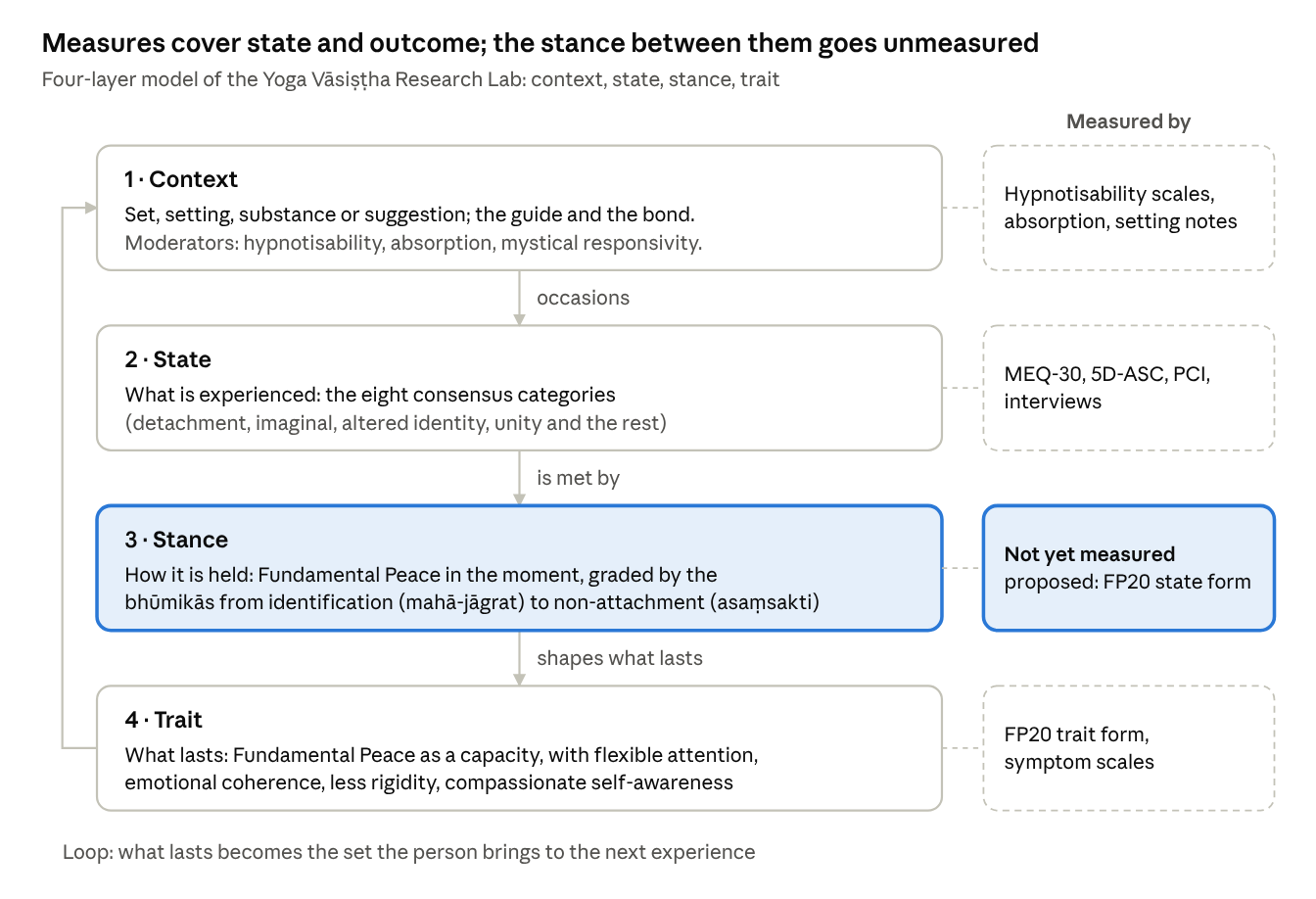
We propose that altered states be described on four linked layers, and that the third, stance, is the missing link between a powerful experience and a lasting change. The model keeps the consensus taxonomy intact as its second layer and places Fundamental Peace at the third and fourth.
Figure 1. The Context–State–Stance–Trait model. Existing instruments measure context (hypnotisability, absorption) and state (MEQ-30, 5D-ASC, PCI); symptom scales measure outcome. The stance taken toward the state is measured by none of them; the FP20 in a state form, with ratings anchored in the jñāna-bhūmikā, is proposed for it, and the FP20 trait form measures what lasts.
Each layer answers one question:
- Context: what occasioned it? The trigger (a molecule, a suggestion, a practice) together with set, setting and the guide. Context is not the state's name, as Cardeña insists, but it is a cause. It is also where traits sit: hypnotisability, absorption, and the mystical responsivity that the Brudner data hint at.
- State: what was experienced? The eight consensus categories, coded from first-person reports, and allowed to change over the course of one session.
- Stance: how was it held? The experiencer's relation to the state, graded on the Yoga Vāsiṣṭha's two ladders and expressed, in modern terms, as Fundamental Peace in the moment. This layer answers Kihlstrom's call for awareness and control, and Colelli's call for thick phenomenology, because stance is how an experience is lived from the inside.
- Trait: what remained? Fundamental Peace consolidated as a capacity, measured by the FP20 alongside symptom scales, and supported by the network changes of Section 8.
10.1 Where hypnosis enters
Hypnosis can act on three of the four layers. At the context layer it is an induction, able to occasion unity, imaginal and detachment states without a drug. At the stance layer its suggestions can invite inquiry (vicāraṇā), non-attachment (asaṃsakti) and self-compassion while the state is still unfolding. At the trait layer, post-session hypnotic revisiting and daily self-hypnosis can consolidate what was seen, as Prediction 5 of the Fundamental Peace model proposes.
This is how the YVH Model reads the therapeutic zone at sattvāpatti in deep trance: the person is absorbed enough for the state to be vivid, and settled enough not to be captured by it.
10.2 Testable hypotheses
- Stance mediates outcome. The association between state intensity (MEQ-30) and clinical outcome will shrink once an in-session stance measure (a state form of the FP20) is entered.
- Same state, different stance, different result. Matched mystical experiences held with clinging will predict less trait change than those held with non-attachment and self-compassion.
- Suggestion can shift stance. Adding stance-directed suggestions to psilocybin preparation, or to a hypnotic mystical-experience protocol, will raise FP20 gains without raising state intensity.
- Fundamental Peace mediates trait change. FP20 change from baseline to follow-up will mediate symptom improvement after both psilocybin and hypnotic interventions, and will do so through the same network pathways (DMN reduction for C3; reduced defensive processing for C4).
11. Implications for Research and Practice
The practical consequence is that hypnosis should become psychedelic science's control condition and its integration tool, and that every trial should measure stance and lasting capacity as well as state.
11.1 For research
- Report states by category, not by trigger. Trials should code session reports against the eight consensus categories, so that psilocybin, hypnosis and meditation studies can be compared directly.
- Use hypnosis as an active placebo. A hypnotic session built to occasion a mystical experience, matched for setting, music and duration, is the closest available control for a drug's experiential effects. It answers Hood and Elkins's second question, and work comparing conventional with placebo hypnosis inductions shows how such controls can be built and tested (Kekecs et al., 2024). Trials should follow the field's guidelines for assessing the efficacy of clinical hypnosis (Kekecs et al., 2022).
- Measure mystical responsivity at baseline. The Brudner repetition pattern suggests a trait. Hypnotisability, absorption and prior unity experiences should be recorded as moderators.
- Add a stance measure. Alongside the MEQ-30 and the 5D-ASC, trials need an instrument that asks how the person related to what arose: identified, curious, clinging, released, compassionate. The Lab proposes a state form of the FP20, with anchors drawn from the seven jñāna-bhūmikā, and will test whether stance mediates the link between state and outcome.
- Measure the trait outcome directly. Symptom scales show relief; they do not show what changed in the person. The FP20 measures the four components of Fundamental Peace and should sit beside symptom scales in psychedelic and hypnosis trials.
- Pair scales with interviews and markers. As the SCEH qualitative work showed, the experience participants most often volunteer may be one the questionnaire never asks about. Session-level EEG and heart-rate variability can test the network pathways directly.
11.2 For practice
- Preparation and integration. Hypnosis can rehearse the session beforehand and revisit it afterwards. In YVH terms, preparation cultivates śubhecchā and vicāraṇā (intention and inquiry); integration works toward asaṃsakti (holding the experience without clinging), and the FP20 profile shows which component needs work.
- Wording that fits the person. The religious participant who could respond to "God" but not to "ultimate reality" shows that suggestion must speak each person's language of the sacred, secular wording included.
- Do not chase the peak. If stance carries the benefit, the clinician's aim is not the most intense experience but the one that changes how the person relates to all experience. In the words that summarise the Fundamental Peace programme: "Fundamental Peace is not the absence of pain… it is the transmutation of its energy into love and compassion."
12. Limitations
This is a conceptual synthesis, not an empirical study. Its clinical sources are small: ten interviews, 31 patients, and 25 heterogeneous trials of moderate quality. The consensus taxonomy is not yet validated. Two SCEH sources are conference presentations rather than peer-reviewed papers, and the Fundamental Peace psychometric and clinical figures are pilot data, the clinical ones uncontrolled.
The mapping of Yoga Vāsiṣṭha narratives onto modern categories, and of the bhūmikās onto the components of Fundamental Peace, is interpretive. The text is a philosophical and soteriological work, and its stories were not written as case reports. The proposed state form of the FP20 does not yet exist. The author developed the Fundamental Peace model, the FP20 and the YVH Model, and edits the Journal that publishes this review; readers should weigh the argument with this in mind.
Three questions remain open:
- Can a hypnotically occasioned mystical experience produce lasting change in a clinical sample, and does it alter the brain beyond the session?
- Is stance measurable reliably by self-report, or does it need observer rating and interview?
- Does a shift in stance precede symptom change, or follow it?
13. Conclusion
The SCEH 2026 evidence converges on one finding: extraordinary states can be occasioned in many ways, and they matter, but they do not heal by themselves. The consensus taxonomy tells us what was experienced. The psychedelic and hypnosis trials tell us that the experience predicts benefit only sometimes. The Yoga Vāsiṣṭha tells us why: what decides the outcome is the stance of the one who experiences. Fundamental Peace gives that stance a definition, a network mechanism and a measure. Joined in a Context–State–Stance–Trait model, these maps turn an old contemplative insight into testable science, and give hypnosis a central place in the study of psychedelic change.
Declarations
Author contributions. L.M.G. conceived the review and the Context–State–Stance–Trait model, developed the Fundamental Peace model and the FP20, wrote the manuscript and approved the final version.
Funding. No specific funding was received for this work.
Conflict of interest. The author is the founder of the World Happiness Foundation, which publishes this Journal, and is the Journal's Editor-in-Chief. He developed the Fundamental Peace model, the FP20 scale and the YVH Model discussed in this article, and presented Circuits of Fundamental Peace at SCEH 2026.
Peer review. This article was assessed under the Journal's editorial-review model and has not undergone external peer review. Because the author is the Journal's Editor-in-Chief, readers should weigh the review process with this relationship in mind.
Use of AI tools. AI assistance (Claude, Anthropic) was used to extract content from the conference presentations, to check figures and references against their sources, to draw the figure and to edit the language. The author reviewed all content and takes full responsibility for it.
Ethics. This review involved no human participants or personal data. The pilot Fundamental Peace data it cites were reported by the author at SCEH 2026; the FP20 is used in field research only after ethics approval.
Data availability. No new data were generated. The conference presentations summarised here are cited in the References; the FP20 scoring rules are given in Section 8.4.
Acknowledgements. The author thanks the presenters of SCEH 2026 whose work is discussed here, and Prof. Saamdu Chetri, co-author of the Fundamental Peace review on which Section 8 rests.
References
- Alldredge, C. T., Vagner, M., Corlett, C., & Elkins, G. R. (2025). Clinical utility of mystical experiences: An overview and conceptual framework. International Journal of Clinical and Experimental Hypnosis, 73(4), 432–448. https://doi.org/10.1080/00207144.2025.2526351
- Anand, A., Mathew, S. J., Sanacora, G., Murrough, J. W., Goes, F. S., Altinay, M., et al. (2023). Ketamine versus ECT for nonpsychotic treatment-resistant major depression. New England Journal of Medicine, 388(25), 2315–2325. https://doi.org/10.1056/NEJMoa2302399
- Brudner, R. M., Kaczmarek, E., Blainey, M. G., Schulz-Quach, C., Meshkat, S., Doyle, Z., Lipsitz, O., Offman, H., Sethi, R., Weiglein, G., McIntyre, R. S., Rosenblat, J. D., et al. (2025). Examining mystical experiences as a predictor of psilocybin-assisted psychotherapy for treatment-resistant depression. Journal of Psychopharmacology, 39(9). https://doi.org/10.1177/02698811251346697
- Cardeña, E. (2005). The phenomenology of deep hypnosis: Quiescent and physically active. International Journal of Clinical and Experimental Hypnosis, 53(1), 37–59. https://doi.org/10.1080/00207140490914234
- Cardeña, E. (2026, October 18). An expert, multidisciplinary, phenomenologically-based taxonomy of states of consciousness [Keynote address]. Society for Clinical and Experimental Hypnosis 77th Annual Conference, online.
- Cardeña, E., Berkovich-Ohana, A., Valli, K., Barttfeld, P., Gomez-Marin, A., Greyson, B., Kumar, V. K., Laureys, S., Luhrmann, T. M., Newberg, A., Preller, K. H., Putnam, F. W., Tagliazucchi, E., Walsh, R., Carter, O., & Yaden, D. (2025). A consensus taxonomy of altered (nonordinary) states of consciousness: Bringing order to disarray. Psychology of Consciousness: Theory, Research, and Practice. Advance online publication. https://doi.org/10.1037/cns0000431
- Cardeña, E., Jönsson, P., Terhune, D. B., & Marcusson-Clavertz, D. (2013). The neurophenomenology of neutral hypnosis. Cortex, 49(2), 375–385. https://doi.org/10.1016/j.cortex.2012.04.001
- Carhart-Harris, R. L., & Friston, K. J. (2019). REBUS and the anarchic brain: Toward a unified model of the brain action of psychedelics. Pharmacological Reviews, 71(3), 316–344. https://doi.org/10.1124/pr.118.017160
- Carhart-Harris, R., Giribaldi, B., Watts, R., Baker-Jones, M., Murphy-Beiner, A., Murphy, R., Martell, J., Blemings, A., Erritzoe, D., & Nutt, D. J. (2021). Trial of psilocybin versus escitalopram for depression. New England Journal of Medicine, 384(15), 1402–1411. https://doi.org/10.1056/NEJMoa2032994
- Colelli, J. (2026). What counts as phenomenological? A "thick" phenomenological note on altered states of consciousness classification. Psychology of Consciousness: Theory, Research, and Practice. Advance online publication. https://philarchive.org/rec/COLWCA-8
- Compass Pathways. (2026, July 7). Compass Pathways announces six month data from second phase 3 trial confirming rapid and durable profile [Press release]. Business Wire. https://www.businesswire.com/news/home/20260707713443/en
- Corlett, C. E., Alldredge, C. T., & Elkins, G. R. (2025). Feasibility of a hypnosis intervention for a mystical experience. International Journal of Clinical and Experimental Hypnosis, 73(4), 414–431. https://doi.org/10.1080/00207144.2025.2491352
- Corlett, C., Norris, J. J., Majeti, S., Alldredge, C., & Elkins, G. (2026). Hypnosis-based intervention for mystical experiences: A qualitative analysis. American Journal of Clinical Hypnosis. Advance online publication. https://doi.org/10.1080/00029157.2026.2704105
- Davis, A. K., Barrett, F. S., May, D. G., Cosimano, M. P., Sepeda, N. D., Johnson, M. W., Finan, P. H., & Griffiths, R. R. (2021). Effects of psilocybin-assisted therapy on major depressive disorder: A randomized clinical trial. JAMA Psychiatry, 78(5), 481–489. https://doi.org/10.1001/jamapsychiatry.2020.3285
- Demertzi, A., Soddu, A., Faymonville, M.-E., Bahri, M. A., Gosseries, O., Vanhaudenhuyse, A., Phillips, C., Maquet, P., Noirhomme, Q., Luxen, A., & Laureys, S. (2011). Hypnotic modulation of resting state fMRI default mode and extrinsic network connectivity. Progress in Brain Research, 193, 309–322. https://doi.org/10.1016/B978-0-444-53839-0.00020-X
- Dupuis, D., & Veissière, S. (2022). Culture, context, and ethics in the therapeutic use of hallucinogens: Psychedelics as active super-placebos? Transcultural Psychiatry, 59(5), 571–578. https://doi.org/10.1177/13634615221131465
- Elkins, G. R. (2025). Intersections of psychedelics, mystical experiences, and hypnosis. International Journal of Clinical and Experimental Hypnosis, 73(4), 391–397. https://doi.org/10.1080/00207144.2025.2554387
- Elkins, G. R., Barabasz, A. F., Council, J. R., & Spiegel, D. (2015). Advancing research and practice: The revised APA Division 30 definition of hypnosis. International Journal of Clinical and Experimental Hypnosis, 63(1), 1–9. https://doi.org/10.1080/00207144.2014.961870
- Erritzoe, D., Barba, T., Greenway, K. T., Murphy, R., Martell, J., Giribaldi, B., Timmermann, C., Murphy-Beiner, A., Baker Jones, M., Nutt, D., Weiss, B., & Carhart-Harris, R. (2024). Effect of psilocybin versus escitalopram on depression symptom severity in patients with moderate-to-severe major depressive disorder: Observational 6-month follow-up of a phase 2, double-blind, randomised, controlled trial. eClinicalMedicine, 102799. https://doi.org/10.1016/j.eclinm.2024.102799
- Evans, J., & Lynn, S. J. (2024). Effects of hypnosis, suggestion, and implementation intention instructions on mystical-type experiences: A replication and extension. Psychology of Consciousness: Theory, Research, and Practice, 11(3), 375–391. https://doi.org/10.1037/cns0000278
- Fingelkurts, A. A., & Fingelkurts, A. A. (2026). Can we really taxonomize the nonordinary? Reflections on a consensus classification for altered states of consciousness. Psychology of Consciousness: Theory, Research, and Practice. Advance online publication. https://doi.org/10.1037/cns0000459
- Gallardo, L. M. (2026a). The Supreme Yoga and the science of suggestion: Bridging the Yoga Vāsiṣṭha and modern hypnotherapy through consciousness, narrative, and neuroscience. Journal of Happytalism and Fundamental Peace, 1(1), JHFP-2026-001. https://doi.org/10.68220/whf.2026.001
- Gallardo, L. M. (2026b, October 18). Circuits of Fundamental Peace: Network-based mechanisms of hypnotic emotion regulation [Paper presentation]. Society for Clinical and Experimental Hypnosis 77th Annual Conference, online.
- Gallardo, L. M. (2026c). Joint psychometric validation of the Shame and Release Scale (SRS) and the Fundamental Peace Scale (FP20) in Indian organisational contexts: A pre-registered validation protocol. Journal of Happytalism and Fundamental Peace, 1(1), JHFP-2026-005. https://doi.org/10.68220/whf.2026.005
- Gallardo, L. M., & Chetri, S. (2026). Hypnosis as a mechanism of emotion regulation and self-integration: An integrative review of neural, cognitive, and experiential pathways to Fundamental Peace. Behavioral Sciences, 16(3), 395. https://doi.org/10.3390/bs16030395
- Gattuso, J. J., Perkins, D., Ruffell, S., Lawrence, A. J., Hoyer, D., Jacobson, L. H., Timmermann, C., Castle, D., Rossell, S. L., Downey, L. A., Pagni, B. A., Galvão-Coelho, N. L., Nutt, D., & Sarris, J. (2023). Default mode network modulation by psychedelics: A systematic review. International Journal of Neuropsychopharmacology, 26(3), 155–188. https://doi.org/10.1093/ijnp/pyac074
- Hashimoto, K. (2024). Are "mystical experiences" essential for antidepressant actions of ketamine and the classic psychedelics? European Archives of Psychiatry and Clinical Neuroscience. https://doi.org/10.1007/s00406-024-01770-7
- Hastings, A. (2006). An extended nondrug MDMA-like experience evoked through posthypnotic suggestion. Journal of Psychoactive Drugs, 38(3), 273–283. https://doi.org/10.1080/02791072.2006.10399853
- Hölzel, B. K., Carmody, J., Vangel, M., Congleton, C., Yerramsetti, S. M., Gard, T., & Lazar, S. W. (2011). Mindfulness practice leads to increases in regional brain gray matter density. Psychiatry Research: Neuroimaging, 191(1), 36–43. https://doi.org/10.1016/j.pscychresns.2010.08.006
- Hood, A., & Elkins, G. (2026, October 18). Psilocybin-assisted psychotherapy for anxiety symptoms: Review and implications for clinical hypnosis [Paper presentation]. Society for Clinical and Experimental Hypnosis 77th Annual Conference, online.
- Hood, A. P., Corlett, C. E., Alldredge, C. T., & Elkins, G. R. (2024). Critical review of 3,4-methylenedioxymethamphetamine (MDMA)-assisted therapy for posttraumatic stress disorder: Unanswered questions and future directions. Journal of Psychedelic Studies, 8(2), 274–285. https://doi.org/10.1556/2054.2024.00383
- Jensen, M. P., Adachi, T., Tomé-Pires, C., Lee, J., Osman, Z. J., & Miró, J. (2015). Mechanisms of hypnosis: Toward the development of a biopsychosocial model. International Journal of Clinical and Experimental Hypnosis, 63(1), 34–75. https://doi.org/10.1080/00207144.2014.961875
- Jensen, M. P., & Patterson, D. R. (2014). Hypnotic approaches for chronic pain management: Clinical implications of recent research findings. American Psychologist, 69(2), 167–177. https://doi.org/10.1037/a0035644
- Johnson, M., Richards, W., & Griffiths, R. (2008). Human hallucinogen research: Guidelines for safety. Journal of Psychopharmacology, 22(6), 603–620. https://doi.org/10.1177/0269881108093587
- Kekecs, Z., Moss, D., Elkins, G. R., De Benedittis, G., Palsson, O. S., Shenefelt, P. D., Terhune, D. B., Varga, K., & Whorwell, P. J. (2022). Guidelines for the assessment of efficacy of clinical hypnosis applications. International Journal of Clinical and Experimental Hypnosis, 70(2), 104–122. https://doi.org/10.1080/00207144.2022.2049446
- Kekecs, Z., Nyiri, B., Alldredge, C. T., Cserni, B., Rizzo, P., Domok, B., Vizkievicz, V., Takacs, A., Giran, K., Nagy, J. K., & Elkins, G. (2024). The effectiveness of hypnoanalgesia using conventional and placebo hypnosis induction. The Journal of Pain, 25(8), 104519. https://doi.org/10.1016/j.jpain.2024.03.015
- Kihlstrom, J. F. (2025). Classifying altered states of consciousness [Comment on Cardeña et al.]. Psychology of Consciousness: Theory, Research, and Practice. In press. https://www.ocf.berkeley.edu/~jfkihlstrom/PDFs/2020s/2026/CardenaComment.pdf
- Lemercier, C. E., & Terhune, D. B. (2018). Psychedelics and hypnosis: Commonalities and therapeutic implications. Journal of Psychopharmacology, 32(7), 732–740. https://doi.org/10.1177/0269881118780714
- Lynn, S. J., & Evans, J. (2017). Hypnotic suggestion produces mystical-type experiences in the laboratory: A demonstration proof. Psychology of Consciousness: Theory, Research, and Practice, 4(1), 23–37. https://doi.org/10.1037/cns0000105
- Maia, L. O., Beaussant, Y., Garcia, A. C. M., et al. (2022). The therapeutic potential of psychedelic-assisted therapies for symptom control in patients diagnosed with serious illness: A systematic review. Journal of Pain and Symptom Management, 63(6), e725–e738. https://pubmed.ncbi.nlm.nih.gov/35157985/
- Majeti, S., & Corlett, C. (2026, October 18). Hypnosis-based intervention for mystical experiences: A qualitative analysis [Paper presentation]. Society for Clinical and Experimental Hypnosis 77th Annual Conference, online.
- McGeown, W. J., Mazzoni, G., Venneri, A., & Kirsch, I. (2009). Hypnotic induction decreases anterior default mode activity. Consciousness and Cognition, 18(4), 848–855. https://doi.org/10.1016/j.concog.2009.09.001
- Menon, V. (2011). Large-scale brain networks and psychopathology: A unifying triple network model. Trends in Cognitive Sciences, 15(10), 483–506. https://doi.org/10.1016/j.tics.2011.08.003
- Mitra, V. L. (Trans.). (1891–1899). The Yoga-Vásishtha-Mahárámáyana of Válmiki (4 vols.). Bonnerjee and Co.
- Nash, J. D., & Newberg, A. B. (2023). An updated classification of meditation methods using principles of taxonomy and systematics. Frontiers in Psychology, 13, 1062535. https://doi.org/10.3389/fpsyg.2022.1062535
- Oakley, D. A., & Halligan, P. W. (2013). Hypnotic suggestion: Opportunities for cognitive neuroscience. Nature Reviews Neuroscience, 14(8), 565–576. https://doi.org/10.1038/nrn3538
- Olson, J. A., Suissa-Rocheleau, L., Lifshitz, M., Raz, A., & Veissière, S. P. L. (2020). Tripping on nothing: Placebo psychedelics and contextual factors. Psychopharmacology, 237(5), 1371–1382. https://doi.org/10.1007/s00213-020-05464-5
- Patterson, D. R. (2010). Clinical hypnosis for pain control. American Psychological Association. https://doi.org/10.1037/12128-000
- Patterson, D. R. (2026, October 18). Hypnosis induced mysticism vs. psychedelics [Paper presentation]. Society for Clinical and Experimental Hypnosis 77th Annual Conference, online.
- Patterson, D. R., & Jensen, M. P. (2003). Hypnosis and clinical pain. Psychological Bulletin, 129(4), 495–521. https://doi.org/10.1037/0033-2909.129.4.495
- Piekarski, M. (in press). From description to explanation: Why altered states of consciousness research needs more than phenomenology. Psychology of Consciousness: Theory, Research, and Practice. https://philarchive.org/rec/PIEFDT
- Rainville, P., Duncan, G. H., Price, D. D., Carrier, B., & Bushnell, M. C. (1997). Pain affect encoded in human anterior cingulate but not somatosensory cortex. Science, 277(5328), 968–971. https://doi.org/10.1126/science.277.5328.968
- Raz, A., Fan, J., & Posner, M. I. (2005). Hypnotic suggestion reduces conflict in the human brain. Proceedings of the National Academy of Sciences, 102(28), 9978–9983. https://doi.org/10.1073/pnas.0503064102
- Romeo, B., Kervadec, E., Fauvel, B., Strika-Bruneau, L., Amirouche, A., Bezo, A., Piolino, P., & Benyamina, A. (2025). The intensity of the psychedelic experience is reliably associated with clinical improvements: A systematic review and meta-analysis. Neuroscience & Biobehavioral Reviews, 172, 106086. https://doi.org/10.1016/j.neubiorev.2025.106086
- Rosenblat, J. D., Meshkat, S., Doyle, Z., Kaczmarek, E., Brudner, R. M., Kratiuk, K., et al. (2024). Psilocybin-assisted psychotherapy for treatment resistant depression: A randomized clinical trial evaluating repeated doses of psilocybin. Med, 5(3), 190–200.e5. https://doi.org/10.1016/j.medj.2024.01.005
- Society for Clinical and Experimental Hypnosis. (2026). Circuits of consciousness: Hypnosis, AI, and psychedelic-assisted change. SCEH 2026 77th Annual Workshops & Scientific Program [Conference programme]. https://mam.memberclicks.net/assets/2026_Conference/SCEH2026ConferenceProgram.pdf
- Thompson, T., Terhune, D. B., Oram, C., Sharangparni, J., Rouf, R., Solmi, M., Veronese, N., & Stubbs, B. (2019). The effectiveness of hypnosis for pain relief: A systematic review and meta-analysis of 85 controlled experimental trials. Neuroscience & Biobehavioral Reviews, 99, 298–310. https://doi.org/10.1016/j.neubiorev.2019.02.013
- Valentine, K. E., Milling, L. S., Clark, L. J., & Moriarty, C. L. (2019). The efficacy of hypnosis as a treatment for anxiety: A meta-analysis. International Journal of Clinical and Experimental Hypnosis, 67(3), 336–363. https://doi.org/10.1080/00207144.2019.1613863
- Vargas, M. V., Dunlap, L. E., Dong, C., Carter, S. J., Tombari, R. J., Jami, S. A., et al. (2023). Psychedelics promote neuroplasticity through the activation of intracellular 5-HT2A receptors. Science, 379(6633), 700–706. https://doi.org/10.1126/science.adf0435
- Wolfgang, A. S., Fonzo, G. A., Gray, J. C., Krystal, J. H., Grzenda, A., Widge, A. S., Kraguljac, N. V., McDonald, W. M., Rodriguez, C. I., & Nemeroff, C. B. (2025). MDMA and MDMA-assisted therapy. American Journal of Psychiatry, 182(1), 79–103. https://doi.org/10.1176/appi.ajp.20230681
Declaration
The author is the founder of the World Happiness Foundation, which publishes this Journal, and its Editor-in-Chief, and developed the Fundamental Peace model, the FP20 scale and the YVH Model discussed in the article. AI assistance (Claude, Anthropic) was used to extract content from the conference presentations, check figures and references against their sources, draw the figure and edit language; the author takes full responsibility for the content.
How to cite
Suggested citation
Gallardo, L. M. (2026). From Altered States to Fundamental Peace: Taxonomies of Consciousness, Psychedelics and Hypnosis Through the Lens of the Yoga Vāsiṣṭha. World Happiness Foundation Research Lab. https://doi.org/10.68220/whf.2026.007