Announcements
A Home for the Research: Announcing the World Happiness Foundation Research Lab
And its first published paper — on the Yoga Vāsiṣṭha, hypnotherapy, and the measurement of peace
September 9, 2026·Luis Miguel Gallardo·5 min read
AI insights
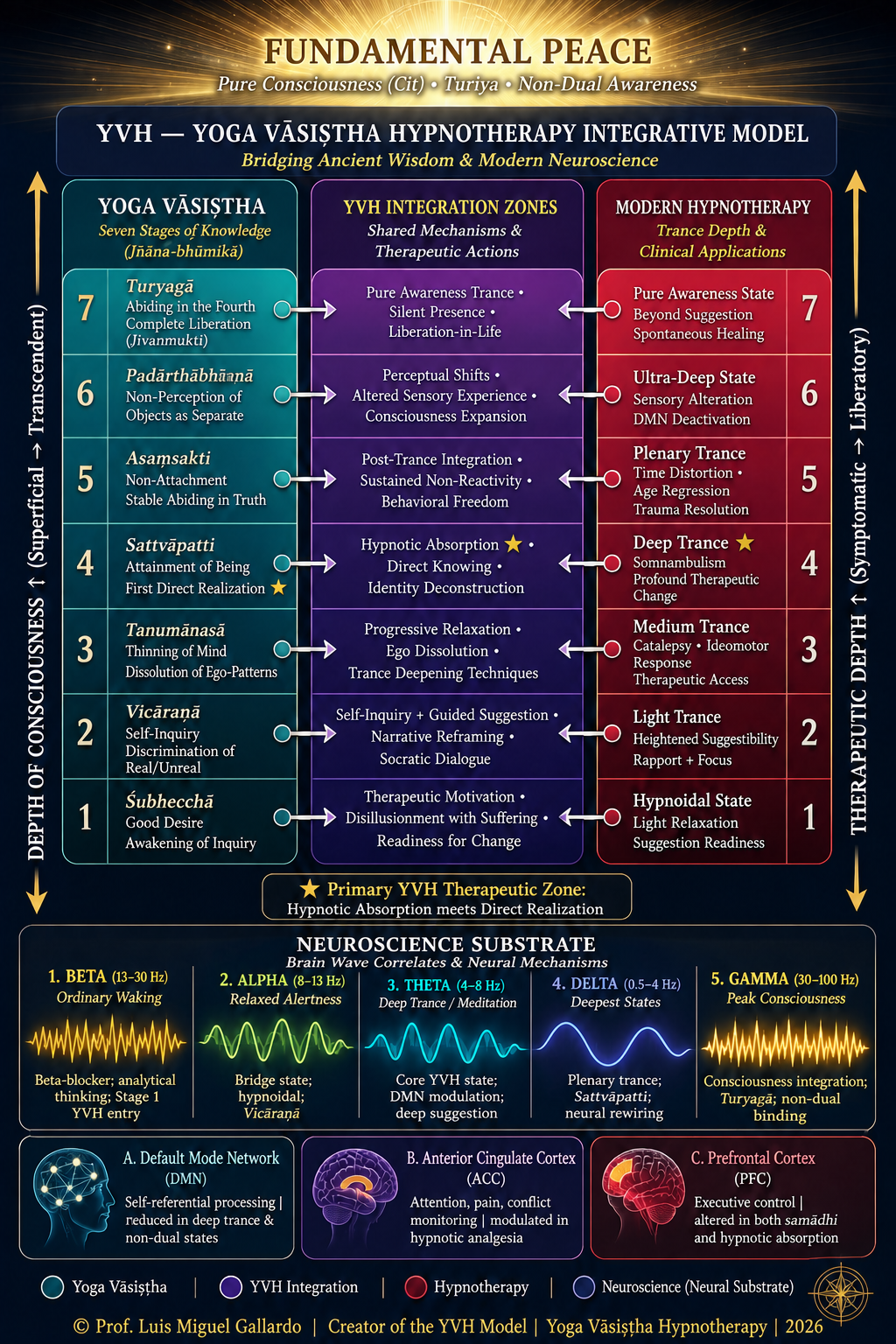
The Yoga Vāsiṣṭha Hypnotherapy (YVH) Integrative Model, v2. © 2026 Luis Miguel Gallardo. Learn more at the official Mindful Diving Institute site, home of Mindful Diving.
By Luis Miguel Gallardo · Founder & President, World Happiness Foundation · September 2026
For twenty years, the World Happiness Foundation has done two things at once. We have convened — summits, festivals, agoras, chapters, the Gross Global Happiness programme at the United Nations University for Peace. And we have studied: what actually makes people free, conscious and happy, and what the evidence will and will not support.
The convening has always had a home. The research has not. Papers went out through journals, preprint servers and PDFs on our website, scattered across a dozen addresses, some of them citable and some of them not. Work that took years to produce could not reliably be found, quoted or built upon.
Today that changes. The World Happiness Foundation is now a member of Crossref, the international registration agency for scholarly content, and holds its own DOI prefix: 10.68220. With it we are opening the World Happiness Foundation Research Lab — the Foundation’s scholarly publishing arm, and the permanent home for the research that underwrites everything else we do.
What the Lab is
The Lab publishes original research on happiness, consciousness, peace and human flourishing. Every work it publishes receives a Digital Object Identifier registered with Crossref — a permanent address that will resolve to that paper for as long as the record exists, independent of any redesign, migration or change of platform. Every work is open access under a Creative Commons Attribution licence: free to read, free to translate, free to reuse with attribution, anywhere in the world.
That combination is the point. A great deal of research on wellbeing sits behind paywalls that put it out of reach of exactly the communities it describes. Our mission is ten billion free, conscious and happy people by 2050. Research that cannot be read by the people it concerns cannot serve that mission.
The Lab does not stand alone. Our sister lab at the Mindful Diving Institute has been publishing under the same prefix, and the two share conventions, standards and infrastructure deliberately — one scholarly practice across the Foundation’s work, not several.
Our editorial standards are simple and non-negotiable. Every paper declares its conflicts of interest. Every paper states its limitations. No invented data, no invented citations, no claims that outrun their evidence. Where a proposal is a proposal, it is labelled as one.
The first paper
The Lab opens with “The Supreme Yoga and the Science of Suggestion: Bridging the Yoga Vāsiṣṭha and Modern Hypnotherapy Through Consciousness, Narrative, and Neuroscience” — DOI 10.68220/whf.2026.001.
The paper argues that two traditions separated by a millennium arrived at the same discovery, and that neither has yet been read in the light of the other.
The Yoga Vāsiṣṭha — the Supreme Yoga, one of the most psychologically sophisticated works of Indian philosophy — teaches through sixty-four stories that the world we suffer is the world we imagine; that latent impressions called vāsanā keep suffering in motion; and that disciplined imagination, bhāvanā, is the instrument that undoes them. It is, read carefully, the most complete pre-modern theory of therapeutic imagination ever composed.
Modern hypnotherapy discovered the operative half of each of those claims and tested it clinically, across an evidence base now spanning dozens of meta-analyses.
Three findings from the paper are worth stating on their own.
Hypnosis has an Indian lineage, and it has been forgotten. The doctrine on which the whole field rests — that hypnotic power lies in the subject, not the operator — entered European science through Abbé Faria, born in Goa in 1756, who rejected Mesmer’s magnetic fluid and located the phenomena in the concentration and susceptibility of the person before him. The largest early clinical corpus of trance medicine was produced in Bengal. And James Braid, who coined the word hypnotism, devoted a late work to analysing reports of a yogi’s samādhi at the court of Lahore — the first scientific encounter between hypnotism and yoga. That history was written out of the field’s account of itself. The paper argues the integration is therefore best understood as restitution: the science of suggestion returning to a civilisation that helped found it.
The tradition had its own clinician. In the Nirvāṇa Prakaraṇa, the liberated queen Cūḍālā awakens her husband not by instruction but by staged experience — assuming a disguise, meeting him inside his own frame of reference, teaching through parable, testing the result, then withdrawing. Meet the client in his model of the world; utilise rather than confront resistance; deliver change through indirect narrative. That is a recognisable therapeutic strategy, and it was written down eleven centuries before Milton Erickson.
Liberation-in-life can be measured — carefully. The text’s portrait of the jīvanmukta — acting in the world, inwardly unshaken, equal in joy and sorrow, friendly to all beings — corresponds, component by component, to Fundamental Peace as defined in our peer-reviewed work in Behavioral Sciences: an integrated regulatory capacity comprising flexible attentional control, emotional coherence, reduced self-referential rigidity and compassionate self-awareness, assessed by the FP20 scale. The correspondence is functional, not metaphysical. A score is not liberation. But it makes the tradition’s terminal aim into something a study can test.
From this the paper derives the Yoga Vāsiṣṭha Hypnotherapy (YVH) model — the seven stages of knowledge aligned with the depths of therapeutic trance — an eight-phase clinical protocol, and five falsifiable hypotheses.
It also devotes an entire section to what the integration cannot claim: that liberation and symptom relief are not the same target; that the model must work for people who reject the text’s metaphysics, or fail as a clinical proposition; that suggestibility is not insight; and that the clinical evidence cited supports hypnotherapy, not yet YVH itself. Those limits are stated openly, because a bridge that hides its gaps is a bridge that fails under load.
What comes next
The paper is a beginning, not a conclusion. Two studies are already in motion — a cluster-randomised trial with women weavers in Rajasthan, and a clinical study of regression with Fundamental Peace as its primary outcome, under ethics review in Spain.
The Lab is open to the Foundation’s partners, chapter leads, fellows and collaborators. If you are working on happiness, consciousness, peace or flourishing and want your research to have a permanent, citable, freely readable home, we would like to hear from you.
The research has a home now. Come and build it with us.
The presentation
The paper also exists as a talk. The full sixteen-slide presentation, The Supreme Yoga and the Science of Suggestion, can be read slide by slide on the paper's page, and downloaded as a PDF or as a PowerPoint file.
The World Happiness Foundation Research Lab publishes under DOI prefix 10.68220. All content is licensed CC BY 4.0 unless otherwise stated.
…
Field notes to your inbox
Stay connected to the shift.
Monthly essays from the Observatory, invitations to Fests and Academy cohorts. Written from abundance — never urgency.