Essays
Counting the Silence: Why We Are Taking the Unmeasured Pain of Women and Girls to the United Nations
Ahead of the seventy-first session of the UN Commission on the Status of Women, the World Happiness Foundation argues that what is not counted is not funded, and what is not funded is not healed — and sets out six ways to count, hear and answer the women and girls our measures of progress leave out.
October 7, 2026·Luis Miguel Gallardo·7 min read
AI insights
Ahead of the seventy-first session of the UN Commission on the Status of Women · New York, 8–19 March 2027
By Luis Miguel Gallardo · 7 October 2026
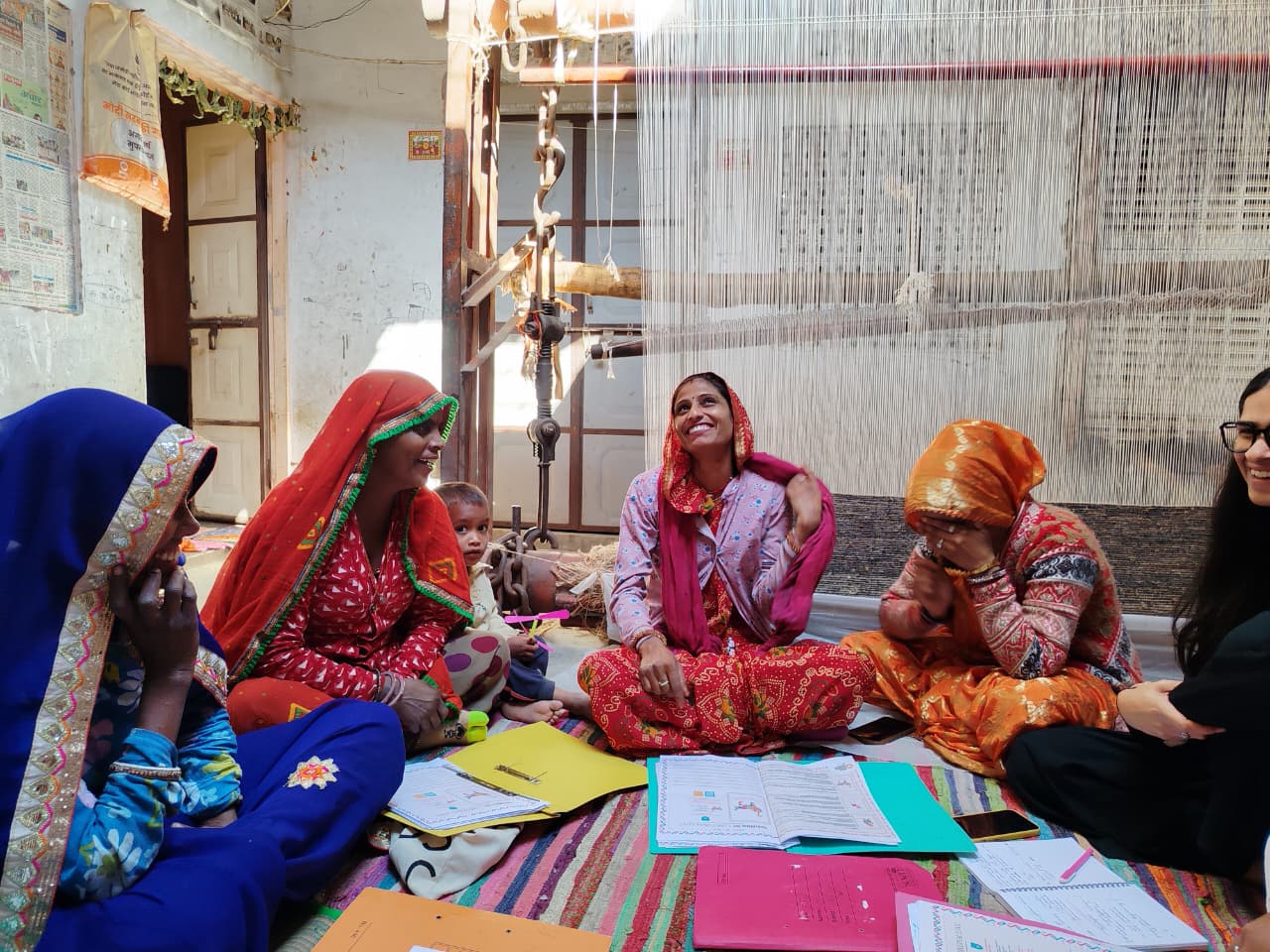
Look at the photograph at the top of this page for a moment before you read on.
Women sit in a circle on a striped cotton rug in rural Rajasthan. Behind them the warp threads of a carpet loom rise to the ceiling like the strings of a great instrument. Workbooks lie open between them. A small child watches from a mother's side. One woman covers her face, laughing; another throws her head back and looks upward with a joy that needs no translation.
Nothing in this picture would appear in a national account. The hours at the loom would be counted, perhaps. The carpet, when it is sold, will certainly be counted. But the circle itself, the laughter, the moment in which a woman is asked how she is and finds that someone is actually waiting for the answer, belongs to the vast economy that our instruments of progress do not see. And neither does the pain that came before it.
That invisibility is the subject of the written statement the World Happiness Foundation is submitting to the seventy-first session of the United Nations Commission on the Status of Women (CSW71), which meets in New York from 8 to 19 March 2027. Its title is Counting the Silence, and its argument fits in one line:
What is not counted is not funded, and what is not funded is not healed.
A session that walks from dignity to flourishing
The calendar of this session carries a message of its own. It opens on 8 March, International Women's Day, and closes on 19 March, the eve of the International Day of Happiness, a day our Foundation worked to bring into being. Between those two dates lies the distance this work is about: the distance between being protected on paper and being heard in life.
The Commission's priority theme is accelerating gender equality and the empowerment of all women and girls under the 2030 Agenda for Sustainable Development. Its review theme looks at climate change, the environment and disaster risk reduction, and its cross-cutting concern is poverty and the economic empowerment of women. Our statement speaks to all three, from a single conviction: no target can be accelerated while the suffering that blocks it remains invisible to the people who make decisions.
A woman who is silenced is not quiet. She is unheard.
The World Health Organization estimates that nearly one in three women worldwide has experienced physical or sexual violence, and most never report it. The International Labour Organization finds that women carry out roughly three quarters of all unpaid care work, labour that appears in no national account. Grief after conflict, exhaustion after a flood, the fear that follows a girl home from school: these are real costs, carried by real bodies, and they are recorded nowhere.
In every region I have worked, from the former Yugoslavia to the villages of Rajasthan, I have seen the same pattern. The women who carry the heaviest burdens are the least often asked how they are. When we finally ask, and create a space safe enough for the answer, something remarkable happens. They do not remain in their pain. They turn it into leadership.
Happytalism: what a society measures, it builds
Happytalism, the paradigm the Foundation advances, places freedom, consciousness, happiness and abundance at the centre of progress. Its premise is simple. Gross domestic product counts the hospital bill and ignores the nurse's night. It counts the weapons and ignores the women who rebuild after them. An economy whose purpose is the full flourishing of every person needs measures designed to see that flourishing, and to see when it is denied.
This is also why we reframe the Sustainable Development Goals as Happytalist Goals: from no poverty to prosperity for all, from zero hunger to nourishment for all, from good health to holistic health and happiness for all. For women and girls the shift is decisive. A woman defined only by what she lacks is treated as a beneficiary. A woman recognised for what she holds, her knowledge, care, leadership and resilience, is treated as a co-author of development. The women in that circle are not waiting to be empowered. They are weaving.
The Global Pain and Trauma Map: one woman, seven domains
To make silenced suffering visible, the Foundation built the Global Pain and Trauma Map, an open framework covering 196 countries that organises human suffering into seven interdependent domains: psychological, relational, collective, structural, existential, somatic and environmental.
Read through a gender lens, the Map shows that the pain of women and girls is rarely confined to one domain. Violence at home becomes anxiety, then chronic pain, then poverty when work is lost, then a loss of meaning. It is often inherited from mothers who carried the wounds of war, and deepened by the displacement that follows drought or flood. A programme that treats one domain at a time produces partial results. A life is not lived in silos, and it cannot be healed in them.
The same lens matters for the climate. Disasters are not only physical events. They leave grief, fear and dislocation that fall disproportionately on women, who are often the last to leave, the first to resume care and the least likely to receive psychological support. A recovery plan that counts damaged homes but not damaged lives will keep reproducing inequality.
Fundamental Peace: measuring what women rebuild
Measuring pain is necessary, but it is not enough. If we only count harm, we teach the world to see women only as victims. Our research on Fundamental Peace, published in peer-reviewed form this year, defines peace as a measurable inner capacity with four components: flexible attention without effortful suppression, emotional coherence across changing states, reduced rigidity in how we see ourselves, and compassionate self-awareness. At the level of populations it becomes the Fundamental Peace Index, the mirror image of the pain the Map records.
I return often to one sentence: Fundamental Peace is not the absence of pain… it is the transmutation of its energy into love and compassion. The women who have survived violence, loss and displacement demonstrate this capacity in every community I know. Policy should learn to recognise it, measure it and invest in it.
Silencing is separation made into a system
In our work, the deepest human wound is separation: being cut off from oneself, from others and from the living world. Silencing is separation made into a system. Every policy that removes a woman's voice from the decisions that shape her life widens that wound. Every space in which she can speak safely, and be answered, begins to close it.
The loom offers a better image than any I could invent. A carpet is made of thousands of knots, each one tied by hand, each one holding the others in place. No single knot is the carpet; none can be left out without a gap appearing. Communities are woven the same way. Giving voice to the silenced is not a gesture of sympathy. It is the first act of healing and the precondition of equality.
What we are asking the Commission to do
The Foundation speaks from practice: more than 60,000 teachers trained across Latin America through the Schools of Happiness, more than 450 cities engaged through the Cities of Happiness network, more than 80 local Agoras, more than 42,000 artisans reached in India, and the Heal the Healers programme supporting those who care for others, a workforce in which women are the majority. From that practice come six recommendations to Member States, United Nations entities and civil society:
- Count the silence. Integrate measures of psychological, relational, somatic, existential and environmental suffering, disaggregated by sex and age, into national statistics and into the UN work on measuring progress beyond GDP.
- Build listening infrastructure. Fund confidential, trauma-informed listening spaces in every municipality, designed with survivors, women and girls, so that speaking up leads to response rather than retaliation.
- Recognise, reduce, redistribute and restore. Add a fourth commitment to the agenda on unpaid care: restoring the inner lives of those who care, through accessible mental health support for carers, health workers and educators.
- Teach peace early. Make emotional literacy, compassion and conflict transformation part of school curricula for girls and boys alike, so that the next generation learns to listen before it learns to dominate.
- Bring the inner life into climate policy. Include psychological first aid, grief support and community healing in climate adaptation and disaster risk reduction plans, with particular attention to rural, Indigenous and displaced women and girls.
- Measure peace, not only harm. Evaluate gender equality programmes by the capacities they restore, agency, emotional coherence, connection and compassion, as well as by the violence they prevent.
An invitation before March
Our North Star is ten billion free, conscious and happy people by 2050. That horizon cannot be reached by half of humanity, nor by a world that keeps half of humanity's pain off the record.
Between now and March, I invite you to do in your own setting what we are asking the United Nations to do. Choose one woman or girl whose work sustains your family, your team or your community, and ask her how she is. Then wait for the answer. Listen to the whole of it. Let something change because of what you heard.
Then look again at the photograph. The circle on the rug is not a programme or a statistic. It is what becomes possible when a woman is counted, heard and answered. Let the peace these women rebuild become the measure of our progress.
…
Explore this topic
Field notes to your inbox
Stay connected to the shift.
Monthly essays from the Observatory, invitations to Fests and Academy cohorts. Written from abundance — never urgency.