REFLECT 2027 · Royal Thimphu College
Educating for Flourishing
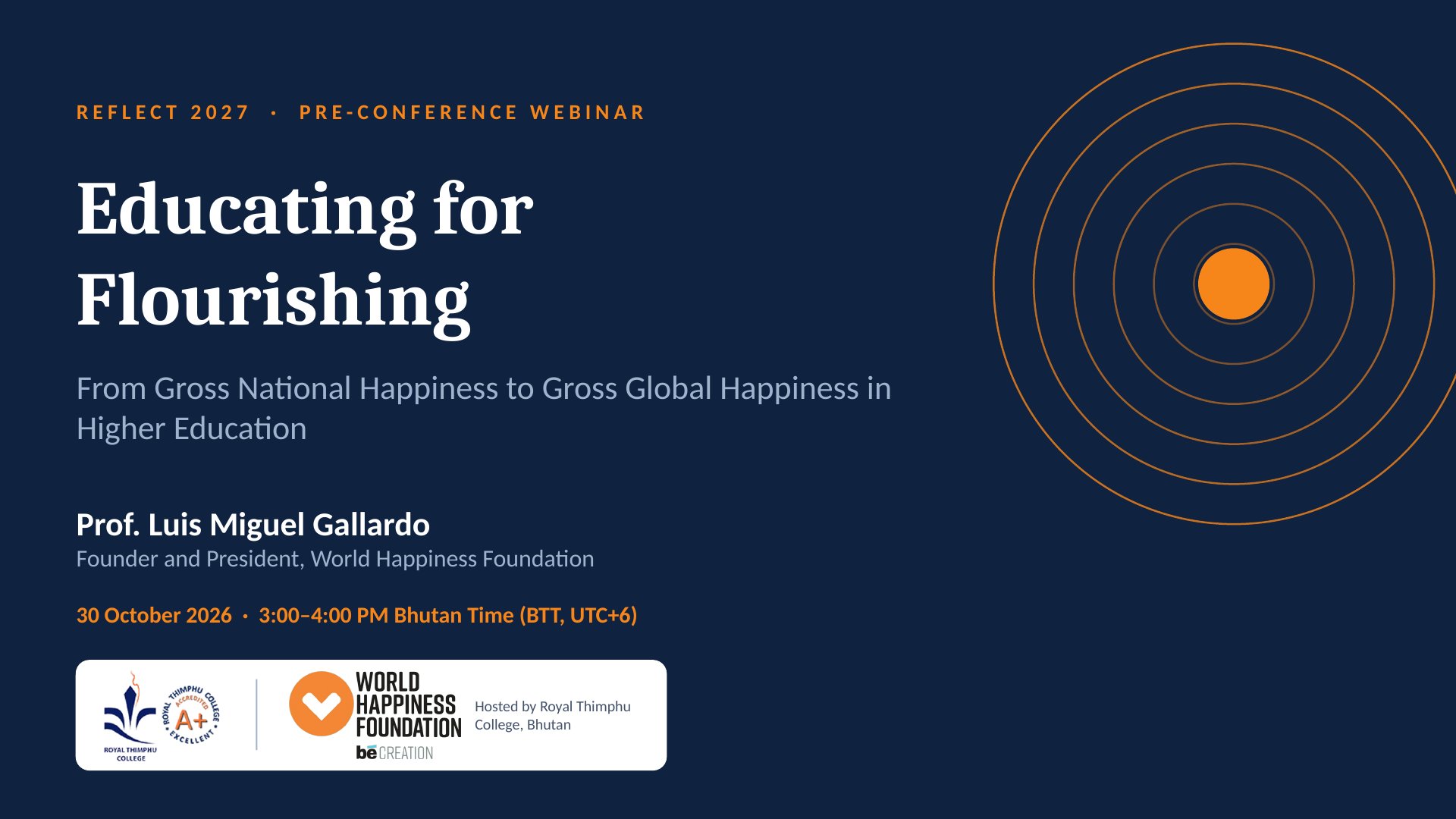
From Gross National Happiness to Gross Global Happiness in higher education — the full presentation of the opening REFLECT 2027 webinar at Royal Thimphu College, Bhutan
By Prof. Luis Miguel Gallardo · Founder and President, World Happiness Foundation · 28 October 2026
Educating for Flourishing
1 / 29
On Friday 30 October, at three in the afternoon in Thimphu, I will open the pre-conference webinar series of REFLECT 2027, the international conference hosted by Royal Thimphu College. I am honoured to serve on its International Advisory Committee, and moved to speak about happiness to Bhutan, the country that taught the rest of us to take the word seriously.
I am sharing the full presentation here in advance: for those who will join us, so they can arrive with questions, and for every teacher, dean and student who cannot be in the room but asks the same question I will ask there.
The question a nation asked
Every institution has a sentence for "we are doing well". The interesting part is what that sentence is counting.
Universities are very good at counting rankings, enrolment, graduation rates, employability and citations. All of that matters. But purpose, belonging, inner peace under pressure, compassion and service rarely reach our dashboards. And what we never measure, we slowly stop seeing.
Bhutan asked this question about a whole nation. Gross National Happiness stands on four pillars — sustainable and equitable development, environmental conservation, the preservation of culture, and good governance — and is measured across nine domains, from psychological wellbeing and time use to community vitality and ecological resilience. Bhutan wrote it into its Constitution in 2008 and carried it to the United Nations: Resolution 65/309 in 2011, and the International Day of Happiness, every 20 March, from 2012.
GNH is not a feeling index. It is a system — a way of designing a society. And a university is exactly that: a small society.
Bhutan did not stop at measurement. With Educating for GNH and the Green Schools of my friend Thakur S. Powdyel — an education of the head, the heart and the hands — it brought the idea into the classroom. In June 2024 the World Happiness Foundation co-hosted the Paro International Symposium, Reimagining Education from a GNH Perspective, and every voice there, from the OECD to CASEL, arrived at the same conviction: education must serve the whole person.
So the question for higher education is not whether this can be done. It is what happens to that whole person when they arrive at university.
Why the university, and why now
The World Health Organization estimates that more than 970 million people live with a mental disorder; that one in seven adolescents aged 10 to 19 lives with one; that suicide is the third leading cause of death among people aged 15 to 29; and that half of all mental health conditions begin by the age of 14.
Fifteen to twenty-nine. Those are our students. The university receives young people in exactly the years when the habits of the mind are set — or healed — for the rest of a life. That makes it the most strategic place on Earth to educate for flourishing.
From a nation to a planet
At the World Happiness Foundation we call the paradigm Happytalism: GDP measures production, Happytalism measures flourishing. It places freedom, consciousness, happiness and abundance at the centre of progress, and reframes the Sustainable Development Goals from what we lack to what we can build together — Prosperity for All, Nourishment for All, Holistic Health and Happiness for All.
In 2018, twenty years after my own peace studies, I created Gross Global Happiness at the United Nations University for Peace in Costa Rica. The idea is simple, and deeply Bhutanese. GNH asks how one nation flourishes. GGH asks how all of us flourish together, because suffering and happiness no longer stop at borders. Our North Star: ten billion free, conscious and happy people by 2050.
Higher education is the bridge between the two. Every university is a small nation, and every graduate is a citizen of the planet.
The inner ground: Fundamental Peace
Johan Galtung, my teacher at Lancaster, gave us two kinds of peace: negative peace, the absence of direct violence, and positive peace, the presence of just structures. After thirty years — in schools, in post-war elections, in boardrooms and in therapy rooms — I became convinced that something was missing at the centre: the inner capacity of the person. Without it, treaties break and good institutions are run by frightened people.
I call it Fundamental Peace. With Professor Saamdu Chetri we described it this year in Behavioral Sciences as a measurable state with four components:
- flexible attentional control without effortful suppression;
- emotional coherence across self-states;
- reduced self-referential rigidity;
- compassionate self-awareness.
It is not equanimity, which is affective neutrality, and it is not only well-being, which is a positive evaluation of life. It is an integrated regulatory capacity under changing conditions, measured with the FP20 scale. And every one of its four capacities can be trained — in a lecture hall, on a sports field, in a meditation room.
The words came to me in Bhutan, in deep meditation at Taktsang, the Tiger's Nest, inspired by Thich Nhat Hanh. In a sense, I am only bringing back to Bhutan something Bhutan gave me.
"Fundamental Peace is not the absence of pain… it is the transmutation of its energy into love and compassion."
Our students will not live lives without pain. Our task is not to protect them from all pain. It is to teach them how to transmute it.
Schools of Happiness, and universities of flourishing
Schools of Happiness is the World Happiness Foundation's education program: classrooms where students learn to know themselves, regulate their emotions and live with purpose. It began in Pinecrest, Miami — the first City of Happiness in the United States — and has trained more than 60,000 teachers across Latin America. It always begins with the adults, because a stressed teacher cannot teach calm.
It rests on six dimensions: a safe and inclusive environment; relational depth; diverse learning experiences; wellbeing woven into the daily rhythm; service and contribution; and measurement and reflection. Read them next to Powdyel's eight greeneries and you will see Bhutan and the rest of the world arriving at the same truth.
For a university, I propose five levers, any one of which can start next semester:
- Learning — credit-bearing courses in happiness and contemplative science, like the Happiness Minor I teach at Shoolini University.
- Leadership — a Chief Well-Being Officer for the campus, and leaders trained in conscious, compassionate leadership.
- Campus life — small daily rituals: a breath before class, circles, mentoring, silence, beauty and nature in shared spaces.
- Research — measuring what matters, with FP20 baselines and partnerships in contemplative science.
- Community — students as agents of happiness, through service, local Agoras and Cities of Happiness.
You do not need all five on the first day. Choose one. Measure it. Let it grow.
Every graduate is a ripple
A teacher trained in this way does not only touch thirty students. She touches their families, their future teachers and every colleague who watches her lead differently. Multiply that by every graduate who leaves a university for their country and the world.
GNH begins in a nation. GGH begins in every graduate.
Five words to take with you
The session will close with a short guided practice and an open conversation. If you cannot join us, you can practise it now, in five minutes: Settle. Focus. Intend. Witness. Choose. Let the body slow down. Rest your attention on the breath. Choose the quality you want to bring today. Watch thoughts and feelings pass, kindly. Then take one small step back into your day.
Bhutan taught the world to measure happiness. Its universities can teach the world how to educate for it.
Kadrinchey la.
Educating for Flourishing: From Gross National Happiness to Gross Global Happiness in Higher Education. REFLECT 2027 pre-conference webinar, hosted by Royal Thimphu College, Bhutan. 30 October 2026, 3:00–4:00 PM Bhutan Time (UTC+6).
Listen
Fundamental Peace
The Mind That Makes the World
The song that closes the guided practice of this session.
Visit the album pageGo deeper
Sources: World Health Organization, Mental health of adolescents; Gallardo, L. M., & Chetri, S. (2026). Hypnosis as a Mechanism of Emotion Regulation and Self-Integration. Behavioral Sciences, 16(3), 395. doi:10.3390/bs16030395.
…
Explore this topic
Field notes to your inbox
Stay connected to the shift.
Monthly essays from the Observatory, invitations to Fests and Academy cohorts. Written from abundance — never urgency.