consciousness
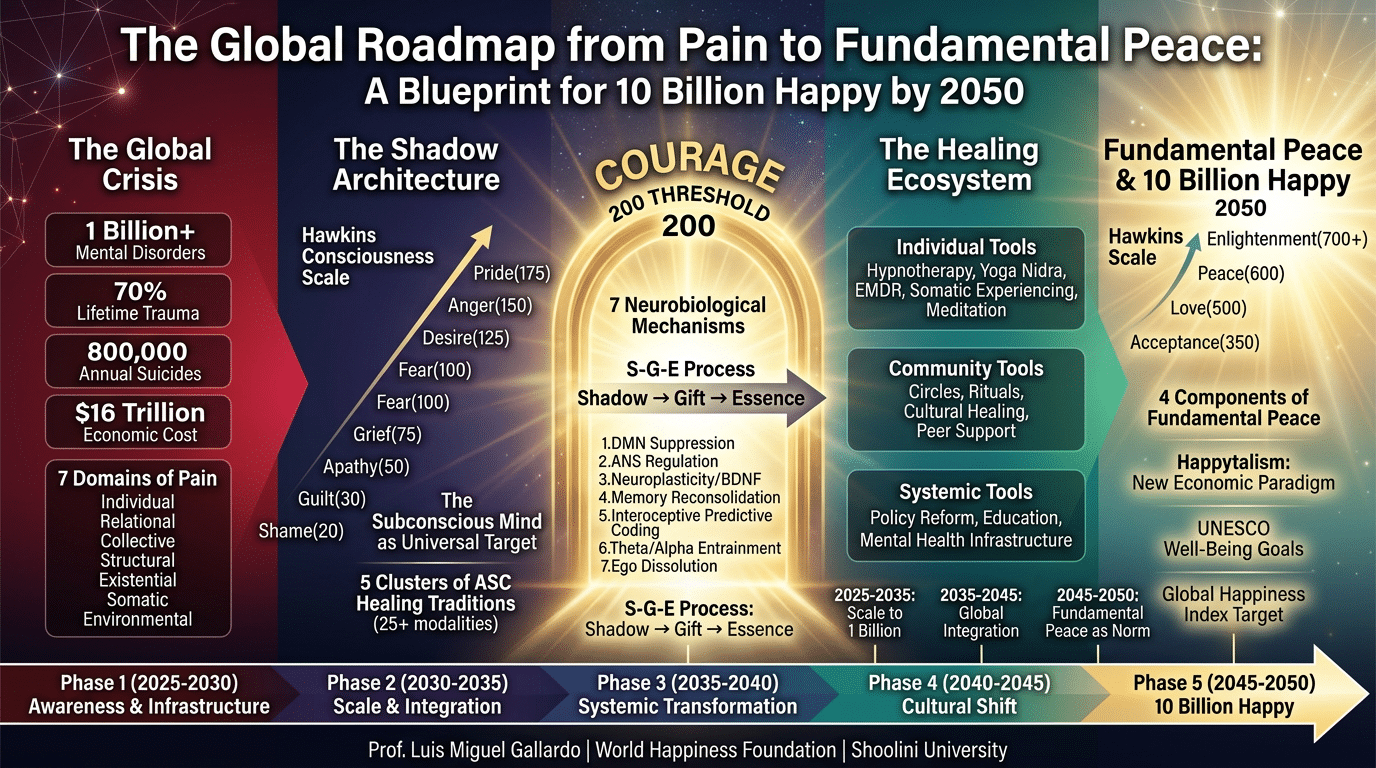
The Global Roadmap from Pain to Fundamental Peace: A Blueprint for 10 Billion Happy by 2050
How a trilogy of papers charts the course from humanity's deepest wounds to its highest potential By Prof. Luis Miguel Gallardo Yogananda School of Spirituality and Happiness, Shoolini University World Happiness Foundation What would it take to create a world where every human being experiences genu
April 2, 2026·Luis Miguel Gallardo·16 min read
AI insights
How a trilogy of papers charts the course from humanity’s deepest wounds to its highest potential
By Prof. Luis Miguel GallardoYogananda School of Spirituality and Happiness, Shoolini UniversityWorld Happiness Foundation
What would it take to create a world where every human being experiences genuine peace — not as a fleeting moment, but as the stable ground of their existence?
This is not a rhetorical question. It is the central challenge of my new paper, “The Global Roadmap from Pain to Fundamental Peace: A Blueprint for 10 Billion Happy by 2050.” And I believe, based on the convergence of neuroscience, clinical evidence, epidemiological data, and the world’s wisdom traditions, that we now have enough knowledge to answer it concretely — with timelines, milestones, and measurable targets.
This paper is the culmination of a body of work that has been building across two previous publications. The first, “Hypnosis as a Mechanism of Emotion Regulation and Self-Integration” — in Behavioral Sciences — laid the neurobiological groundwork. It demonstrated how altered states of consciousness, particularly hypnotherapy, quiet the default mode network, regulate the autonomic nervous system, open windows for memory reconsolidation, and create the conditions for what we defined as Fundamental Peace: a measurable state characterized by flexible attentional control, emotional coherence, reduced self-referential rigidity, and compassionate self-awareness.
The second paper, “Mapping Global Pain and Trauma: A Framework for Transitioning from Shadow to Fundamental Peace,” expanded from mechanism to map. It introduced the Global Pain and Trauma Map (GPTM) — a seven-domain taxonomy organizing human suffering across Individual/Psychological, Relational/Social, Collective/Cultural, Structural/Systemic, Existential/Spiritual, Somatic/Biological, and Environmental/Planetary dimensions. It calibrated each domain using Hawkins’ Map of Consciousness, identified the neurobiological correlates, and proposed healing protocols through the Shadow-Gift-Essence (S-G-E) process.
This new paper takes both foundations and asks the question that has been building behind them all along: Now what? At scale? For everyone?
The answer is a 25-year, five-phase roadmap from 2025 to 2050. And it begins with an honest reckoning with where we are.
The Scale of the Crisis
The numbers deserve to be stated plainly, because their magnitude is what makes incrementalism insufficient.
Over one billion people worldwide live with a mental health disorder. Depression and anxiety are the leading causes of disability on Earth. Seventy percent of all adults have experienced at least one traumatic event. In conflict-affected regions, PTSD prevalence exceeds 30%. Adverse childhood experiences — abuse, neglect, household dysfunction — affect billions and cascade across generations through epigenetic mechanisms, altering gene expression in the descendants of those who suffered. The economic burden of mental disorders alone exceeds $16 trillion annually in lost productivity.
And these clinical statistics, staggering as they are, capture only the visible surface. Beneath diagnostic thresholds lies a vast, unmapped territory of human pain: the shame that silences survivors of sexual abuse, the grief of parents who have outlived their children, the existential emptiness of those who have lost all sense of meaning, the intergenerational trauma coursing through the bodies of descendants of genocide and slavery, the eco-grief of young people watching their planet unravel. In the previous paper on the GPTM, I attempted to map this territory systematically for the first time. The seven domains revealed how deeply interconnected these forms of suffering are — individual psychological wounds rooted in relational trauma, embedded in collective historical wounds, maintained by structural oppression, compounded by existential crisis, stored in the body, and amplified by environmental destruction.
What this new paper adds is the insistence that mapping is not enough. We need a destination, a vehicle, and a route.
The Destination: Fundamental Peace
In my work with Sanjay Chetri on altered states of consciousness, published in Behavioral Sciences, we defined Fundamental Peace with scientific precision. It is not merely the absence of suffering — it is a positive, measurable state of consciousness with four core components:
Flexible attentional control — the ability to direct awareness with ease, sustaining focus when needed and shifting it when appropriate, without effortful suppression or rigid fixation.
Emotional coherence across self-states — an inner continuity where emotions are experienced as information rather than threat, where different parts of the self communicate rather than conflict.
Reduced self-referential rigidity — freedom from the repetitive, ruminative loops of self-criticism and worry that the default mode network perpetuates when left unchecked.
Compassionate self-awareness — the capacity to observe one’s own experience with genuine kindness, the way one would treat a beloved friend.
This state corresponds to consciousness levels of 500–600+ on Hawkins’ Map of Consciousness — the levels of Love, Joy, and Peace. And it has specific, measurable neural signatures: reconfigured default mode network activity, enhanced executive-salience network coupling, high heart rate variability, increased BDNF (brain-derived neurotrophic factor), and gamma coherence across brain regions.
Fundamental Peace is not a mystical abstraction. It is a brain state. And it can be cultivated.
The Vehicle: Altered States of Consciousness and the Subconscious Mind
Here is where the three papers converge most powerfully. The Behavioral Sciences paper established that hypnotherapy works through seven neurobiological mechanisms to access and transform the subconscious mind. The GPTM paper mapped where suffering lives across seven domains and calibrated it on the consciousness scale. This new paper reveals a startling insight: all effective healing modalities — despite radical differences in methods, cultural origins, and theoretical frameworks — converge on the same seven neurobiological mechanisms and the same therapeutic target: the subconscious mind.
The paper organizes 25+ healing disciplines into five clusters:
Contemplative and meditative practices — yoga, clinical hypnotherapy, qigong, Tibetan Buddhist meditation, mindfulness-based interventions.
Breathwork and somatic practices — holotropic breathwork, pranayama, Somatic Experiencing, trauma-release exercises, the Wim Hof method.
Plant-based and psychedelic practices — ayahuasca, psilocybin, MDMA-assisted therapy, ketamine, ibogaine.
Ritual, cultural, and energetic practices — shamanic drumming, Sufi whirling, sound therapy, sweat lodge ceremonies, lucid dreaming.
Neurotechnology and sensory modulation — neurofeedback, transcranial magnetic stimulation, float therapy, virtual reality therapy, EMDR.
What unites them all? Seven shared mechanisms: default mode network suppression, autonomic nervous system regulation, neuroplasticity enhancement via BDNF, memory reconsolidation, interoceptive predictive coding, theta/alpha brainwave entrainment, and ego dissolution.
This convergence is the most important finding of the paper. It means we are not dealing with 25 separate healing traditions that happen to work for different reasons. We are dealing with 25 different doorways into the same room — the subconscious mind — where conditioning, trauma, and maladaptive beliefs can finally be accessed and transformed.
This is what the Vedantic tradition calls purifying samskaras. What Buddhist psychology calls transforming the seeds in the alaya-vijnana (storehouse consciousness). What Jung called making the unconscious conscious. What predictive coding theory calls updating maladaptive priors. What polyvagal theory calls restoring ventral vagal tone. Different languages. Same territory.
The Route: From Shadow to Essence, from Individual to Planetary
If the vehicle is altered states of consciousness, the route is the Shadow-Gift-Essence process — now expanded from the three-step version in the GPTM paper to a more detailed six-step protocol:
- Arrive and Ground — Establish physiological safety through breath and body awareness. Activate the parasympathetic nervous system. Create the ventral vagal state that makes processing possible.
- Recognize and Name — Identify the shadow emotion without judgment. Locate it in the body. Name it simply: fear, anger, shame, grief. Affect labeling alone reduces amygdala activation.
- Listen — Ask for the Gift — Approach the emotion with curiosity. What is it trying to protect? What unmet need does it represent? Fear wants safety. Anger wants justice. Shame wants belonging. This step transforms the relationship with the emotion from adversarial to collaborative.
- Integrate and Embody the Gift — Physically embody the transformed quality. Create an anchor — a gesture, word, or image — that installs the new pattern at the level of procedural memory.
- Touch the Essence — Rest in the deeper quality of being that emerges when shadow is integrated: peace, wisdom, love, freedom. This is not something you create but something you recognize — it was always there beneath the conditioning.
- Act and Ground in Daily Life — Translate the inner transformation into concrete behavioral change. Without integration, even the most profound altered state experience remains a peak experience without lasting impact.
The S-G-E process can be integrated with any of the 25+ ASC modalities. With meditation, it works with difficult emotions that arise in practice. With psychedelics, it structures integration sessions. With hypnotherapy, it guides the trance experience. With EMDR, it provides the framework for target identification, reprocessing, and positive cognition installation. It is a universal transformation protocol.
The Clinical Evidence: What Works for What
The paper presents a rigorous evidence summary across conditions:
For PTSD, the strongest evidence supports MDMA-assisted therapy (67% response rate in Phase 3 randomized controlled trials), EMDR (endorsed by the WHO as first-line treatment), and Somatic Experiencing. For treatment-resistant depression, psilocybin therapy shows 60–70% response rates, with effects sustained at 12-month follow-up. Ketamine produces rapid antidepressant effects within hours; its nasal spray form (esketamine) has FDA approval. Transcranial magnetic stimulation achieves 50–60% response rates.
For anxiety, mindfulness-based interventions have strong meta-analytic support, alongside yoga, hypnotherapy, neurofeedback, and float therapy. For addiction, psilocybin has shown an extraordinary 80% smoking cessation rate in an open-label trial, and MDMA-assisted therapy shows promise for alcohol use disorder. For chronic pain, hypnotherapy leads the evidence base, with strong support also for mindfulness, yoga, and float therapy. For existential distress and end-of-life anxiety, psilocybin has demonstrated sustained reductions in death anxiety in cancer patients.
The paper also makes a case — carefully — for transpersonal modalities that have been largely excluded from mainstream research: Life Between Lives (LBL) hypnotherapy and Past Life Regression (PLR). While the evidence base consists primarily of clinical case series rather than controlled trials, the phenomenological data from over 7,000 LBL cases documented by Michael Newton shows remarkable consistency. The paper argues that therapeutic benefit may not depend on whether past-life experiences are literally what they seem — from a Jungian perspective, they may represent archetypal material; from a neuroscience perspective, symbolic processing of current-life issues. What matters is that the experiences produce measurable relief from existential distress, grief, and life-purpose confusion, and that they warrant rigorous investigation rather than reflexive dismissal.
Why Conventional Approaches Have Failed
The paper does not shy away from diagnosing why we are where we are despite decades of psychiatric research and billions spent on mental healthcare.
First, the biomedical model’s focus on symptom management through pharmacotherapy fails to address root causes. Antidepressants provide temporary relief but do not resolve underlying trauma, attachment wounds, or existential crises. Treatment-resistant depression affects 30% of patients. Relapse rates are high upon medication discontinuation.
Second, traditional psychotherapy, while more effective than medication for lasting change, remains inaccessible to 75% of people with mental disorders in low- and middle-income countries. Cost, availability of trained therapists, and cultural barriers make it an elite solution to a universal problem.
Third — and this is the insight the GPTM paper drove home — conventional approaches treat suffering as individual pathology rather than recognizing its collective, structural, and environmental dimensions. Treating depression without addressing poverty, discrimination, or meaninglessness is treating symptoms while feeding the disease.
Fourth, the fragmentation of healing modalities obscures their convergence. Psychedelic researchers, meditation scientists, hypnotherapists, somatic practitioners, and indigenous healers operate in separate silos. This paper reveals they are all working through the same seven mechanisms. Integration is not a luxury — it is the key to the next leap.
Fifth, conventional approaches lack a coherent framework for consciousness elevation. Reducing symptoms is not the same as cultivating Fundamental Peace. We need interventions that don’t just alleviate suffering but actively promote human flourishing.
Happytalism: The New Paradigm
The vision of 10 Billion Happy by 2050 cannot be achieved through clinical interventions alone. It requires a fundamental reimagining of our economic and social systems. This is where Happytalism enters — a framework I developed through the World Happiness Foundation that places happiness, well-being, and consciousness at the center of human development.
Unlike capitalism’s singular focus on GDP growth or socialism’s emphasis on material redistribution, Happytalism recognizes that true prosperity must encompass psychological well-being, social connection, environmental sustainability, and spiritual fulfillment. It calls for National Happiness Indices to complement or replace GDP, for trauma-informed governance, for education systems that prioritize consciousness development, and for economic policies that value care work, community building, and ecological regeneration.
The economic case is clear. Every $1 invested in evidence-based mental health treatment returns $4 in improved health and productivity. Preventing adverse childhood experiences saves $7 for every $1 invested. Corporate well-being programs see 25% lower healthcare costs and 40% lower turnover. The return on investment in human flourishing far exceeds that of conventional approaches.
Bhutan’s Gross National Happiness framework, the OECD Better Life Index, and the World Happiness Report all point in this direction. The paper argues that integrating these alternative metrics into national accounting — and eventually replacing GDP as the primary measure of progress — is essential for achieving the 2050 vision.
The Five-Phase Roadmap: 2025–2050
The heart of the paper is a detailed, phased implementation blueprint:
Phase 1 (2025–2030): Awareness and Infrastructure
Build the foundation. Train 1 million practitioners in ASC modalities worldwide. Integrate shadow work and social-emotional learning into education systems, reaching 100 million students. Build digital healing platforms reaching 100 million users. Support WHO member states in implementing the Global Mental Health Action Plan. Establish neuroimaging standards for ASC research with 50 major studies published.
Phase 2 (2030–2035): Scale and Integration
Scale healing tools to 1 billion people. Expand consciousness-based education to 1 billion students across 150 countries. Transform healthcare systems so that 50% offer ASC modalities as standard care. Establish community healing circles in 100 countries, reaching 100 million people. Implement National Happiness Indices in 50+ countries. Target: global average consciousness level at 210 — above the Courage threshold.
Phase 3 (2035–2040): Systemic Transformation
Transform governance and institutions. Train 1 million government officials in trauma-informed approaches. Establish Truth and Reconciliation Commissions in 50 countries. Transition 100 countries to Happytalism economic metrics. Develop AI-powered personalized ASC matching algorithms. Address environmental trauma and eco-grief at scale.
Phase 4 (2040–2045): Cultural Shift
Establish Fundamental Peace as the cultural norm. Achieve 4 billion people calibrating at Courage (200+). Integrate consciousness education from birth, reaching 2 billion children. Launch intergenerational healing protocols targeting epigenetic transmission. Conduct rigorous research on transpersonal modalities including LBL and PLR. Target: 80% of nations at Acceptance (350+) on the Global Peace Index.
Phase 5 (2045–2050): 10 Billion Happy
Achieve Fundamental Peace as the global standard. 8 billion people at Acceptance (350+). 2 billion at Love (500+). 150 countries fully embodying Happytalism. Global life satisfaction average of 7.5/10 (up from 5.5). Mental disorder prevalence below 5% (down from 13%). The emergence of what the paper calls Homo Consciens — a generation raised with consciousness-based education from birth, characterized by emotional intelligence, shadow integration, compassion, and wisdom.
The Trilogy: How the Three Papers Work Together
These three publications form a coherent architecture:
The Behavioral Sciences paper on altered states of consciousness answered the question: How does healing work? It identified seven neurobiological mechanisms through which hypnotherapy and altered states access the subconscious mind and create the conditions for Fundamental Peace.
The Global Pain and Trauma Map paper answered the question: Where does suffering live? It mapped the full spectrum of human pain across seven domains, from individual psychology to planetary ecology, calibrated each on the consciousness scale, and proposed the Shadow-Gift-Essence process as a universal transformation pathway.
This new Global Roadmap paper answers the question: How do we heal the world? It reveals the convergence of all 25+ healing traditions on the same seven mechanisms and the same therapeutic target. It defines the destination (Fundamental Peace), the vehicle (altered states of consciousness targeting the subconscious mind), the route (the S-G-E process), and the timeline (five phases from 2025 to 2050). And it embeds all of this in a new economic and social paradigm — Happytalism — that recognizes human flourishing, not GDP, as the measure of civilization’s progress.
Together, these papers offer something that I believe has been missing from the global conversation about mental health, consciousness, and human development: an integrative framework that honors both the empirical rigor of modern neuroscience and the experiential wisdom of ancient traditions, that spans from the individual subconscious to planetary systems, and that provides not just theory but a concrete, evidence-based plan of action.
The Courage Threshold
At the center of all three papers is a single, pivotal insight from Hawkins’ Map of Consciousness: the Courage threshold at 200.
Below 200 — in the shadow spectrum from Shame (20) through Pride (175) — consciousness is characterized by contraction, reactivity, victimhood, and force. Above 200, consciousness becomes constructive, creative, empowered, and genuinely powerful. Every major positive shift in human civilization has occurred when enough individuals crossed this threshold — when they moved from blaming to taking responsibility, from fear to engagement, from helplessness to agency.
The global crisis of suffering is fundamentally a crisis of consciousness operating below 200. Shame silences. Fear paralyzes. Anger destroys. Pride divides. The entire shadow spectrum generates suffering and perpetuates it through cycles of trauma, projection, and reactivity.
Healing — real healing, not just symptom management — means elevating consciousness across this threshold. First individually, through practices that access the subconscious mind and transform shadow material into gifts and essence. Then collectively, through communities, institutions, and policies that embody Fundamental Peace rather than perpetuating fear. Then globally, through a civilization that measures its success by the flourishing of its members rather than the growth of its GDP.
Hawkins’ research revealed that consciousness operates logarithmically. One individual at Love (500) counterbalances 750,000 below Courage. One at Peace (600) counterbalances 10 million. Your personal healing is not a private matter — it is a contribution to the collective field. And it ripples outward in ways we cannot fully measure but that are profoundly real.
A Research Agenda for the Next Decade
The paper proposes ten priority research questions, including: What are the optimal combinations and sequences of ASC modalities for different conditions? Can we develop validated measures of Fundamental Peace and consciousness level? What are the neurobiological mechanisms of Life Between Lives and Past Life Regression experiences? Can epigenetic changes from trauma be reversed through healing interventions? Can neurofeedback or brain stimulation accelerate consciousness elevation? What are the mechanisms of collective consciousness and how can we measure and elevate it? Can we develop AI-powered global platforms for delivering personalized healing at scale?
These are not abstract questions. They are the research infrastructure required to turn a vision into reality. And they represent a call to the global scientific community to take consciousness research as seriously as we take particle physics or genomics — because the stakes are at least as high.
The Moral Imperative
I want to end where the paper ends — with a statement of moral conviction.
Every human being, regardless of geography, socioeconomic status, or historical circumstance, deserves access to Fundamental Peace. This is not a luxury for the privileged few. It is a birthright.
We possess the knowledge to alleviate suffering at a global scale. The neuroscience is clear. The clinical trials are compelling. The wisdom traditions converge. The economic case is overwhelming. The question is not whether transformation is possible — the science and the traditions confirm that it is. The question is whether we have the collective will, courage, and compassion to implement it.
The world cannot be built on violence, on fear, on shame, or on separation. It can only be built on peace — Fundamental Peace — arising from the integration of our shadows, the elevation of our consciousness, and the recognition of our profound interconnection with all life.
This is the work of our generation. The roadmap exists. The time to begin is now.
This article summarizes findings from “The Global Roadmap from Pain to Fundamental Peace: A Blueprint for 10 Billion Happy by 2050” by Prof. Luis Miguel Gallardo, Yogananda School of Spirituality and Happiness, Shoolini University, and the World Happiness Foundation.
The paper builds on and integrates three earlier publications:
- Gallardo, L. M., & Chetri, S. (2026). “Hypnosis as a Mechanism of Emotion Regulation and Self-Integration: An Integrative Review of Neural, Cognitive, and Experiential Pathways to Fundamental Peace.” Behavioral Sciences, 16(3), 395.
- Gallardo, L. M. (2026). “Mapping Global Pain and Trauma: A Framework for Transitioning from Shadow to Fundamental Peace.”
- Gallardo, L. M. (2026). “What If Every Healing Tradition on Earth Has Been Targeting the Same Thing?“
Access the presentation: From Global Pain & Traumato Altered States of Consciousness
https://worldhappiness.my.canva.site/global-pain-and-suffering-map-and-asc-luis-miguel-gallardo
…
Explore this topic
Field notes to your inbox
Stay connected to the shift.
Monthly essays from the Observatory, invitations to Fests and Academy cohorts. Written from abundance — never urgency.