Essays
The Integrative Transformation Model: how a glimpse becomes a stage
A state is not a stage. The Integrative Transformation Model places shadow integration at the centre of transpersonal development — five stages, seven mechanisms, and the Shadow-Gift-Essence cycle now taught as the core model of the Transpersonal Coaching Program.
September 2, 2026·Luis Miguel Gallardo·4 min read
AI insights
Every coach and therapist meets the same puzzle sooner or later. A client has a session that opens something real — a moment of stillness, a wave of compassion, a sudden view of their life from above. They leave lit up. Three weeks later they are back inside the same pattern, apologising for it.
Nothing went wrong. What happened was a state, and a state is not a stage. This is the oldest unfinished argument in transpersonal psychology: we have rich descriptions of self-transcendent experience and careful maps of developmental stages, and almost no agreement about the bridge between them.
The Integrative Transformation Model (ITM) is my answer to that gap, and it is now the core model of the Transpersonal Coaching Program at the World Happiness Academy.
The claim: shadow integration is the bridge
ITM places shadow integration at the centre of transpersonal development rather than at its margins. Conscious contact with unconscious material is what gives a transpersonal state something to become. Repeated cycles of that contact — not the intensity of any single experience — consolidate a new stage of being.
Stated as a working principle: never bypass psychological difficulty in pursuit of transcendent states. Work directly with shadow material, and trust that gift and essence emerge through the integration process itself.
The engine: Shadow → Gift → Essence
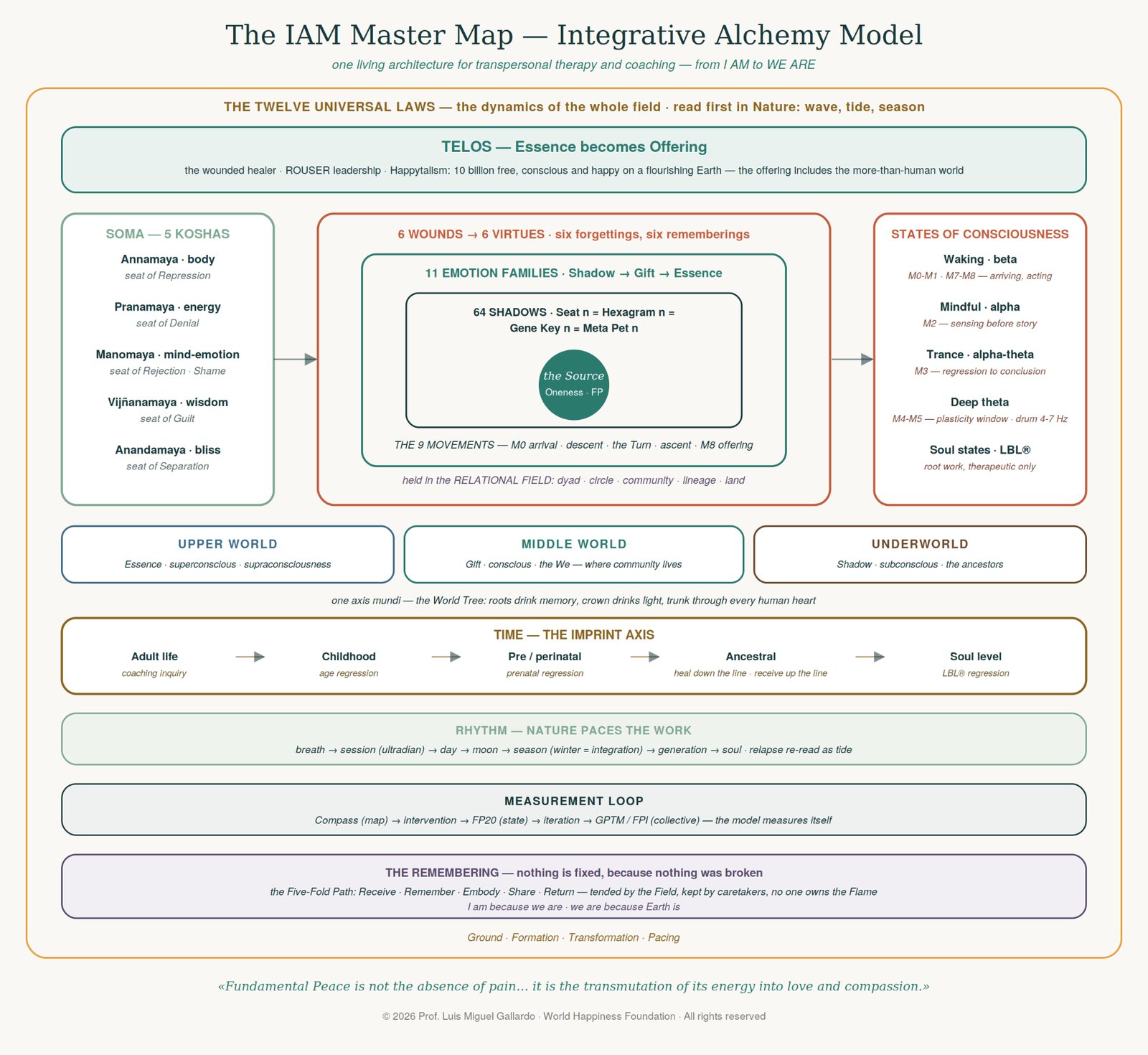
The S-G-E cycle is the machinery of the model. Each developmental transition asks three things of us:
- Shadow — the unconscious pattern, defence, projection or reactive behaviour operating below awareness. Every defence originally served a protective function.
- Gift — the adaptive capacity hidden inside the pattern. Integrate the defence consciously and its underlying strength becomes a resource.
- Essence — the fundamental quality of being that emerges when gifts are fully embodied.
A concrete example: anger (shadow) becomes assertiveness and the capacity to set boundaries (gift), which becomes authentic power and sovereignty (essence). The anger was never the enemy. It was the door, badly labelled.
Five stages, held as a map and not a ladder
ITM articulates five developmental stages, each including and transcending the one before it. All stages have value; nobody is worth more for standing further along.
- Unconscious Reactivity — automatic defences and extensive projection; the person experiences themselves as a victim of circumstance. Work: psychoeducation, grounding, body scans, structured journalling.
- Conscious Recognition — the capacity to observe one’s own patterns; metacognitive awareness emerges. This is where genuine psychological development begins. Work: Vipassanā, reflective dialogue, shadow journalling, Gestalt exercises.
- Active Integration — deliberate engagement with shadow through the S-G-E process, with real tolerance for discomfort. Work: parts work, active imagination, dreamwork, breathwork.
- Embodied Wisdom — integrated insight becomes stable trait across contexts; shadow becomes information rather than threat. Work: somatic practice, retreats, integral daily practice, relational and group work.
- Transcendent Integration — stable nondual awareness; shadow and light, self and other, form and emptiness held together. Work: nondual meditation, contemplative retreat, service and legacy.
Seven mechanisms that actually do the work
Where earlier frameworks described the territory, ITM specifies the mechanisms: recognition, witnessing, intention discovery, symbolic integration, embodied practice, relational mirroring and meaning-making. Each has its own techniques and its own moment. Recognition and witnessing come first and build metacognitive capacity; intention discovery and symbolic integration go deeper once patterns can be seen; relational mirroring and meaning-making consolidate what has changed.
The sequencing matters more than the inventory. Graduated complexity — foundations before depth — is what keeps depth work safe.
Why this prevents spiritual bypassing
Because shadow integration is embedded in every stage transition, contemplative practice cannot become a route around difficult material. Unexamined psychology has to be met before a stage consolidates. That is also why ITM names its contraindications out loud: active psychosis or severe dissociation, severe unprocessed trauma without stabilisation, ruptures in the working alliance, spiritual emergency, significant dysregulation without coping resources, acute suicidality, and practitioner burnout. Establish safety first, always.
How we teach it
In the Transpersonal Coaching Program, ITM is not theory to admire — it is the structure of how you assess, contract, plan and hold a journey. Level 1 builds recognition and witnessing, so you learn to see patterns in yourself before naming them in anyone else. The shadow weeks run the full S-G-E cycle, with the Wound-to-Essence work and the Compass as practice instruments. Each mechanism arrives with the practices that activate it. Supervision and your own ongoing shadow work are treated as professional requirements, not extras.
Two instruments accompany the model for those who want to measure: the ITM Stage Assessment (ITMSA, 50 items) and the ITM Mechanism Inventory (ITMMI, 70 items across seven subscales).
Where to go next
- Read the full model: The Integrative Transformation Model
- See the program and join the next cohort: Transpersonal Coaching Program
- Wider context: the full guide to transpersonal coaching
A glimpse is a gift. A stage is a life. The work between them is shadow work — and it can be taught.
Gallardo, L. M. (2026). The Integrative Transformation Model: Bridging Transpersonal States and Developmental Stages Through Shadow Integration.
…
Free reflective assessment
Where are you on the path from states to stages?
Take the Transformation Profile — 120 statements, about 40 minutes — and receive your ITM stage and mechanism report, privately.
Field notes to your inbox
Stay connected to the shift.
Monthly essays from the Observatory, invitations to Fests and Academy cohorts. Written from abundance — never urgency.