Core model · Transpersonal Coaching Program
How temporary states become permanent stages.
The Integrative Transformation Model (ITM) places shadow integration at the centre of transpersonal development: five developmental stages, seven transformation mechanisms, and the Shadow–Gift–Essence cycle that turns a passing glimpse into a lasting capacity.
Prof. Luis Miguel Gallardo — World Happiness Foundation & Shoolini University, Yogananda School of Spirituality and Happiness
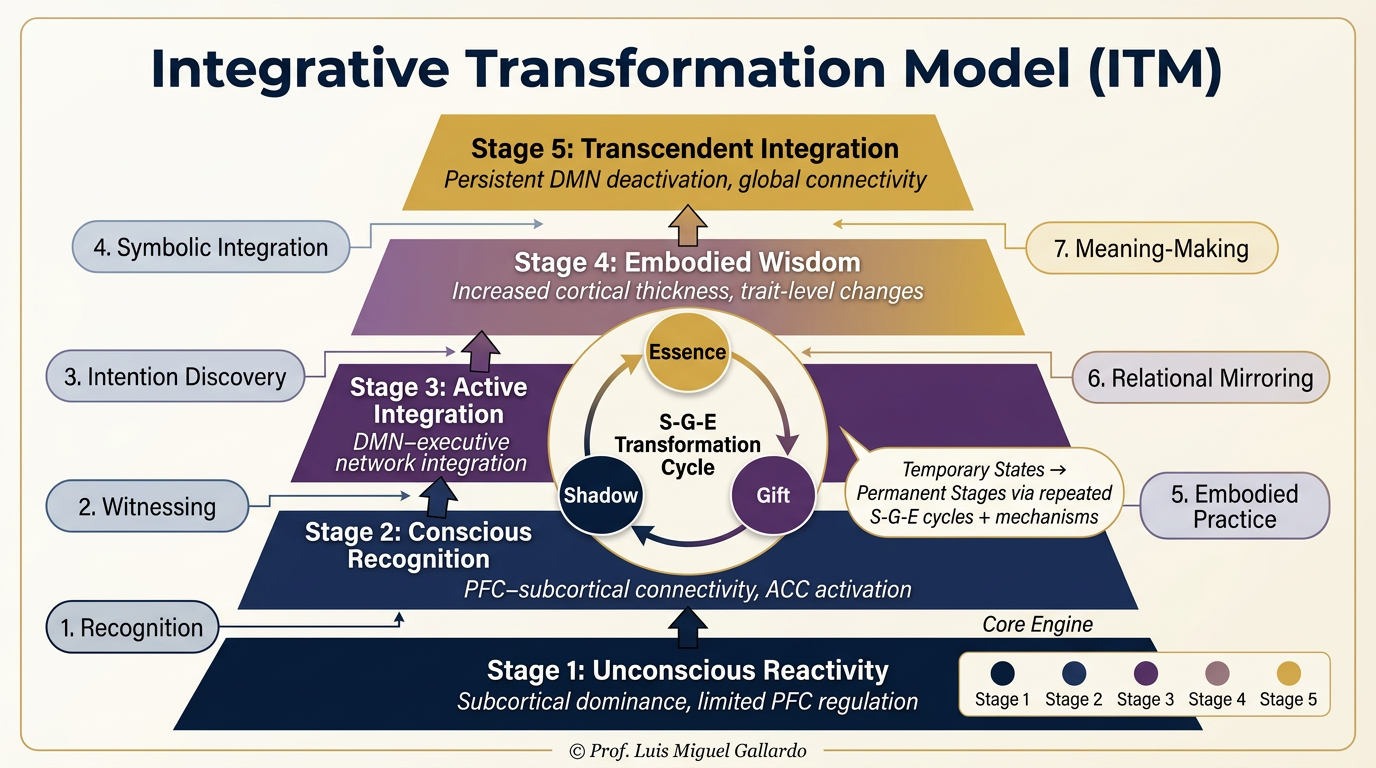
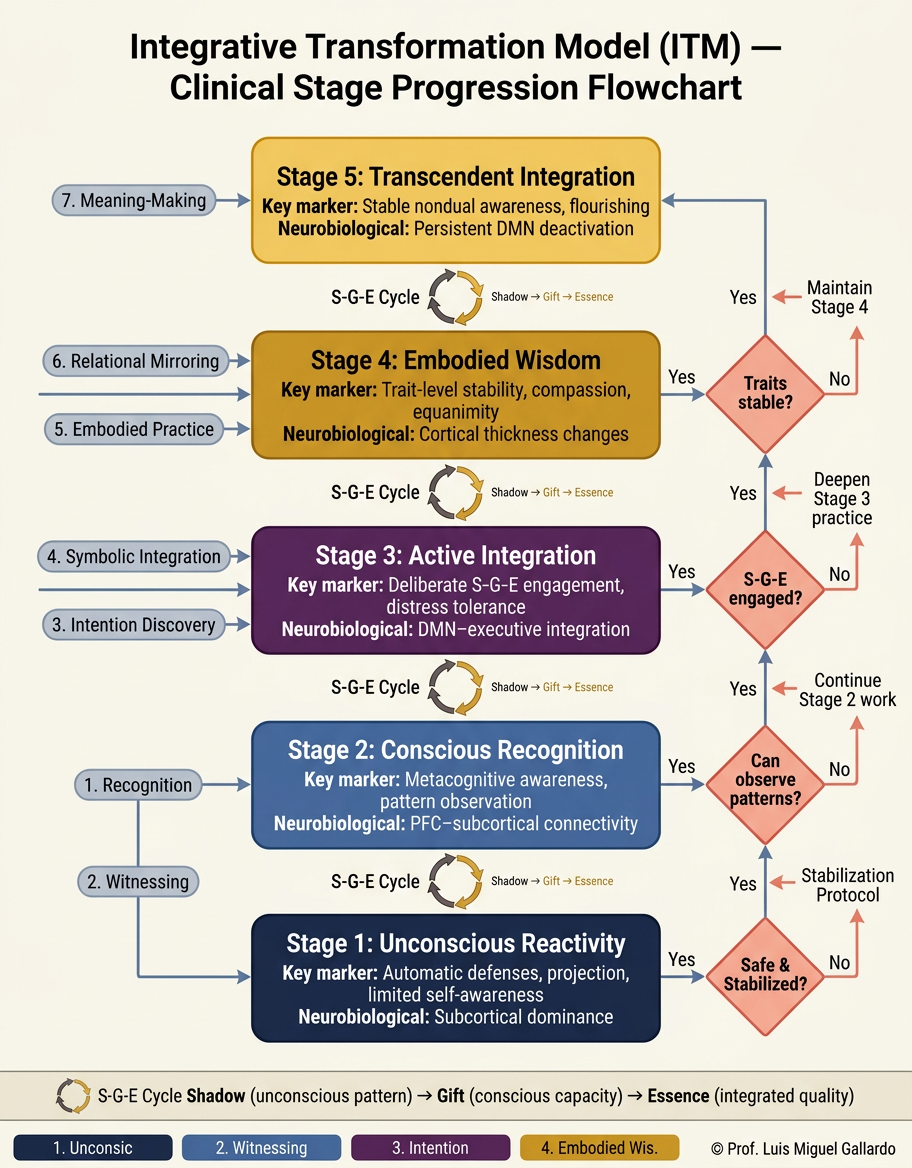
Integrative Transformation Model diagram showing the path from temporary states to lasting developmental stages
The state-to-stage problem
A glimpse is not a stage.
Transpersonal psychology has described self-transcendent experiences in rich detail and mapped developmental stages with care. What it has not settled is the bridge between them: how a temporary state of consciousness becomes a permanent structure of being.
ITM answers that question by naming shadow integration as the pathway. Conscious engagement with unconscious material is what gives a transpersonal state something to become. Repeated cycles of that work — not the intensity of any single experience — consolidate a new stage.
For coaches, this is the difference between a client who has a beautiful session and a client whose life changes.
Shadow integration is the pathway through which transpersonal capacities emerge. Rather than bypassing psychological difficulty in pursuit of transcendent states, we work directly with shadow material, trusting that gifts and essence emerge through the integration process.
The core engine
Shadow → Gift → Essence.
The S-G-E cycle is the engine of the model. Every developmental transition involves recognising shadow material, discovering the gift it conceals, and revealing the essence beneath. Repeated cycles convert states into stages.
Shadow
Unconscious patterns, defences, projections and reactive behaviour operating below awareness. Every defence originally served a protective function.
Gift
The adaptive capacity hidden inside the pattern. When a defence is consciously integrated, its underlying strength becomes available as a resource.
Essence
The fundamental quality of being that emerges when gifts are fully embodied — the deepest dimension of each psychological pattern.
Example: anger (shadow) → assertiveness and boundary-setting (gift) → authentic power and sovereignty (essence).
Five developmental stages
From unconscious reactivity to transcendent integration.
Each stage includes and transcends the one before it. All stages have value: the model is a map, not a hierarchy, and nobody is worth more for standing further along it.
- 01
Unconscious Reactivity
- Phenomenology
- Automatic defensive patterns and extensive projection of shadow material; the person experiences themselves as a victim of circumstance.
- Key practices
- Psychoeducation, MBSR, grounding, body scans, structured journalling.
- Primary mechanisms
- Recognition · initial witnessing
- Neurobiological correlates
- Subcortical dominance · limited PFC regulation
- 02
Conscious Recognition
- Phenomenology
- Capacity to observe one's own patterns; metacognitive awareness emerges. This is where genuine psychological development begins.
- Key practices
- Vipassanā meditation, reflective dialogue, shadow journalling, Gestalt exercises.
- Primary mechanisms
- Recognition · witnessing (strengthening)
- Neurobiological correlates
- PFC–subcortical connectivity · ACC activation
- 03
Active Integration
- Phenomenology
- Deliberate engagement with shadow material through the S-G-E process; sustained commitment to inner work and tolerance for discomfort.
- Key practices
- Parts work (IFS), active imagination, dreamwork, breathwork, Immunity to Change.
- Primary mechanisms
- All seven mechanisms actively engaged
- Neurobiological correlates
- DMN–executive network integration
- 04
Embodied Wisdom
- Phenomenology
- Integrated insight becomes stable trait across contexts; consistent access to compassion and equanimity, and shadow becomes information for growth.
- Key practices
- Somatic experiencing, advanced retreats, integral daily practice, relational and group work.
- Primary mechanisms
- Embodied practice · relational mirroring · meaning-making
- Neurobiological correlates
- Increased cortical thickness · trait-level change
- 05
Transcendent Integration
- Phenomenology
- Stable nondual awareness; integration of shadow and light, self and other, form and emptiness; recognition of fundamental interconnection.
- Key practices
- Nondual meditation (Dzogchen, Advaita), contemplative retreat, service and legacy work.
- Primary mechanisms
- Meaning-making · ongoing integration maintenance
- Neurobiological correlates
- Persistent DMN deactivation · global connectivity
Seven transformation mechanisms
What actually does the work.
ITM specifies seven mechanisms that mediate the move from temporary state to permanent stage. Build the foundational mechanisms before engaging the deeper ones — graduated complexity, always.
| Mechanism | Technique | When to activate |
|---|---|---|
| 1. Recognition | Mindfulness practice · interpretation · interpersonal feedback | Stages 1–2: the foundation for all other work; activate first |
| 2. Witnessing | Vipassanā meditation · self-observation protocols · body awareness | Stages 1–2: build metacognitive capacity before deeper work |
| 3. Intention Discovery | Parts work (IFS) · compassion-focused work · protective-function inquiry | Stages 2–3: once patterns are recognised and observed |
| 4. Symbolic Integration | Active imagination · dreamwork and dream journalling · expressive arts | Stages 2–4: engage the archetypal dimension of shadow |
| 5. Embodied Practice | Breathwork (prāṇāyāma) · yoga and somatic work · body-based trauma work | Stages 2–4: ground cognitive insight in the body |
| 6. Relational Mirroring | The coaching relationship · group process · projection analysis | Stages 3–4: use interpersonal dynamics for self-discovery |
| 7. Meaning-Making | Narrative work · journalling and life review · legacy and purpose work | Stages 3–5: consolidate transformation through narrative |
Inside the training
ITM is the spine of the Transpersonal Coaching Program.
The World Happiness Academy teaches ITM as the working model of the Transpersonal Coaching Program — not as theory to admire, but as the structure of how you assess, plan and hold a coaching journey.
- Level 1 builds recognition and witnessing: you learn to see patterns in yourself before you name them in anyone else.
- Shadow weeks run the full S-G-E cycle, with the Wound-to-Essence work and the Compass as practice instruments.
- Each mechanism arrives with the practices that activate it, so your toolkit grows in the order clients can actually receive.
- Stage-appropriate contracting: you learn to match intervention to stage, and to stabilise before you deepen.
- Supervision and your own ongoing shadow work are treated as professional requirements, not extras.
Safety and ethics
Depth without harm.
Deep shadow work is not always the right next step. ITM names its contraindications explicitly — establish safety first, always.
- Active psychosis or severe dissociative symptoms.
- Severe unprocessed trauma without adequate stabilisation.
- Ruptures in the working alliance — repair the relationship before going deeper.
- Active spiritual crisis or spiritual emergency.
- Significant emotional dysregulation without coping resources.
- Existential crisis or acute suicidality.
- Practitioner burnout — keep your own shadow work current.
Preventing spiritual bypassing
Because shadow integration is embedded in every stage transition, contemplative practice cannot become a way around difficult material. Challenge spiritual language used to avoid emotional engagement, and watch for claims of advancement unaccompanied by shadow work.
Source and instruments
Where the model comes from.
ITM synthesises Jungian depth psychology, contemplative neuroscience and developmental stage theory. It proposes two measurement instruments: the ITM Stage Assessment (ITMSA, 50 items) and the ITM Mechanism Inventory (ITMMI, 70 items across seven subscales).
Gallardo, L. M. (2026). The Integrative Transformation Model: Bridging Transpersonal States and Developmental Stages Through Shadow Integration.
Instruments, scoring guidance and psychometric documentation are available on request from the Foundation.
Take the private ITM assessment120 statements · approximately 35–45 minutes · sign-in required
ORCID 0009-0005-3222-6092Free reflective assessment
Where are you on the path from states to stages?
Take the Transformation Profile — 120 statements, about 40 minutes — and receive your ITM stage and mechanism report, privately.