Essays
The Moon Beneath the Water: night diving, rescue and the alchemy of depth
A first-person essay from Bali — a full-moon night dive, rescue training, and the seven practices the ocean teaches about calm, care and transpersonal leadership.
July 29, 2026·Luis Miguel Gallardo·8 min read
AI insights
To my lovable life buddy Magui.
Night diving, rescue and the alchemy of depth — notes from Bali
BALI · PURNAMA · JULY 2026
Descent
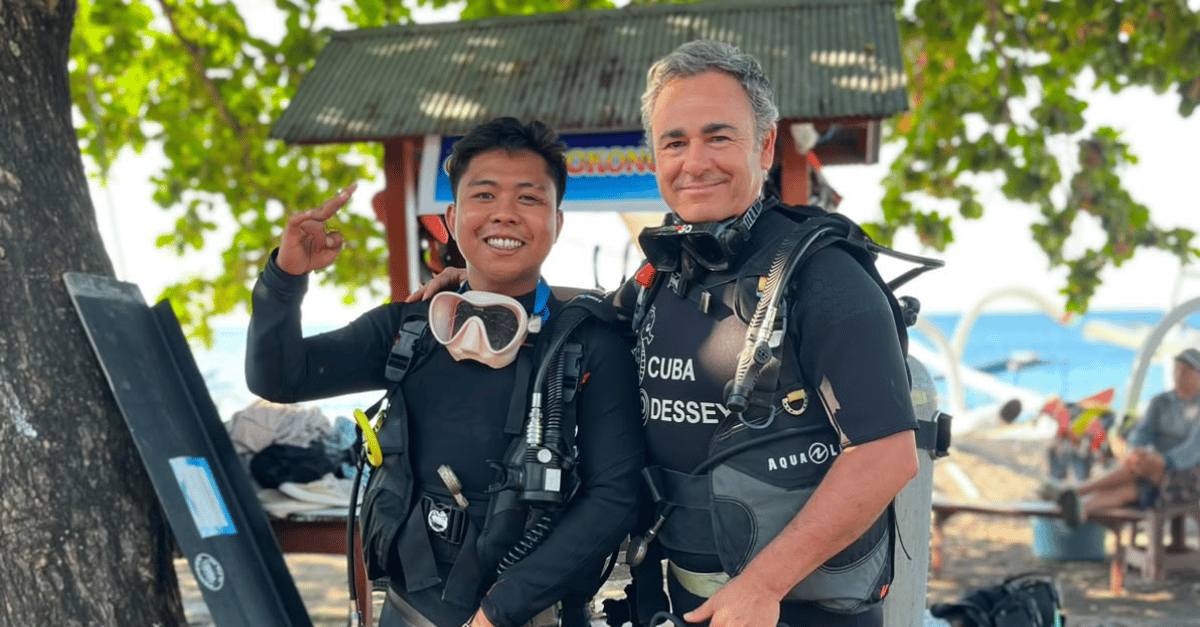
On the night of Purnama — the full moon that Bali honours with water, incense and flowers — we stepped off the edge of the boat into black water. A giant stride, one hand holding mask and regulator, a torch in the other, and the sea received us the way the sea receives everything: without ceremony, and completely.
The first thing that changes at night is sound. The ocean becomes a listening room. You hear your own breath — the long draw of air, the silver rush of bubbles — and you remember the first rule every diver ever learns: never hold your breath. Keep breathing, always. Underwater this is not a wellness slogan; it is physiology, it is law, it is life. The lungs must remain open to the exchange. So must we.
Our torch beams crossed in the dark like slow lighthouses. Above us the surface rocked with a light chop, and the moon broke and reassembled itself on the ceiling of the sea — a trembling silver coin. At one point we covered our lights, waved a hand through the black, and the water answered with sparks: plankton igniting like a private sky. Stars above the surface, stars below it. As above, so below.
The calm beneath
Then we descended past ten metres, and everything went quiet.
This is the ocean's first teaching, and in years of diving it has never stopped being true: the turbulence lives at the surface. Wind, chop, spray, noise — all of it belongs to the thin border between worlds. Drop a few metres and you enter a vast, patient calm. The storm is real, but it is not the whole story. It is not even most of the story.
Consciousness is built the same way. Our agitation is superficial in the precise sense of the word: it belongs to the surface. Beneath the mind's weather there is a depth that has never once been disturbed, and the practice — in meditation as in diving — is simply learning to descend to it on purpose.
And yet the depth is not motionless. There are currents down there: broad, silent forces that never announce themselves. In Bali they can take you mid-breath, like a decision made on your behalf. Here the ocean gives its second teaching: you do not fight a current. Fighting it burns your air, your muscles and your judgement. Instead you read it. You align your body, refine your profile, stay beside your buddy — and you let it carry you. What could have been a struggle becomes flight. Divers call it drift diving. I have come to call it the physics of surrender with awareness: not passivity, not control, but a third thing that only exists in relationship with the force itself.
I have written elsewhere that "Fundamental Peace is not the absence of pain; it is the transmutation of its energy into love and compassion." Under the surface I would say it like this: peace is not still water. Peace is right relationship with the current.
An ancient teacher
She rose from behind a coral formation with no more urgency than the moon crossing the sky: a sea turtle, old enough to be unimpressed by us. We hung in the water beside her, torches dimmed out of respect, and for a few minutes she taught the masterclass no certification can give: perfect buoyancy without visible effort, no hurry, no argument with the water. She was not managing the ocean. She was of it.
The Balinese say the world rests on Bedawang Nala, the cosmic turtle, the great serpents coiled around him holding everything steady. I understand that image better underwater than I ever did on land. Some beings carry the world by doing nothing more than being — fully, calmly — what they are. In my work I call that stage essence embodiment: the point where transformation stops being effortful and starts looking like grace. The turtle has no name for it. She simply swims that way.
Stop. Breathe. Think. Act.
These weeks in Bali I have been deepening into rescue training, and rescue begins with an uncomfortable truth: underwater, the equipment rarely fails first. The mind does. Panic is the only real emergency; everything else is a task.
That is why every diver on Earth is taught the same four words for the moment something goes wrong: Stop. Breathe. Think. Act. Read them slowly and you will recognise them, because they are the smallest complete unit of emotional alchemy I know.
Stop is the interruption of unconscious reactivity — the split second in which you refuse to let fear pilot the body. In shadow work we call this naming the shadow: I see you, panic. The controls are not yours.
Breathe is the somatic anchor. One slow exhalation tells the nervous system the ancient news it is waiting for: we are alive, we have air, there is time. The breath is the one instrument that plays the body and the mind at once.
Think is the discovery that the gift was already there. Your training holds the response; fear was simply standing in front of it. Anxiety, crossed with awareness, becomes what it always wanted to become — attention first, then courage.
Act is the micro-action: one clear thing, done calmly, and then the next. Not the whole rescue at once. One thing.
Shadow, anchor, gift, action. Fear transmuted into presence. The whole protocol fits on a dive slate, and it is the same protocol I teach leaders on land — because a boardroom in crisis and a flooded mask at eighteen metres are, to the nervous system, close cousins.
Never dive alone
Diving has one social law above all others: you do not dive alone. Before every descent, buddies check each other piece by piece — air open, releases located, regulators breathing, weights secure. It looks like procedure. It is actually a liturgy: trust, built by hand, before the water. When the two of you finally meet eyes and exchange the OK sign, something has been agreed that words would only weaken: down there, your breath and mine are one system.
I have long held that Separation is the deepest wound we carry, and that its healing virtue is Care. The buddy system is Care made procedure. And rescue training deepens the vow: you stop diving only for your own wonder and become answerable for another person's breathing. It is the passage from egocentric to worldcentric consciousness, performed in five metres of water.
Rescue also teaches the paradox that every caregiver, parent and leader eventually meets: secure yourself first. A rescuer who becomes a second victim rescues no one; you cannot share air you do not have. Self-compassion is not indulgence — it is load-bearing structure. And when you approach a diver in panic you learn the final law: calm is contagious, and so is panic. The rescuer's first gift is a regulated nervous system. So is the leader's. Very often, the most transpersonal act available to us is simply to be the calmest breath in the water.
The school of the sea: seven practices
Everything I teach about transpersonal leadership, the ocean teaches faster. Here is the curriculum, exactly as it was given to me.
1 · Plan the dive, dive the plan. Intention is set on the surface, together, while heads are clear — depth, time, signals, the pressure at which we turn back. In life: make your agreements before you are twenty metres deep inside the situation.
2 · Check your buddy. Care is not a feeling; it is a checklist performed on another person's equipment. Trust is built before the descent, never during the crisis.
3 · Equalize early and often. Divers relieve the pressure in their ears before it hurts — small adjustments, constantly, all the way down. Attend to the pressures in your body, your team and your relationships the same way: early, gently, often. Pain means you waited too long.
4 · Find neutral buoyancy. Neither sinking nor floating: held between forces, adjusting with nothing but breath. This is the leader's trim — rooted enough not to be tossed, light enough to move. Effortless is a skill.
5 · Never hold your breath. The one absolute rule. Keep the exchange alive — air, truth, emotion, giving and receiving. What is held under pressure ruptures; what flows, adapts.
6 · Stop. Breathe. Think. Act. Carry the alchemical interrupt everywhere. It works in black water and in boardrooms, in conflict and in grief.
7 · Ascend slowly and make your safety stop. Under pressure, nitrogen dissolves silently into the body; rise too fast and it becomes bubbles that can injure you. Insight behaves identically. After every deep experience — a retreat, a ceremony, a crisis, a triumph — hang a while in the shallows and let what you absorbed integrate safely. Transformation, like nitrogen, must be given time to leave solution.
Surfacing
We surfaced into moonlight and floated a while before climbing the ladder, saying nothing, the way you fall silent when something has been understood rather than merely seen. Later came the last ritual: the logbook. Depth, time, air consumed, what we saw, what we felt. Divers call it logging the dive. I call it what reflection has always been — the moment experience is converted into wisdom, so that the next descent begins deeper than the last.
The moon was above us and beneath us that night, whole in the sky and trembling on the water, and the old alchemical sentence kept rising with my bubbles: as above, so below. The depth does not stay behind when you climb out. It comes with you — a calm you now know is always there, a few metres beneath any storm, reachable by breath.
We dream, at the World Happiness Foundation, of ten billion human beings free, conscious and happy by 2050 — on a blue planet where most people still believe the surface chop is all there is. Every diver knows otherwise. Perhaps that is the quiet service of this practice: to keep returning from below with the same report. There is calm under the turbulence. There are currents, and they can be ridden. No one should go down alone. And if something happens — stop, breathe, think, act.
Take the descent further
The protocols in this essay — Stop. Breathe. Think. Act., neutral buoyancy, the buddy check — are the same ones we teach on land at the World Happiness Academy.
- TransPersonal Coaching Program — train to hold depth for others: shadow, anchor, gift, action.
- Chief Well-Being Officer — leadership that regulates the nervous system of a whole organisation.
- Coaching, Hypnotherapy & NLP pathways — the practitioner routes into this work.
- Born from the Spring — the companion essay from Ubud.
Fund the mission and help us reach ten billion free, conscious and happy people by 2050.
The rest is beauty.
…
Field notes to your inbox
Stay connected to the shift.
Monthly essays from the Observatory, invitations to Fests and Academy cohorts. Written from abundance — never urgency.