Yoga Vāsiṣṭha
Sixty-Four Tales, One Map: The Vāsiṣṭha Atlas
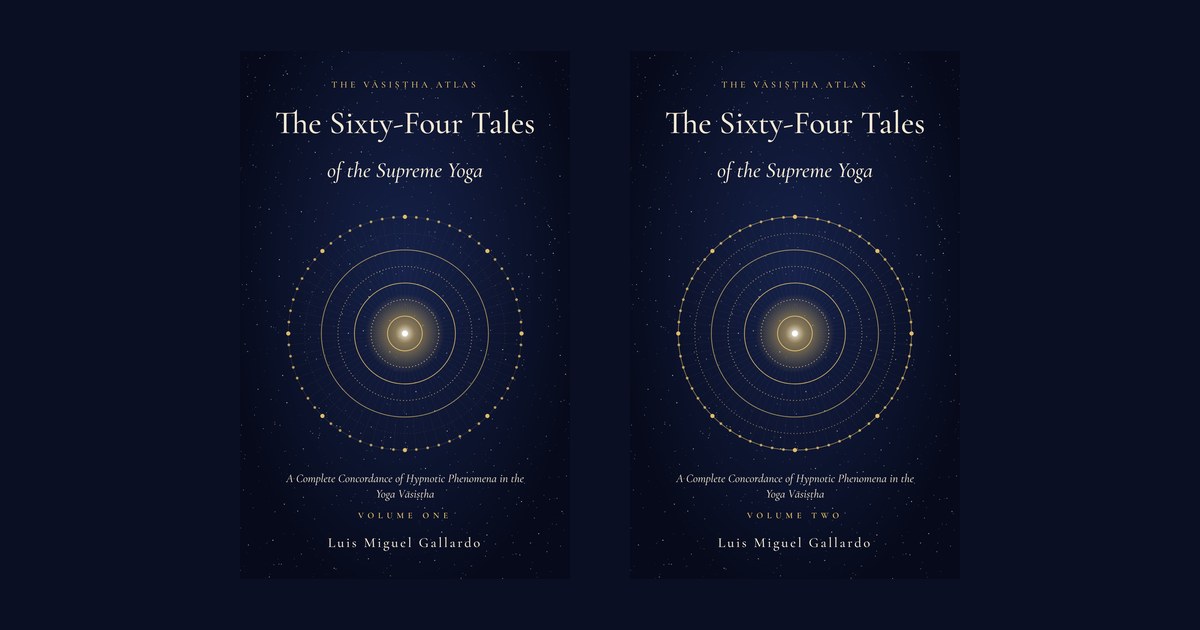
The Sixty-Four Tales of the Supreme Yoga is out in two volumes, and the Vāsiṣṭha Atlas places every tale of the Yoga Vāsiṣṭha in the work of healing: its trance, its wound and virtue, its stage of transformation, its measure of peace, its ally and its song.
October 29, 2026·Luis Miguel Gallardo·6 min read
AI insights
In the 1890s a Calcutta scholar translating the Yoga Vāsiṣṭha reached for an unexpected word. Queen Cūḍālā, wrote Vihārī Lāla Mitra, “had hypnotized her husband”. Today two things built on that word open to everyone: The Sixty-Four Tales of the Supreme Yoga, in two volumes, and the Vāsiṣṭha Atlas, the map that places every tale in the work of healing.
The oldest map of the healing trance
The Yoga Vāsiṣṭha is a dialogue of some thirty thousand verses in which the sage Vasiṣṭha answers a young prince’s despair with stories. Kings live whole lifetimes in a moment. A queen travels through worlds nested inside one another. A crow on the wish-fulfilling tree has watched the ages pass. Each story is a demonstration of the text’s single teaching: the mind makes the world it lives in, and the mind can remake it.
As a clinical hypnotherapist, I read those stories and kept recognising my own consulting room. There was induction and deepening, hallucination and time distortion, dissociation, regression, suggestion that outlasts the trance, and above all the return: the careful way the text brings each sleeper back to waking life. So I read every tale in full, in Mitra’s complete public-domain translation (1891–99), and wrote down only what the text says.
The result is a concordance of twenty-five hypnotic phenomena across 412 verified passages, each referenced by book, chapter and verse. It is set beside the seven stages of knowledge that the text itself describes, and beside Patañjali, the Buddhist absorptions, the Māṇḍūkya, yoga nidrā and the clinical scales of trance depth.
Sixty-four tales, one set of coordinates
The Vāsiṣṭha Atlas gives every tale the same coordinates, so that a story many centuries old can be read alongside the frameworks I use with clients today:
- The trance. Which phenomena the tale shows, and where it sits on the ladder of the seven stages.
- The wound and its virtue. From the Integrative Emotional Alchemy Framework, now accepted in Frontiers in Psychology, come six wounds, each healed by its virtue: Repression by Honesty, Denial by Ease, Shame by Humour, Rejection by Gentleness, Guilt by Forgiveness and Separation by Care. The Atlas shows which wound each tale heals.
- The stage of transformation. Where the tale serves the Integrative Transformation Model, published this month in the Integral Transpersonal Journal. It runs from Unconscious Reactivity, through Conscious Recognition, Gift Discovery (Active Integration) and Essence Embodiment (Embodied Wisdom), to Transcendent Integration.
- The measure of peace. Which of the four components of Fundamental Peace the tale trains, as the FP20 measures them: flexible attentional control without effortful suppression, emotional coherence across self-states, reduced self-referential rigidity and compassionate self-awareness.
- An ally. Each tale walks with one of the sixty-four Meta Pets, and Felicia keeps the Threshold.
- A voice. Every tale has a song, and every Meta Pet has a Sister of the Nine Paths. Through her, each tale belongs to a Path, a pilgrimage of seven or eight tales.
- Its echoes. Parallels in the Yoga Sūtra, the Gītā, the Vijñāna Bhairava and the other contemplative traditions.
The sixty-four tales and the Threshold make sixty-five in all. Each one has its own page, free to read.
Three ways in
Which tale do I need? The compass asks a few questions about what you are carrying and points you to the tales that work on that wound, with the virtue they cultivate.
The forty-day path. The path is a practice for one person over forty days. It climbs the ladder of understanding, not the ladder of depth: every sitting stays light, and every sitting ends with the full return. You complete the FP20 on day 1, day 20 and day 40, so the path is something you can observe, not only something you feel. In Mitra’s phrase, the aim is a kind of “hypnotism in waking”: asleep to what does not matter, and awake to what does.
The sixty-four allies. The allies pair each tale with its Meta Pet. The illustrated booklet is free to download in English and Castilian, for families, teachers and facilitators.
The book, in two volumes
The Sixty-Four Tales of the Supreme Yoga: A Complete Concordance of Hypnotic Phenomena in the Yoga Vāsiṣṭha gathers all of this into one work. Each tale has its own chapter: Mitra’s passage, the tale retold, its phenomena, its place on the ladder, its coordinates in the Atlas, what it teaches the therapy room, a guided practice written to be read aloud, its song and its notes.
- Volume One: The Foundations and Books I to V. The translator who called it hypnotism, the twenty-five phenomena, the ladder and the trance, the protocols hidden in the tales, and the map of the Atlas. Then the Threshold and tales 1 to 25: Rāma’s dejection, Līlā’s worlds within worlds, the ten sons of Indu, the king who lived a lifetime in a moment, and Uddālaka talking his own mind to rest.
- Volume Two: Book VI, the Concordance and the Atlas. The Book of Liberation, which holds the deepest trances and the most careful returns. Bhuśuṇḍa the crow; Queen Cūḍālā waking a husband no shout could rouse; Manu’s seven stages of knowledge; and the last tale, where Rāma, roused from his trance, is sent back to the duties of his kingdom. Then the evidence the other way round: the Concordance of every phenomenon, the Ladder of Ladders, the forty-day path and the full Atlas.
Both volumes are available now as ePub, US$11.11 each, directly from the book’s page. The paperback and Kindle editions will follow on Amazon. Each volume has its own index of the figures of the tales, the clinicians and authors cited, the concepts, the phenomena and the practices.
The research underneath
The Atlas is the practical face of a research programme, not a replacement for it. Its foundation is the paper The Supreme Yoga and the Science of Suggestion, published by the World Happiness Foundation Research Lab (DOI 10.68220/whf.2026.001). It is the first systematic integration of the Yoga Vāsiṣṭha and clinical hypnotherapy, and the source of the YVH Model.
The Mind That Makes the World is the book for the general reader, and the album Twelve Songs of the Supreme Yoga sets its teaching to music. The Sixty-Four Tales is the reference work beneath both: every claim traced to the verse that supports it. Fundamental Peace, its definition and the FP20 are set out in full in Fundamental Peace: The Source Book.
We are now preparing a pilot study of the forty-day path, to be submitted for independent ethical review before anyone is enrolled. The tales make a strong claim about the mind. They deserve to be tested with the same care with which they were read.
A note on care
The practices in the book and on the path are for healthy adults. They are not a treatment and do not replace one. Each one stays in light or medium trance and ends with the full return. Each tale’s chapter also says what the therapy room has learned about its risks. If you live with a psychotic or dissociative condition, with trauma that returns as flashbacks, or with thoughts of ending your life, walk the tales with a qualified clinician, not alone.
One project, many doors
On the World Happiness Foundation’s site, the Yoga Vāsiṣṭha Project gathers the paper, the book and the album. On lmgallardo.org, the Atlas holds the tales, the phenomena, the ladder and the path. On ninetoone.org, each Sister and each seat now shows the tale of the Supreme Yoga that enacts her arc. On Meta Pets World, the same sixty-four allies speak to children and families.
It is one map, read from different doors.
Vasiṣṭha never tells Rāma to escape the world. He shows him how the mind makes it, and sends him back to it awake. That is still the best description I know of what a good trance does, and of what Fundamental Peace asks of us.
…
Field notes to your inbox
Stay connected to the shift.
Monthly essays from the Observatory, invitations to Fests and Academy cohorts. Written from abundance — never urgency.