World Happiness Press · 2026
The Mind That Makes the World
El Yoga Supremo, el trance que cura y el camino a la Paz Fundamental. Dieciocho capítulos que van de los relatos del Yoga Vāsiṣṭha a lo que un trance es de verdad, y de ahí a un camino que se practica.
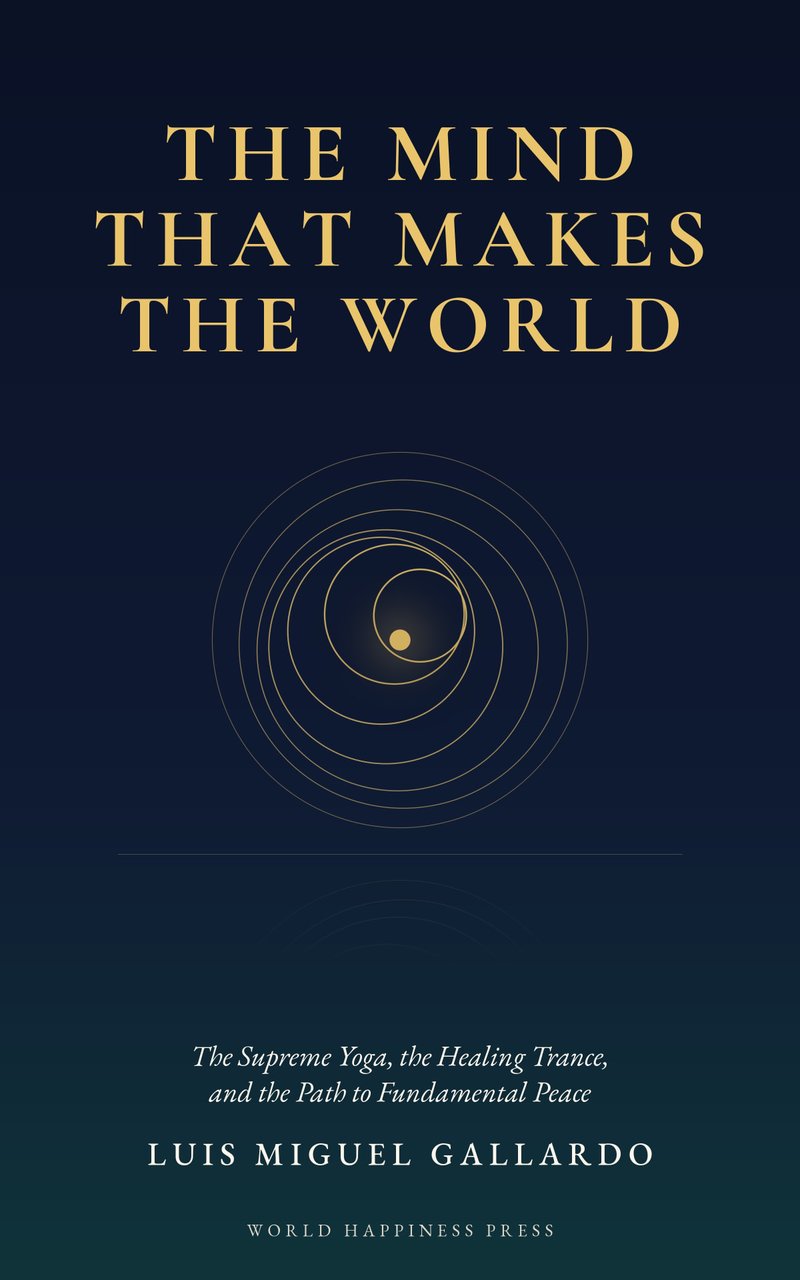
Luis Miguel Gallardo · 2026 · 18 capítulos · 34.340 palabras
Por qué este libro
Un texto antiguo dice que el mundo está hecho de mente. Una consulta moderna dice que la imaginación puede cambiar un cuerpo. Este libro los sienta en la misma sala —con cuidado, con los relatos intactos y con la ciencia dicha como ciencia— y te deja algo que practicar.
Los títulos de capítulo, los encabezados de sección y las primeras líneas que ves en esta página son el texto del autor, reproducido literalmente del libro en inglés.
Ediciones
Kindle, tapa blanda, tapa dura y audiolibro, en todas las tiendas de Amazon. El ePub y el PDF listo para imprenta se abren aquí para quienes han medido.
AmazonMedir y luego leer
El FP20 es una escala breve de autoinforme: veinte afirmaciones, cinco minutos, una fotografía de dónde descansa hoy tu paz. Leer y medir van juntos, así que el ePub se abre cuando tienes un resultado registrado.
El FP20 es una escala de autoinforme, no un instrumento clínico ni diagnóstico.
En palabras del autor
Por qué existe este libro, cómo está construido y cómo leerlo: el anuncio del fundador sobre su publicación.
Leer el anuncioLa investigación que lo sostiene
El Modelo Integrativo YVH con el que cierra el libro está desarrollado por completo en el primer artículo revisado de la Fundación, publicado en acceso abierto en el Journal of Happytalism and Fundamental Peace.
Leer el artículoSu compañero
Fundamental Peace: El Libro Fuente ofrece el constructo y la escala FP20 en los que este libro se apoya. Léelos juntos.
Abrir el Libro FuenteÍndice
Índice
Tres partes —los relatos, el trance, el camino— con prólogo, epílogo y cuatro apéndices. Abre cualquier capítulo para ver sus secciones y sus primeras líneas.
The Mind That Makes the World
445 palabras
Secciones
- A note before you begin
Así empieza
No part of this book may be reproduced in any form without written permission from the publisher, except for brief quotations in reviews or scholarly work.
Prologue — The Prince Who Could Not Rest
1269 palabras
Así empieza
What is this thing we call a life? The days go past like leaves off a tree, and every joy I reach for is already turning in my hand. I have a kingdom and I cannot want it. I have a body and it is a borrowed coat. Tell me, if you know it — is there anything that does not end? — Rāma to the court, rendered after the Sanskrit (Vairāgya Prakaraṇa)
Parte · THE STORIES
1. A Sage Speaks to a Prince
1951 palabras
Secciones
- Why stories
- The evening the room changed
- What the text asks of you
- A practice — Watching the room be made
Así empieza
Listen, Rāma, and I will tell you how this whole appearance came to be, what holds it up, and how it ends — not so that you believe me, but so that you look, and see it for yourself. Everything I say, you will test in your own mind, for that is the only place it can be true. — Vasiṣṭha’s promise, rendered after the Sanskrit (Mumukṣu-vyavahāra Prakaraṇa)
2. Līlā, or The Worlds Within
2178 palabras
Secciones
- The first world within
- The second world within
- The bridge
- What Līlā knew
- A practice — The two worlds
Así empieza
Do not weep, child. He is not gone. He is exactly where he was — in the space of his own mind, ruling a kingdom he has made from memory, fighting a war he has dreamed. Close your eyes and I will take you there. But understand this before we go: the world you are leaving is made in the same way. — Sarasvatī to Līlā, rendered after the Sanskrit (Utpatti Prakaraṇa)
3. Lavaṇa, or A Lifetime in an Hour
1728 palabras
Secciones
- The village
- The bridge
- A practice — The hour in a minute
Así empieza
He rode until the horse was gone and the road was gone and he was no one, hungry, in a desert of white stone. He married. He had children. He grew old. He watched the famine take them, one by one. He walked into the fire — and opened his eyes upon his throne, the court exactly as he’d left it, the magician bowing, and the peacock feather still in the air. — The tale of King Lavaṇa, rendered after the Sanskrit (Utpatt
4. Bhuśuṇḍa, or The Breath That Outlives the Gods
1718 palabras
Secciones
- The oldest induction
- The bridge
- Why the crow
- A practice — The crow’s breath
Así empieza
I have seen the ocean rise and drink the hills. I have seen the fire that ends an age, and the dark after it, and the first light of the next, and the same hills rising. I have watched gods be born and grow old and be forgotten. You ask how I have lasted. There is no secret. I watch the breath go out, and I watch it come in, and in the pause between, I rest in what does not move. — Bhuśuṇḍa to Vasiṣṭha, rendered afte
5. Cūḍālā, or The Queen Who Woke the King
2417 palabras
Secciones
- The king in the forest
- Kumbha
- The tests
- The bridge
- What the queen knew
- A practice — Writing your own Kumbha
Así empieza
He looked at her and did not see her. “You are radiant,” he said. “Some herb, some charm.” She did not argue. She had learned already that what is seen cannot be argued into being seen. She went back to her rooms and thought: He will not come to it by my door. Then I will find his. — The tale of Cūḍālā, rendered after the Sanskrit (Nirvāṇa Prakaraṇa)
6. The Seven Stairs
1792 palabras
Secciones
- How to use the map
- The bridge — and a warning
- A practice — Finding your stair
Así empieza
There are seven grounds of knowing, Rāma, and every mind that has ever woken has crossed them — the wish, the looking, the thinning, the arrival, the letting go, the world unseparated, and the seventh, which cannot be said, only lived, walking among the others as one who has come home and does not need to leave. — The seven bhūmikās, rendered after the Sanskrit (Utpatti Prakaraṇa)
Parte · THE TRANCE
7. The Priest from Goa
2173 palabras
Secciones
- Candolim
- Bengal
- Lahore
- The circle
- A practice — The Faria sentence
Así empieza
The power is not in me. It was never in the passes of the hand or the iron rod or the magnetic fluid nobody has seen. The power is in you — in your attention, in your expectation, in the shape of your own mind. I only ask you to close your eyes, and to sleep. — After Abbé Faria, Paris, 1813
8. What a Trance Is
1782 palabras
Secciones
- The three myths
- How it works
- What suggestion is not
- A practice — A first self-hypnosis, honestly small
Así empieza
Whatever the mind holds with conviction, that it becomes. Hold fear, and the world is a wilderness. Hold the self, and it is the self. This is the law, Rāma. It is not a punishment. It is the one door, and it opens both ways. — Vasiṣṭha on saṅkalpa, rendered after the Sanskrit (Utpatti Prakaraṇa)
9. The Body’s Assent
1874 palabras
Secciones
- Three things the brain does
- What the rhythms say — carefully
- Why this matters for you
- A practice — Noticing the body agree
Así empieza
As the mind grows thin, Rāma, the world grows light. What was a wall is a cloud; what was a cloud is air. The body, which carried the whole weight of the kingdom, sets it down, and does not know when it did. Do not force this. It is not forced. It is what a mind does when it stops holding on. — Vasiṣṭha on the thinning of mind, rendered after the Sanskrit (Upaśānti Prakaraṇa)
10. Twelve Doors, One Room
1431 palabras
Secciones
- The first door — Saṅkalpa · Suggestion
- The second door — Bhāvanā · Absorption
- The third door — Vāsanā · The old rivers
- The fourth door — Manas · The mind that makes
- The fifth door — Pauruṣa · Agency
- The sixth door — Upaśama · Settling
- The seventh door — Manonāśa · Reconsolidation
- The eighth door — Dṛṣṭa and Draṣṭṛ · The witness
- The ninth door — The seven stairs · Depth
- The tenth door — The sixty-four tales · Therapeutic metaphor
- The eleventh door — Cūḍālā’s staging · Utilisation and parts
- The twelfth door — Vairāgya · Readiness
- The room
- A practice — Choosing your door
Así empieza
Call it by any name — the mind, the self, the world, the way. Enter by any door — the breath, the story, the wish, the seeing. All the doors open into the same room, and in the room there is one lamp, and you are the one who lit it. — Rendered after the Sanskrit (Nirvāṇa Prakaraṇa)
11. The Cool Mind
1993 palabras
Secciones
- What Fundamental Peace is not
- What it is
- And measured — carefully
- The triad
- A practice — The mirror
Así empieza
If the mind is cool, the whole world is cool. If the mind is on fire, the whole world burns. The wise one carries a cool mind through the fire and the fire does not know it has been passed through. He acts. He rules. He grieves and laughs. And nothing that happens to him happens to what he is. — The jīvanmukta, rendered after the Sanskrit (Upaśānti Prakaraṇa)
Parte · THE PATH
12. The Wish
1402 palabras
Secciones
- The story — Rāma, again
- The reason
- The practice — The wish, spoken
- For practitioners
Así empieza
The first ground is the wish. Not the wish for things — that is the old mind — but the wish to know what is true, arising in one who has grown tired of the rest. Nourish it, Rāma. It is a small fire. Everything else is only wood. — On śubhecchā, rendered after the Sanskrit (Utpatti Prakaraṇa)
13. Settling
1327 palabras
Secciones
- The story — The crow
- The reason
- The practice — The settling script
- For practitioners
Así empieza
When the wind stops, the lake shows the sky. The sky was there all along. So with the mind, Rāma: it is not made peaceful. It is allowed to be what it already was when the wind of wanting was not blowing across it. — On upaśama, rendered after the Sanskrit (Upaśānti Prakaraṇa)
14. The Trained Imagination
1393 palabras
Secciones
- The story — Līlā, again
- The reason
- The practice — The garden that is yours
- For practitioners
Así empieza
The mind builds what it dwells on. Dwell on the wilderness and you will wake in one. Dwell on the self and the self will be your house. This is not a gift given to some, Rāma. It is a skill, like the archer’s, and it is trained the same way — by aiming. — On bhāvanā, rendered after the Sanskrit (Utpatti Prakaraṇa)
15. Old Rivers
1763 palabras
Secciones
- The story — Lavaṇa’s village, and the priest’s wish
- The reason
- The practice — The riverbank
- For practitioners
Así empieza
What you did long ago, Rāma, and what you wished, has soaked into you like scent into cloth. You do not smell it. You are it. And every world you enter, you enter perfumed — until one day you go back to the flower, and see it was only a flower, and small, and the scent lets go of the cloth. — On vāsanā, rendered after the Sanskrit (Sthiti Prakaraṇa)
16. The Queen’s Dialogues
1445 palabras
Secciones
- The story — the ascetic in the hut
- The reason
- The practice — The dialogue with Kumbha
- For practitioners
Así empieza
He fought the ascetic in himself for eighteen years and never won, because the ascetic was not his enemy. The ascetic was the part of him that had wanted, most of all, to be free — and had chosen the only door it knew. When he saw that, he stopped fighting, and the door opened by itself. — On Śikhidhvaja in the forest, rendered after the Sanskrit (Nirvāṇa Prakaraṇa)
17. The Witness
1171 palabras
Secciones
- The story — Gādhi
- The reason
- The practice — The seer’s seat
- For practitioners
Así empieza
The eye sees the world, Rāma, but who sees the eye? The mind knows the thought, but who knows the mind? Go back, and back, and back — and you will not find a thing at the end, for the one who sees is not a thing among things. It is the seeing. It was never seen. — On the seer and the seen, rendered after the Sanskrit (Upaśānti Prakaraṇa)
18. Living Free
1415 palabras
Secciones
- The story — the queen at her desk
- The reason
- The practice — Ruling the kingdom
- The forty days
- For practitioners
Así empieza
And she returned to the palace, and ruled, and the ministers noticed nothing, and the people noticed nothing, except that the kingdom went well, and that the queen laughed more than before, and that when the famine came, she was the last to be afraid and the first to open the granary. — On Cūḍālā’s return, rendered after the Sanskrit (Nirvāṇa Prakaraṇa)
Epilogue — The Circle Closes
495 palabras
Así empieza
I finished the first draft of this book in the days before a symposium in Delhi, in September 2026, where I was to present the scientific paper on which it rests — the first publication of a research lab my foundation had just opened, carrying the first permanent identifier we had ever issued, so that the work could be found, and quoted, and argued with, for as long as the record exists.
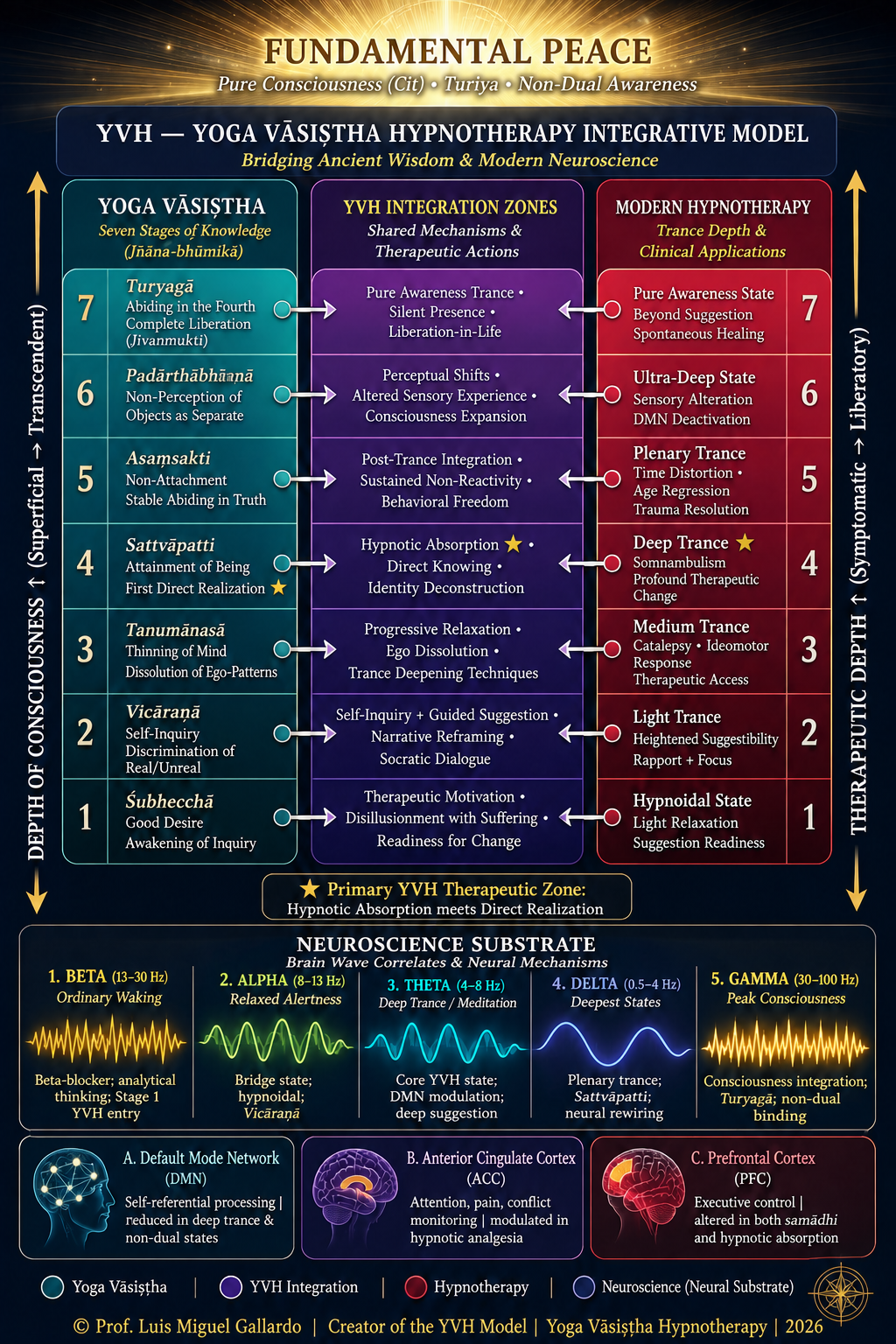
Appendix A — The YVH Integrative Model
403 palabras
Secciones
- How to read the figure in one page
Así empieza
The left column is the tradition’s staircase — the seven grounds of knowing from Chapter 6, rising from the wish at the bottom to abiding at the top. These are developmental: crossed over years, retained, cumulative.
Appendix B — The Twelve Doors and the Room
92 palabras
Así empieza
The Construct Concordance of the research paper, stated plainly. Each row is one door from Chapter 10 — the tradition’s word on the left, the clinic’s on the right — and the thirteenth row is the room they all open onto.
Appendix C — Where the Passages Come From
149 palabras
Así empieza
Every chapter of this book opens with a passage attributed to the Yoga Vāsiṣṭha. They are renderings: the sense of the Sanskrit set into this book’s own English, made to be read aloud. They were prepared with the two complete public-domain translations at hand — Vihari-Lala Mitra’s Yoga-Vāsishtha-Mahārāmāyana of Vālmīki (Calcutta, 1891–99) and K. Narayanaswami Aiyar’s Laghu Yoga Vāsiṣṭha (Madras, 1896) — and the read
Appendix D — Further Reading
534 palabras
Secciones
- The text
- The history
- The science
- This book’s own foundations
Así empieza
Swami Venkatesananda, The Concise Yoga Vāsiṣṭha (SUNY Press, 1984) and Vasiṣṭha’s Yoga (SUNY Press, 1993). Begin here. The Concise edition is the best single door into the text; the full edition is the one to live with.
La figura
La figura
Un modelo, dibujado una sola vez, que sostiene toda la arquitectura del libro.
Hablar con el libro
Pregunta lo que quieras: la respuesta sale solo de los pasajes del propio libro y nombra el capítulo del que viene. Nada se inventa.
El libro todavía se está preparando para responder. Vuelve en un momento.
Haz tu primera pregunta: el libro responde con sus propias palabras.
Un acompañante de lectura, no un terapeuta. Si atraviesas una crisis, contacta con los servicios de emergencia locales y con un profesional cualificado.
Tu ejemplar
El ePub y el PDF de interior listo para imprenta están abiertos a quienes han registrado un resultado FP20 o ITM.
Comprobando…
Edición en español
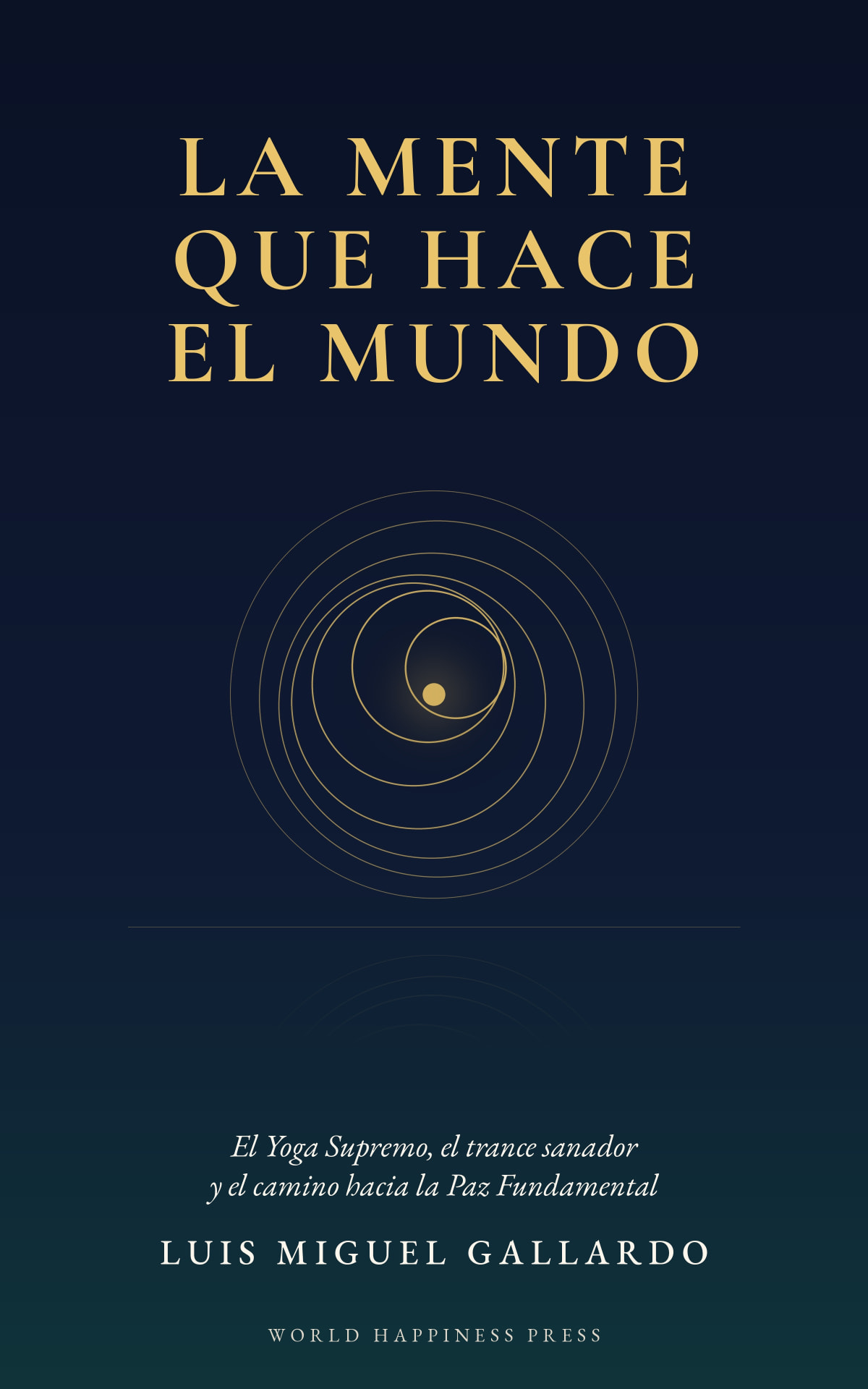
La mente que hace el mundo es la edición en español del autor: los mismos dieciocho capítulos, escritos en español y no traducidos. Quienes ya han medido pueden abrir arriba su ePub y su PDF listo para imprenta.
AmazonUna nota de cuidado
Las prácticas de este libro son contemplativas, no clínicas. No son un tratamiento para el trauma, la psicosis o una crisis aguda, y no sustituyen a un profesional cualificado.