A City of Happiness proposal — the heart of Central America
Antigua turned ruin into beauty. It already knows what the world is trying to learn.
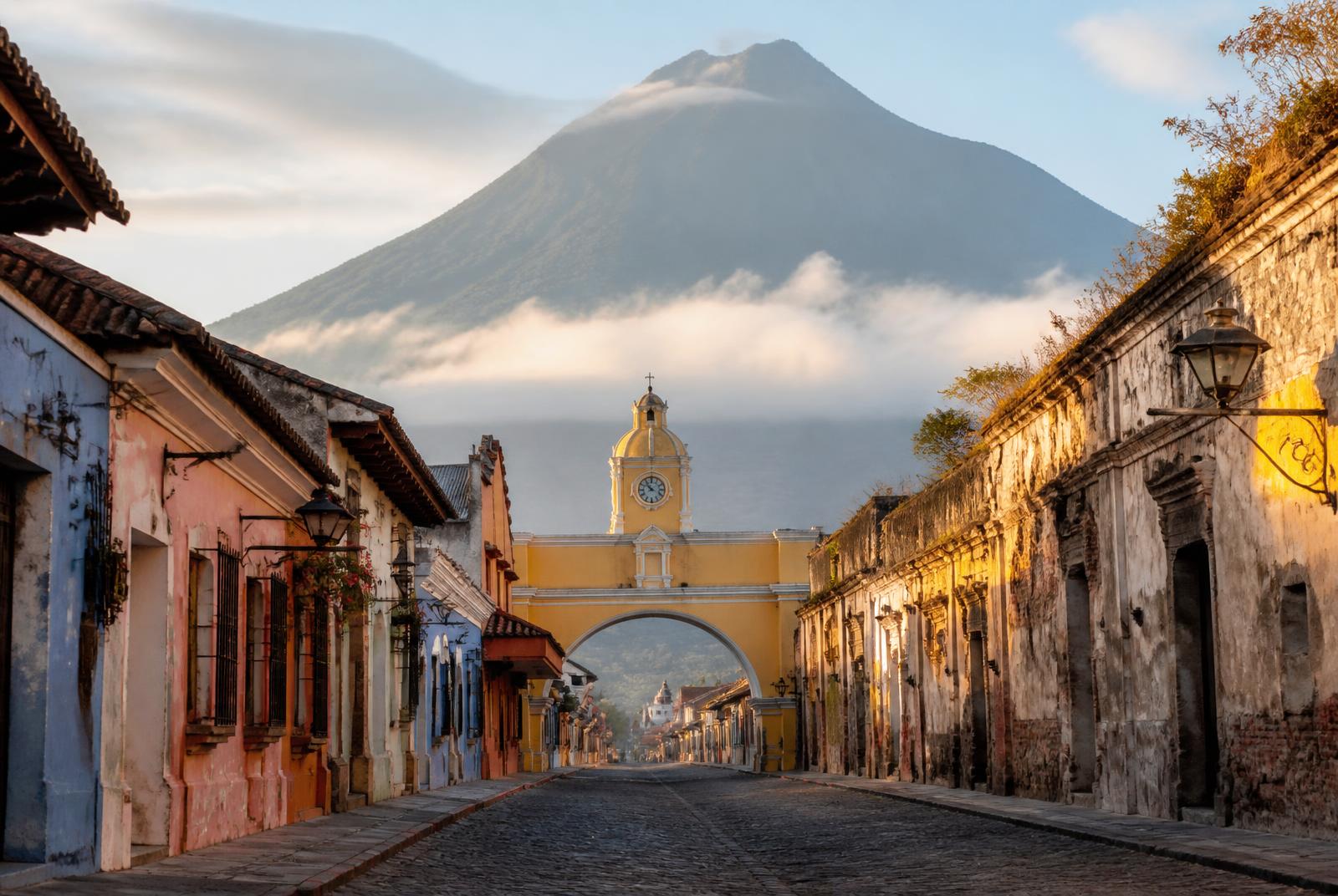
Founded in 1543 as Santiago de los Caballeros, capital of Spanish Central America until the Santa Marta earthquakes of 1773, a UNESCO World Heritage Site since 1979, in the Panchoy Valley at around 1,500 m among the volcanoes Agua, Acatenango, and the active Fuego.
This proposal does not come to import happiness. It comes to honor, measure, protect, and share what Antigua and Guatemala already teach the world — while healing real pain: economic, youth opportunity, migration, and disaster trauma.
An open proposal · Antigua Guatemala, Panchoy Valley
10 Billion Free, Conscious & Happy by 2050.
The ecosystem family
A city is where every ecosystem meets.
The World Happiness Foundation works through five ecosystems of happiness. In Antigua all five fit within a few blocks: schools, businesses, hospitals, and visitors share the same cobblestones.
Cities of Happiness
The municipality as the unit of flourishing: policy, measurement, belonging.
Schools of Happiness
Teachers and students supported before performance is asked of them.
Enterprises of Happiness
Coffee, craft, and hospitality as dignified, sustainable livelihoods.
Hospitals of Happiness
Care systems that also care for the people who deliver care.
Destinations of Happiness
A city that welcomes the world without exhausting the people who live in it.
The spectrum
From pain to flourishing.
Guatemala lives both ends of this line at once. Measuring the whole line is the only way not to mistake joy for the absence of pain.
Pain that goes unnamed becomes policy by default.
Flourishing that gets measured becomes policy by choice.
Guatemala's paradox
A World Happiness Report life evaluation of 6.29 (2024), above the world average of 5.56, and a culture consistently rich in daily positive emotions rooted in faith, family, and resilience — alongside more than half the population living in poverty and real pressures on youth opportunity and migration.
The map
The seven domains of the Global Pain & Trauma Map in Antigua.
The map neither romanticizes nor condemns: it names. These are the domains where Antigua and its region have a story to measure with care.
Economic
More than half the country's population lives in poverty: structural economic pain, not an anecdote.
Youth & opportunity
Real pressures on youth opportunity shape life plans before the age of twenty.
Migration
For many families, leaving is a decision made of love and pain at the same time.
Disaster trauma
The 2018 Volcán de Fuego eruption is recent collective trauma for the region, named with dignity and without spectacle.
Mental & emotional
Mental health and grief, measured without stigma.
Social & relational
Faith, family, and neighbourliness: here the social domain is above all an asset.
Spiritual & existential
Meaning, devotion, and belonging: Guatemala's most measurable strength.
Antigua is Shadow → Gift → Essence written in stone and sawdust: a capital destroyed that became a World Heritage jewel; alfombras made over hours and swept away in minutes.
“Fundamental Peace is not the absence of pain… it is the transmutation of its energy into love and compassion.”
Luis Miguel Gallardo
The crossmap
Shadow → Gift → Essence.
Each domain of pain carries a gift when it is faced, and an essence when the gift is lived. In Antigua, the city itself teaches it.
The framework
The Wheel of Happiness and Well-Being: nine spheres for Antigua.
The nine spheres let a World Heritage city plan its well-being without being reduced to tourism figures.
Body
Health, food, and rest in daily life.
Mind
Mental health, learning, and emotional literacy.
Spirit
Living devotion, without imposing any doctrine.
Relationships
Family and neighbourliness, including the bonds migration sustains.
Community
Cofradías, neighbourhoods, and local organizing as real fabric.
Work
Coffee, craft, and hospitality as dignified livelihoods.
Prosperity
Sufficient income and fair access to opportunity.
Nature
The Panchoy Valley, the volcanoes, and water as common goods.
Purpose
A city that knows why it protects what it protects.
Nine spheres, one municipal strategy.
The instrument
Measure the city from day one.
The baseline is not a promise — the instrument already exists. The Ecosystems of Happiness Diagnostic measures a city across 54 KPIs, the 7 domains of the Global Pain & Trauma Map, the 9 spheres of the Wheel of Happiness and Well-Being, the Shadow → Gift → Essence framework, and the Fundamental Peace Index. It is the same instrument behind the Pinecrest and Las Rozas profiles — and it is ready for Antigua.
Guided assessment · No data is uploaded — results live in your browser until shared.
The architecture
Seven layers for a city that already has a soul.
Antigua does not need another campaign. It needs layers that hold care beyond any single administration.
Leadership
A municipal owner and a technical team with a clear mandate.
Framework
The Wheel of Happiness and Well-Being as the shared language.
Listening
Participatory measurement in neighbourhoods, schools, and cofradías.
Programs
Interventions on youth, mental health, and dignified livelihoods.
Convening
Public moments that celebrate what the city already teaches.
Measurement
Baseline and annual re-measurement with the same instrument.
Network
Learning exchanged with the other Cities of Happiness.
The five pillars
Where the work lands.
Five pillars so the proposal becomes administration, not rhetoric.
Leadership
Well-being as a governing responsibility, with an owner and a calendar.
Schools of Happiness
Teachers supported first; young people offered mentorship and horizon.
Enterprises of Happiness
Coffee, craft, and hospitality with well-being inside their leadership.
Community and belonging
Cofradías, neighbourhoods, and organizations recognized as a care network.
Observatory
Public measurement returned to residents in plain language.
Why Antigua
Six reasons that already exist.
UNESCO World Heritage (1979)
Antigua was declared a UNESCO World Heritage Site in 1979: a city the world already decided to protect.
Holy Week, Intangible Heritage (2022)
Guatemala's Holy Week — with Antigua's alfombras at its heart — was inscribed by UNESCO as Intangible Cultural Heritage of Humanity in 2022.
The happiness paradox
A World Happiness Report life evaluation of 6.29 (2024), above the world average of 5.56, with a culture rich in daily positive emotions.
Resilience among volcanoes
A city living in the Panchoy Valley among Agua, Acatenango, and the active Fuego, which has rebuilt its life more than once.
Living Maya and colonial heritage
Not a museum: an inhabited inheritance — in language, textile, food, and devotion.
Coffee and craft as dignified work
An economy of hands and time, able to grow without wearing out its people.
Cities of Happiness network
No city moves alone.
Cities of Happiness share a framework, a measurement instrument, and their learning. Five cities hold the network today — designated first.
Antigua, Guatemala
Proposed — heart of Central America: a World Heritage city that already teaches happiness.
This cityThe partnership
Co-designed, not quoted.
We do not propose a price: we propose partnership tiers defined with the municipality and its partners, according to the scope the city chooses.
Tier 1 — Baseline
- A municipal owner
- Access to existing public data
- Convening of neighbourhoods and schools
- Application of the Diagnostic
- Baseline report across the seven domains
- Public findings in plain language
Tier 2 — Activation
- A technical team and a calendar
- Schools and companies invited in
- Municipal spaces for gatherings
- Teacher and leadership training
- Program design by sphere
- Support from the Foundation's ecosystem
Tier 3 — City of Happiness
- A multi-year commitment with public reporting
- Integration into municipal planning
- Designation and membership of the network
- Annual re-measurement and city-to-city learning
- Presence in the Foundation's global agenda
Roadmap
Ignite, expand, flourish.
Ignite
- Baseline measurement with the Wheel of Happiness and Well-Being + GPTM
- A municipal owner and a public working agreement
- Listening in neighbourhoods, schools, and cofradías
Expand
- Programs on youth, mental health, and dignified livelihoods
- Schools and companies brought into the framework
- Public reporting of findings
Flourish
- Integration of the nine spheres into municipal planning
- Annual re-measurement and comparability with the network
- Antigua as Central America's Cities of Happiness reference
Impact simulator
How many people does Antigua reach?
Move the sliders to see reach in people reached. This is an illustrative estimate for conversation, not an official projection.
Illustrative figures: each slider multiplies an average number of people per school, business, or organization. These are not verified municipal data.
What success looks like
Signals Antigua can see.
A public baseline exists, with annual re-measurement using the same instrument.
Young people find training and mentorship without having to leave to get them.
Talking about mental health stops being taboo in schools and neighbourhoods.
Craft — coffee, textile, hospitality — sustains dignified income.
What Antigua teaches is shared with the network, rather than merely admired.
Next steps
Let's begin by listening.
- 1
Open the Diagnostic and build the baseline
Run the instrument for Antigua: 54 KPIs, seven domains, nine spheres. the Diagnostic
- 2
Bring the table together
Municipality, schools, businesses, cofradías, and organizations in one conversation.
- 3
Define the partnership tier
Co-design the scope with the Foundation, with nothing fixed in advance.
- 4
Publish the commitment
A public document with an owner, priority spheres, and a reporting rhythm.
Let's make Antigua a City of Happiness.
The World Happiness Foundation works with municipalities and their partners to measure, activate, and sustain well-being — at the city's own pace, with its own people.
Write to the FoundationSources: UNESCO; World Happiness Report (2024); World Happiness Foundation.