Essays
The Ocean Is a Meditation Hall: mindful diving and the path to Fundamental Peace
Every diver carries a secret they rarely name. Diving trains the four capacities of Fundamental Peace — breath, buoyancy, silence and care — one immersion at a time.
August 1, 2026·Luis Miguel Gallardo·5 min read
AI insights
Every diver carries a secret they rarely name. A few meters below the surface, the world simplifies itself: breath, water, light, attention. The narrating mind grows quiet. Time changes texture. Somewhere between the descent line and the sand, we stop performing and start witnessing. We call it diving. The contemplative traditions have another name for it: meditation.
At the World Happiness Foundation we speak of Fundamental Peace — not the absence of pain, but the transmutation of its energy into love and compassion. Peace, in this sense, is not a mood. It is a trainable capacity of the nervous system: flexible attention, emotional coherence, a softer grip on the self, and compassionate awareness. What fascinates me, as a contemplative scientist and as a diver, is that diving trains exactly these four capacities — quietly, reliably, one immersion at a time.
The breath you cannot ignore
On a cushion, attention returns to the breath by intention. Underwater, it returns by necessity. Each inhale lifts you slightly; each long exhale settles you. Breath stops being background and becomes your instrument of control, calm, and position. Slow, extended exhalation through a regulator is a form of paced breathing — precisely the pattern that stimulates the vagus nerve and shifts the body toward its parasympathetic “rest and restore” mode. Divers commonly report less stress and anxiety after a dive, and deeper sleep at night. This is not magic; it is respiratory physiology practiced for forty-five minutes in the most beautiful classroom on Earth.
A sanctuary of sensory simplicity
Modern attention is fragmented by design: notifications, feeds, artificial light, ambient noise. The ocean removes all of it. No phone. No conversation. Only water, light, breath, and bubbles. What contemplatives create through retreat — a radical reduction of inputs — the sea gives freely to anyone who descends. In that simplicity, presence stops being an achievement and becomes the default.
Buoyancy: attention made visible
Neutral buoyancy is one of the most elegant attention-training devices ever discovered. To hover motionless in the water column, you must make continuous micro-adjustments of breath, posture, and awareness. Drift mentally, and the water tells you immediately — you rise, you sink, you tilt. The dive gives your attention instant, honest feedback, the way a good teacher corrects a posture. Body and mind cannot work separately; they must become one system. Psychologists call this flow. Yogis call it dharana ripening into dhyana. Divers simply call it good trim.
Silence that speaks
Underwater, the soundscape reduces to breath and bubbles. In that near-silence, you begin to hear yourself: the tension in your shoulders, the rhythm of your breathing, the moments of resistance. Meditation teaches us to sit with silence; the ocean immerses us in it. Silence becomes a mirror for the state of your nervous system.
Where thought loops go to dissolve
On land, rumination feeds on idle attention. At depth, attention has somewhere real to go: monitor your gas, check your depth, equalize, watch your buddy, read the reef. The loop starves. This is one of mindfulness’s central mechanisms — redeploying attention from self-referential spinning to direct sensory contact — and diving delivers it structurally, not aspirationally.
The chemistry of post-dive clarity
Ask any diver about the feeling on the boat afterwards: the unhurried calm, the easy laughter, the appetite, the deep sleep that night. Research on aquatic environments and wellbeing — what marine scientist Wallace J. Nichols called our “blue mind” — suggests that time in, on, and under water tends to lower stress and lift mood. Add controlled breathing, gentle full-body movement, and awe, and you have a natural protocol for nervous-system restoration. The clarity after a dive is not random. It is the signature of a practice.
The four capacities of Fundamental Peace — underwater
Map the dive onto the architecture of Fundamental Peace and the correspondence is striking:
- Flexible attentional control — trained by buoyancy, navigation, and task cycling.
- Emotional coherence across self-states — trained by staying soft and precise under task load, at depth, in current.
- Reduced self-referential rigidity — trained by weightlessness and awe; in the big blue, the small self loosens its grip.
- Compassionate self-awareness — trained by buddy care, reef care, and honest self-pacing. There are no egos at thirty meters; there are only breaths and friends.
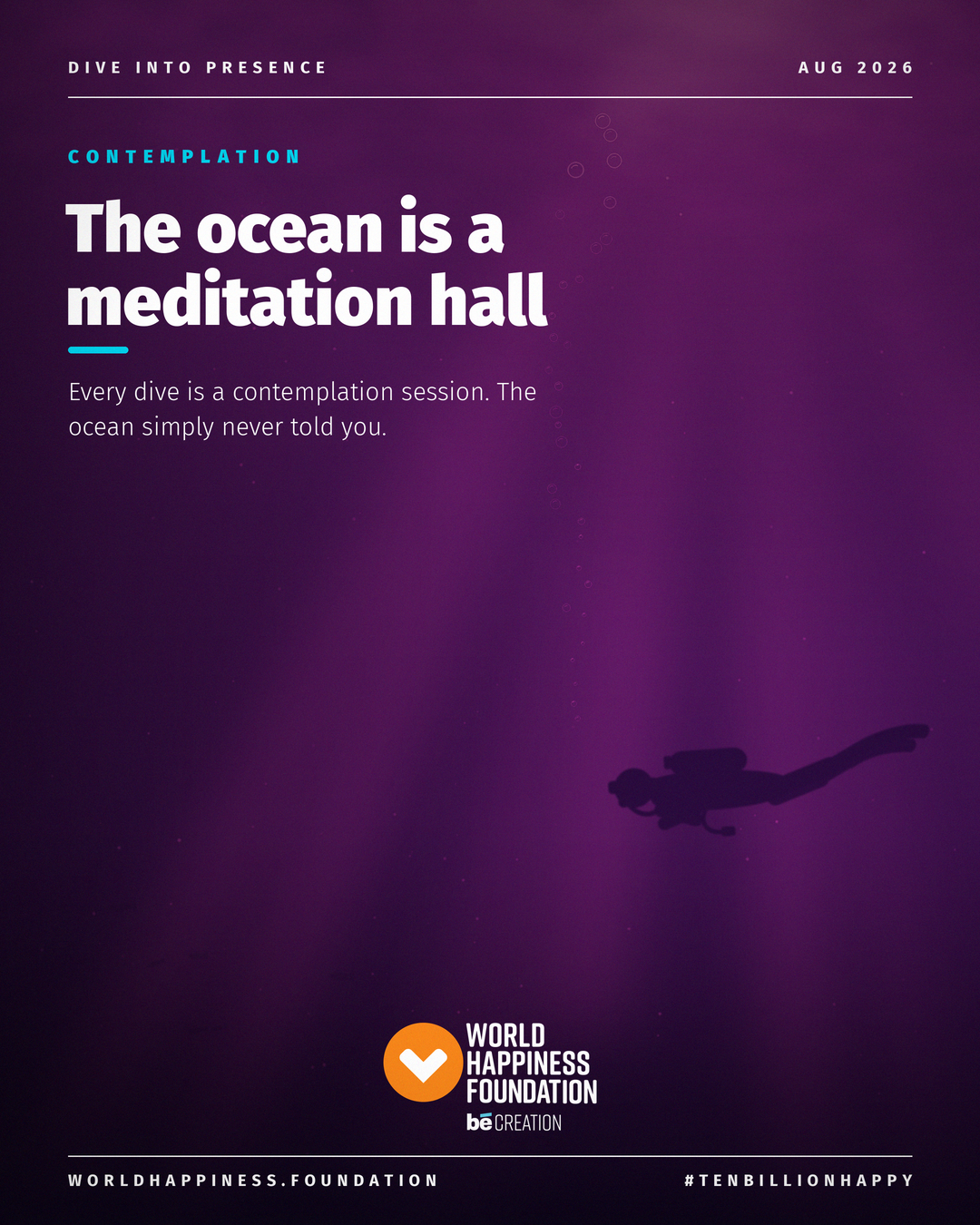
This is why I say, without romance and with scientific seriousness: the ocean is a meditation hall, and every mindful dive is a session.
The deepest wound and the widest water
In our work on the Six Wounds of Humanity, Separation is the deepest — the felt sense that we are cut off from each other, from nature, from life itself. Its healing virtue is Care, is Love. And here the ocean offers its most profound teaching: immersion. Suspended in water, the boundary between “me” and “world” thins. We remember that we are mostly water, briefly organized, visiting the rest of it. From that remembering, care stops being a duty and becomes a reflex — for our buddy, for the reef, for the ocean that regulates the climate and feeds billions.
This is where mindful diving meets the mission of the World Happiness Foundation. Our Global Pain & Trauma Map includes a planetary domain (D7) precisely because human flourishing and Earth’s flourishing are one curriculum. GDP counts what we extract from the sea. Happytalism asks us to count what the sea teaches us — presence, humility, interbeing — and what we owe it in return. Beyond GDP begins, quite literally, below the surface.
An invitation: dive with us
So here is my invitation, offered with the sea’s own simplicity.
If you have never dived — learn. Find a certified school, complete your medical check, and ask for an instructor who teaches slowly, with breath at the center. Entering the ocean consciously may be one of the most direct doorways to embodied mindfulness available to a human being.
If you already dive — dedicate your next dive as a meditation. Three long exhales on descent. One minute of motionless neutral buoyancy, simply witnessing. Gratitude at the safety stop. Surface as someone who has practiced, not just visited.
And if you wish to go further — dive with us. The World Happiness Foundation is weaving mindful-diving immersions into our global programs: breath, buoyancy, silence, awe, and service to the sea, guided as contemplative practice. From the springs and reefs of Bali to waters near you, we are building a community of divers who surface calmer, kinder, and committed to the blue heart of the planet.
Our mission is ten billion free, conscious, and happy human beings by 2050. The ocean covers seventy percent of the classroom.
Come breathe with us, below.
— Prof. Luis Miguel Gallardo
Continue reading
- Dive Into Presence — the World Happiness Academy program: buddy, nature, breath. First group in Madrid, September.
- Born from the Spring — Ubud, the two dragons of Bali, and the day the water spoke.
- The Moon Beneath the Water — night diving, rescue, and the alchemy of depth.
Safety note: scuba diving requires proper certification, medical fitness, and adherence to safety protocols. Mindful diving complements — never replaces — your training and your buddy system.
…
Explore this topic
Field notes to your inbox
Stay connected to the shift.
Monthly essays from the Observatory, invitations to Fests and Academy cohorts. Written from abundance — never urgency.