ArticleCC BY 4.0
The Supreme Yoga and the Science of Suggestion: Bridging the Yoga Vāsiṣṭha and Modern Hypnotherapy Through Consciousness, Narrative, and Neuroscience
Luis Miguel Gallardo1 ORCID 0009-0005-3222-6092
- 1Yogananda School of Spirituality and Happiness, Shoolini University, Solan, Himachal Pradesh, India; World Happiness Foundation
- Published
- septembre 2026
- Version
- 1.0
- Issue
- Vol. 1, No. 1 (2026)
- Article number
- JHFP-2026-001
- Licence
- CC BY 4.0
- Published by
- World Happiness Foundation Research Lab
- Related
- Research programme
Abstract
The Yoga Vāsiṣṭha (Mokṣopāya), among the most psychologically sophisticated works of Indian philosophy, teaches that experienced worlds are mind-made, that latent impressions (vāsanā) sustain suffering, that disciplined imagination (bhāvanā) and self-effort can dissolve them, and that liberation is available in life (jīvanmukti). Modern hypnotherapy — whose founding doctrine of suggestion entered Europe through the Goa-born Abbé Faria, whose largest early clinical corpus was produced in Bengal, and whose first theorist, James Braid, analysed reports of yogic samādhi — has independently validated the operative core of these claims across a meta-analytic evidence base. This article presents the first systematic integration of the two traditions and introduces Yoga Vāsiṣṭha Hypnotherapy (YVH), an integrative clinical model. Using a method of complementarity without collapse, we map thirteen construct concordances, align the seven jñāna-bhūmikās with graded trance depths as a heuristic clinical map, and identify the text's jīvanmukta with Fundamental Peace — an integrated regulatory capacity comprising flexible attentional control, emotional coherence, reduced self-referential rigidity and compassionate self-awareness, measurable by the FP20 scale. We state the model's disanalogies and cultural-integrity commitments, derive an eight-phase protocol, and propose five testable hypotheses, returning the science of suggestion to its deepest source while giving contemplative clinical practice a validated endpoint.
Keywords
- Yoga Vāsiṣṭha
- Mokṣopāya
- hypnotherapy
- hypnosis
- non-duality
- suggestion
- absorption
- jīvanmukti
- Fundamental Peace
- FP20
- YVH
- consciousness
Read the paper
Presentation
The author's presentation of this paper. Move through the slides here, or download the deck as a PDF or PowerPoint file.
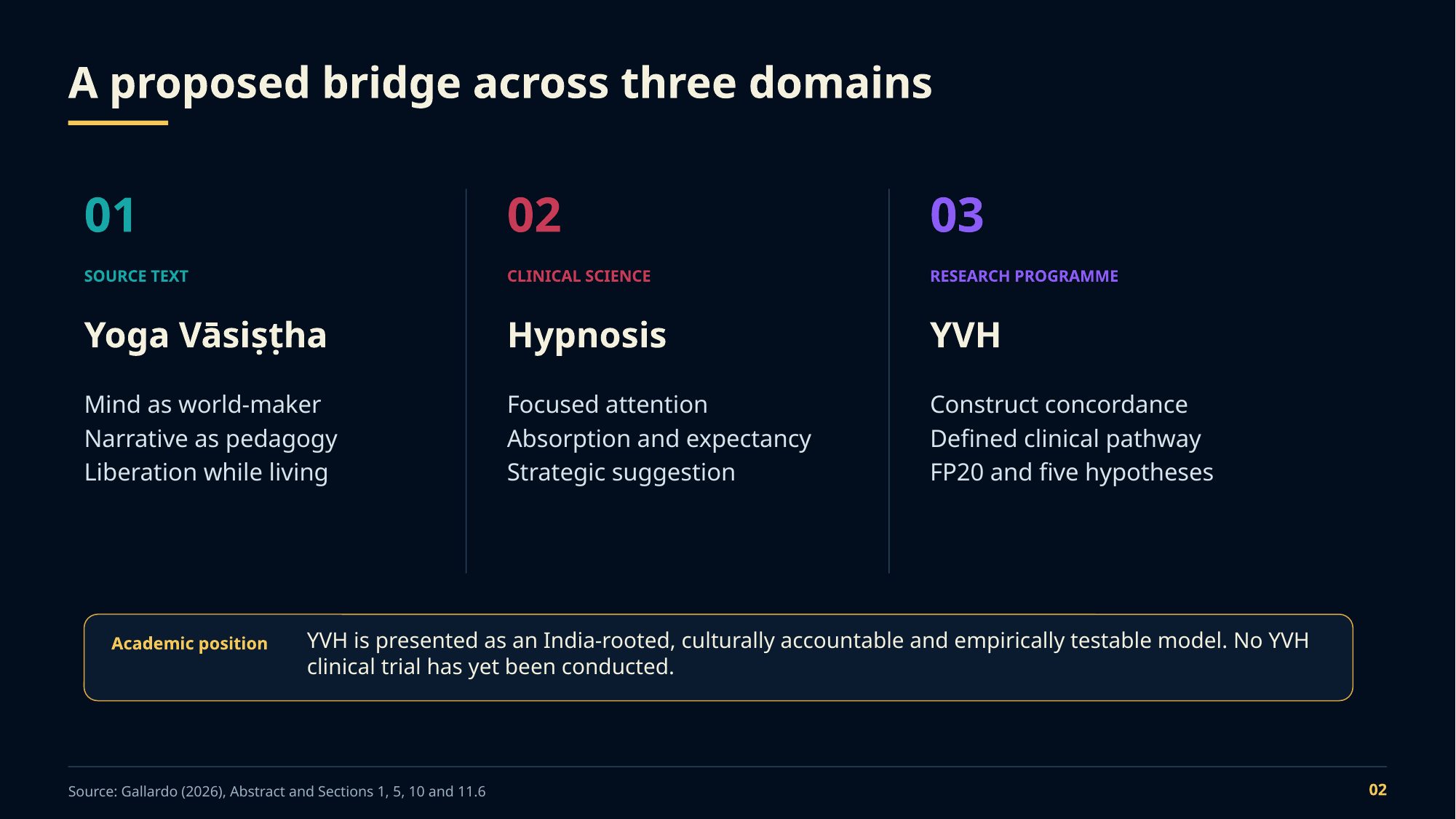
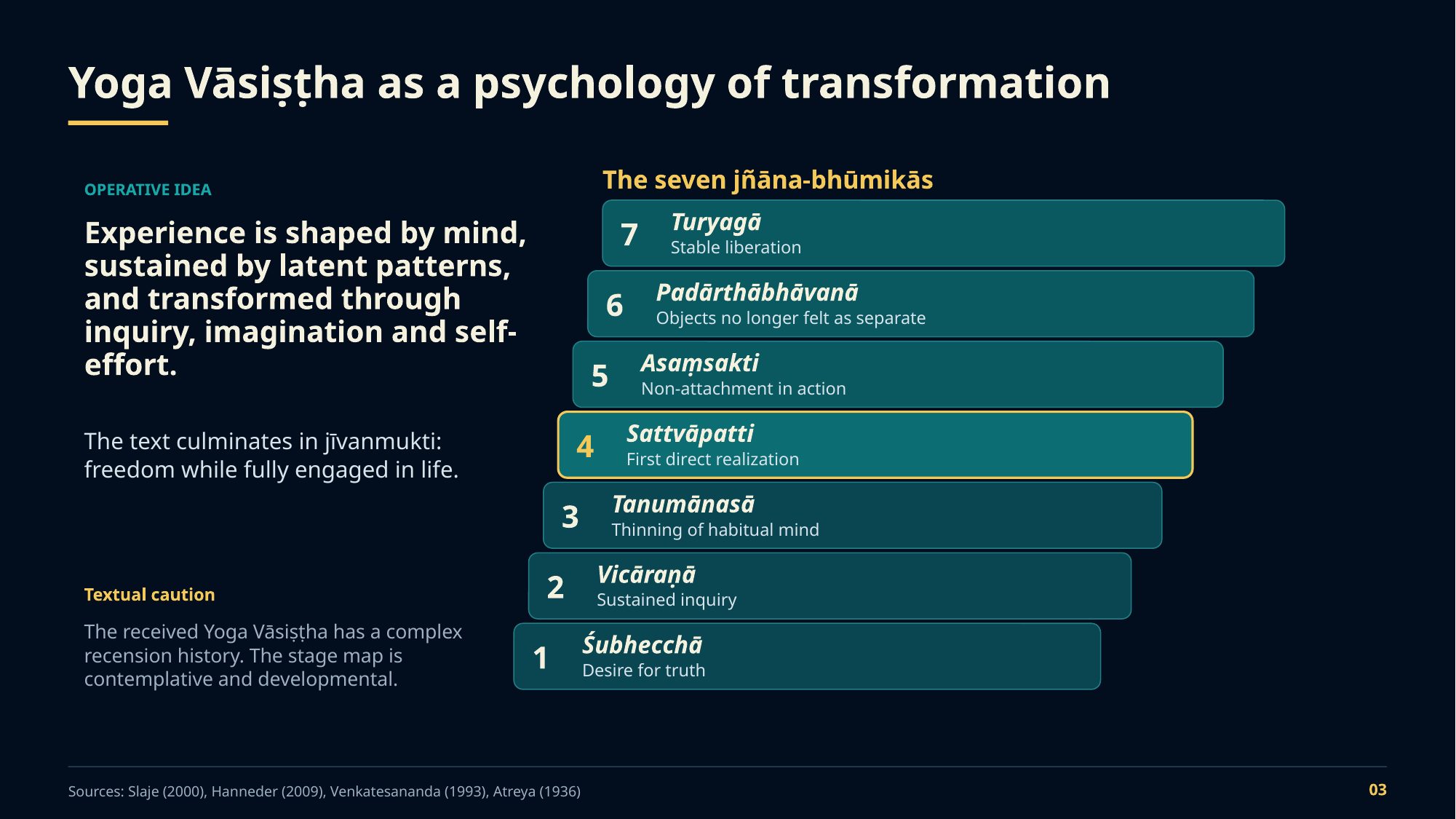
Use the arrow keys, the thumbnails or fullscreen to move through the slides.
Full text
The complete paper, as registered with its DOI. Section links below jump within this page.
Table of Contents
-
3. The Forgotten Lineage: Hypnosis, India, and the Science of Suggestion
-
4. Modern Hypnotherapy: History, Mechanisms, and Applications
-
10. Yoga Vāsiṣṭha Hypnotherapy (YVH): An Integrative Framework
1. Introduction
The relationship between ancient contemplative traditions and modern psychotherapeutic approaches represents one of the most fertile areas of contemporary interdisciplinary research. While substantial scholarship has explored connections between Buddhist mindfulness practices and cognitive-behavioral therapy, or between yogic meditation and neuroscience, a profound and largely unexplored convergence exists between the Yoga Vāsiṣṭha—one of India's most sophisticated philosophical texts on consciousness and liberation—and modern clinical hypnotherapy. This paper establishes, for the first time, a comprehensive theoretical and empirical bridge between these two traditions, demonstrating their deep structural parallels and proposing an integrative framework with significant implications for clinical practice, consciousness studies, and human wellbeing.
The Yoga Vāsiṣṭha (also known as Mokṣopāya or Vāsiṣṭha Rāmāyaṇa) is a monumental Sanskrit philosophical text comprising approximately 29,000 verses, traditionally attributed to the sage Vālmīki and structured as a dialogue between the sage Vasiṣṭha and the young prince Rāma [1], [2]. Dating to approximately the 10th-14th century CE, this text presents a radical non-dual (advaita) philosophy in which consciousness (cit, caitanya) is recognized as the sole reality, and the entire phenomenal world—including our ordinary waking experience—is understood as a dream-like construction (māyā) of mind [3], [5], [9]. Through elaborate stories, philosophical arguments, and practical instructions, the text guides the reader toward jīvanmukti (liberation-in-life): a state of freedom, peace, and authentic being achieved not through withdrawal from the world but through profound recognition of consciousness's true nature [3], [7].
Modern hypnotherapy, by contrast, emerged from 18th-century European investigations into "animal magnetism" by Franz Anton Mesmer, was scientifically reformulated by James Braid in the 19th century, and achieved clinical sophistication through 20th-century pioneers like Milton Erickson, Ernest Hilgard, and Pierre Janet [24], [29], [46]. Contemporary hypnotherapy is now recognized as an evidence-based intervention employing altered states of consciousness, focused attention, and strategic suggestion to facilitate therapeutic change across diverse conditions including pain, anxiety, trauma, and psychosomatic disorders [25], [36], [42]. Neuroscientific research has identified specific neural correlates of hypnotic states, including altered activity in the anterior cingulate cortex, prefrontal regions, and changes in functional connectivity [26], [37], [48], [53].
Despite their vastly different historical and cultural origins, these two traditions converge on fundamental insights about the nature of consciousness and its transformation. Both recognize that ordinary waking consciousness is not a transparent window onto reality but a constructed, suggestible state shaped by beliefs, narratives, and habitual patterns [9], [29], [43]. Both employ altered states of consciousness—whether termed samādhi, dhyāna, or hypnotic trance—as gateways to deeper levels of mind and pathways to healing [42], [49], [59]. Both understand narrative and metaphor as primary vehicles for transformation, with the Yoga Vāsiṣṭha's elaborate stories serving functions remarkably similar to Ericksonian therapeutic metaphors [8], [35]. Both recognize mind as the creator of experienced reality, with profound implications for therapeutic change [5], [40], [43].
This paper synthesizes a structured review of the scholarly literature in four streams. Searches were run in PubMed, PsycINFO, Scopus, Google Scholar and JSTOR between June and September 2026, combining terms for the text (Yoga Vāsiṣṭha, Yogavāsiṣṭha, Mokṣopāya, Laghu Yoga Vāsiṣṭha) with terms for the clinical field (hypnosis, hypnotherapy, suggestion, trance, absorption, altered states) and, separately, with terms for mechanism (default mode network, self-referential processing, emotion regulation, reconsolidation). Indological sources were traced through the Mokṣopāya critical-edition project and the citation networks of Atreya [69] and Chapple and Chakrabarti [70]; clinical evidence was anchored to meta-analytic syntheses rather than to individual trials [74]. The combined text-and-hypnotherapy searches returned no prior study integrating the Yoga Vāsiṣṭha with clinical hypnotherapy at the level of construct, protocol, or outcome measure — the vacancy this paper addresses. We demonstrate that the Yoga Vāsiṣṭha and modern hypnotherapy share parallel epistemologies, complementary methods, and convergent goals. Contemporary neuroscience—particularly research on brain wave states, the default mode network, and neural correlates of altered consciousness—provides a unifying framework for understanding these convergences [32], [36], [56], [57]. We propose an integrative Yoga Vāsiṣṭha Hypnotherapy (YVH) model that combines the philosophical depth and liberation-oriented framework of the Yoga Vāsiṣṭha with the clinical precision and evidence-based methods of modern hypnotherapy.
The significance of this synthesis extends across multiple domains. Clinically, it offers enhanced therapeutic approaches for mental health, pain management, and wellbeing that integrate ancient wisdom with modern science [34], [39], [42]. Theoretically, it advances our understanding of consciousness, suggestion, and the mechanisms of psychological transformation [23], [36], [43]. Philosophically, it demonstrates the enduring relevance of non-dual contemplative traditions for contemporary psychology and neuroscience [14], [17], [18]. Practically, it addresses the growing recognition that Western psychology can benefit from integration with Eastern contemplative traditions, while ensuring such integration is rigorous, evidence-based, and culturally sensitive [14].
The structure of this paper proceeds systematically through the what, who, how, where, when, and why of both traditions and their integration. We begin by examining the Yoga Vāsiṣṭha in depth—its origins, structure, key teachings, and central figures—followed by a parallel examination of modern hypnotherapy. We then explore their deep connections through parallel epistemologies, neuroscientific bridges, and therapeutic applications. We examine the dimension of fundamental peace and pure consciousness that transcends both trance and ordinary thought. Finally, we propose the integrative YVH framework and identify critical gaps and future research directions. This paper represents a landmark contribution to an emerging field at the intersection of ancient wisdom, modern psychology, and consciousness studies.
2. The Yoga Vāsiṣṭha: Philosophy, Structure, and Teachings
2.1. Historical Context and Authorship
The Yoga Vāsiṣṭha (YV), also known as the Mokṣopāya ("Path to Liberation") or Vāsiṣṭha Rāmāyaṇa, is one of the most extensive and philosophically sophisticated texts in the Sanskrit literary tradition. Comprising approximately 29,000 verses (śloka) in its longer recension, the text presents a comprehensive non-dual (advaita) philosophy of consciousness through an elaborate narrative framework [1], [2], [9]. While traditionally attributed to the sage Vālmīki—the legendary author of the Rāmāyaṇa epic—modern scholarship dates the text's composition to approximately the 10th-14th century CE in Kashmir, with the shorter Mokṣopāya version likely preceding the expanded Yoga Vāsiṣṭha [3], [9].
The text emerged within the rich intellectual milieu of medieval Kashmir, a region renowned for its sophisticated philosophical traditions including Kashmir Śaivism, Advaita Vedānta, and Buddhist Yogācāra philosophy [9], [10]. Scholars have identified influences from multiple traditions, though the text maintains a distinctive philosophical voice that synthesizes non-dual metaphysics with practical guidance for liberation [3], [5]. The authorship question remains complex, with the text likely representing a compilation and elaboration of earlier materials by multiple authors over several centuries [9].
The Yoga Vāsiṣṭha's influence on Indian philosophy, literature, and spiritual practice has been profound and enduring. It has been translated into numerous Indian languages, commented upon by major philosophers, and continues to be studied and practiced in contemporary yoga and Vedānta traditions [4], [7]. The text's unique combination of philosophical rigor, literary artistry, and practical instruction has made it a cornerstone of non-dual teachings [7], [10].
2.2. Textual Structure and Literary Form
The Yoga Vāsiṣṭha is structured as a frame narrative in which the sage Vasiṣṭha instructs the young prince Rāma, who has returned from a pilgrimage experiencing profound disillusionment with worldly existence [1], [7]. This outer frame contains six major books (prakaraṇa) plus an introductory section, with each book addressing specific aspects of the path to liberation [2], [8]:
- Vairāgya Prakaraṇa (Book of Dispassion): Rāma's existential crisis and questioning
- Mumukṣu Prakaraṇa (Book of the Seeker): Qualifications for liberation
- Utpatti Prakaraṇa (Book of Creation): The nature of creation and consciousness
- Sthiti Prakaraṇa (Book of Existence): The maintenance of the world-appearance
- Upaśama Prakaraṇa (Book of Dissolution): The dissolution of false identifications
- Nirvāṇa Prakaraṇa (Book of Liberation): Final liberation and its characteristics
Within this structure, the text employs a distinctive pedagogical method: nested stories within stories, often extending to multiple levels of narrative embedding [6], [8]. These stories are not mere illustrations but constitute the primary vehicle for philosophical instruction, demonstrating rather than merely describing the text's central insights about consciousness, reality, and liberation [8]. The narrative method serves multiple functions: it engages the reader's imagination, bypasses intellectual resistance, demonstrates the dream-like nature of all experience, and provides models for transformation [8].
This sophisticated use of storytelling as a transformative technology bears remarkable similarity to modern narrative therapy and Ericksonian hypnotherapy, as we shall explore in detail [8], [35].
2.3. Core Philosophical Teachings
The Yoga Vāsiṣṭha presents a comprehensive non-dual philosophy centered on several interconnected core teachings:
Consciousness as Ultimate Reality (Brahman/Cit): The text's fundamental ontological claim is that pure consciousness (cit, caitanya, brahman) is the sole reality [5], [10], [11]. This consciousness is not a property of objects or beings but the ground and substance of all existence. It is self-luminous (svaprakāśa), infinite, unchanging, and identical with one's true Self (ātman) [10], [11], [12]. As one passage states, consciousness is "the light by which all else is known, yet which requires no other light to be known" [2].
Māyā and the Illusion of Ordinary Experience: The phenomenal world, including our ordinary waking experience, is understood as māyā—not non-existent, but lacking independent reality apart from consciousness [1], [5], [9]. The text employs the dream analogy extensively: just as dream objects appear real during the dream but are recognized as mental constructions upon awakening, so too is waking experience a construction of mind that appears real only due to ignorance (avidyā) of consciousness's true nature [1], [9]. This is not nihilism but a radical idealism: the world is real as consciousness, unreal as independent matter [5].
Mind (Manas) as Creator: The mind is understood as the creative power (śakti) of consciousness, responsible for the entire appearance of multiplicity and differentiation [2], [5], [14]. Through the power of imagination (saṃkalpa, vikalpa), mind constructs the experienced world moment by moment [2]. Crucially, this creative power can be redirected: just as mind creates bondage through false identifications, it can create liberation through right understanding [2], [14]. The text states: "The mind alone is the cause of bondage and liberation; when attached to objects, it is bondage; when detached, liberation" [2].
Self-Inquiry (Vicāra) and Discrimination (Viveka): The primary method for liberation is sustained self-inquiry—investigating the nature of the self, consciousness, and reality through direct examination of one's own experience [2], [7]. This is complemented by discrimination (viveka) between the real and unreal, the eternal and transient [7]. The text provides detailed instructions for this inquiry, emphasizing direct investigation rather than mere intellectual understanding [2].
Jīvanmukti (Liberation-in-Life): Unlike traditions that posit liberation only after death, the Yoga Vāsiṣṭha emphasizes jīvanmukti—liberation achieved while still embodied and engaged in worldly activity [3], [7]. The liberated being (jīvanmukta) continues to function in the world but is no longer identified with body, mind, or ego, and experiences profound peace, freedom, and spontaneous right action [3]. This state is characterized by the dissolution of the sense of separate selfhood while maintaining functional capacity [3].
Effort and Effortlessness (Prayatna and Aprayatna): The text presents a nuanced teaching on the role of effort in spiritual practice. Initial effort (prayatna) is necessary to overcome habitual patterns and cultivate understanding, but ultimate realization involves recognizing what already is—the ever-present nature of consciousness—which requires no effort to create [3], [7]. The text navigates this paradox through its teaching on the stages of knowledge [3].
2.4. The Seven Stages of Knowledge (Jñāna-bhūmikā)
The Yoga Vāsiṣṭha presents a systematic map of spiritual development through seven stages of knowledge (jñāna-bhūmikā), describing the progressive transformation of consciousness from ignorance to complete liberation [3], [7]:
- Śubhecchā (Good Desire): The arising of sincere desire for truth and liberation, often catalyzed by disillusionment with worldly pursuits
- Vicāraṇā (Inquiry): Sustained investigation into the nature of self and reality through study, reflection, and contemplation
- Tanumānasā (Thinning of Mind): The weakening of habitual mental patterns, attachments, and the sense of separate selfhood
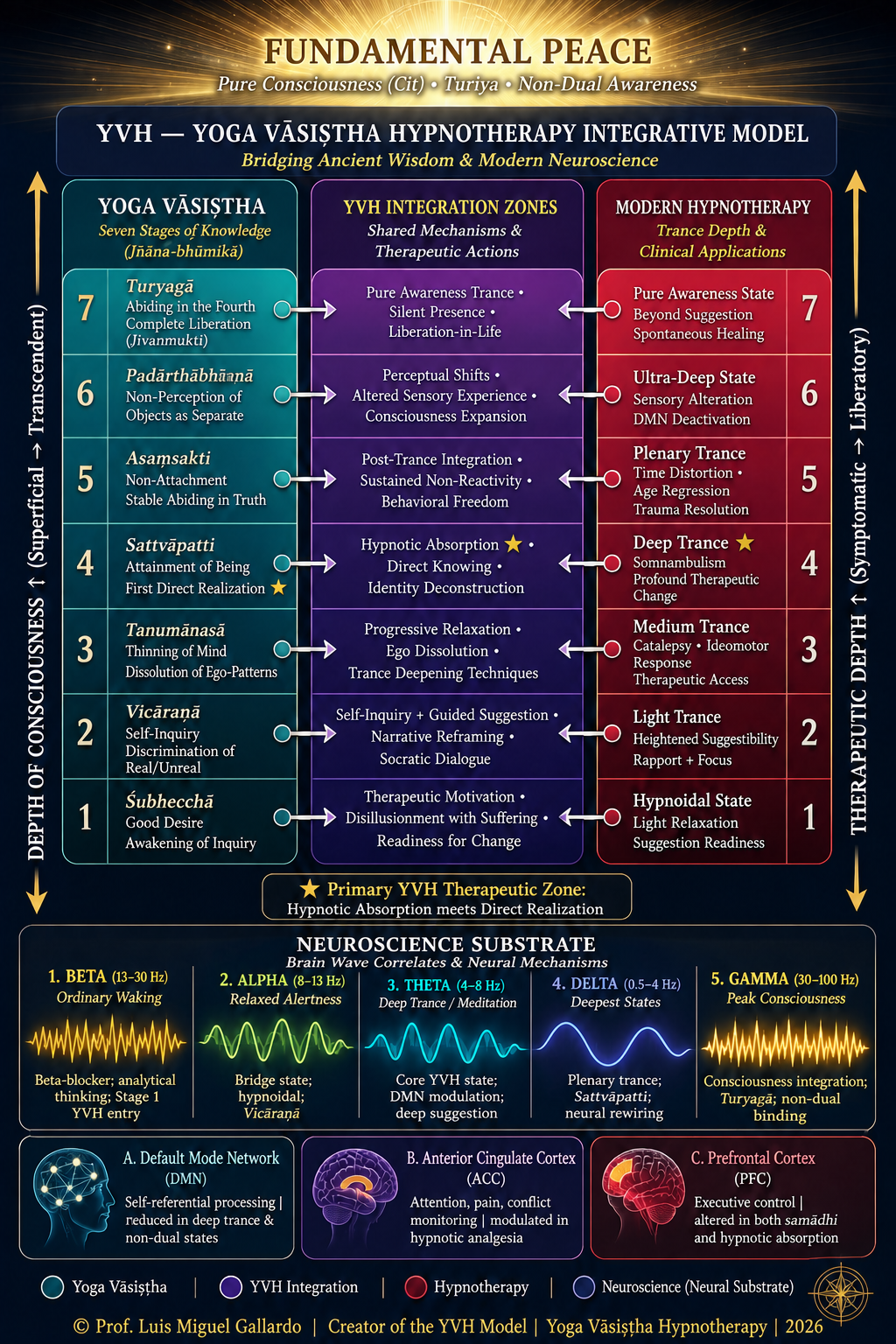
- Sattvāpatti (Attainment of Being): Direct realization of one's true nature as consciousness; the first stage of actual liberation
- Asaṃsakti (Non-Attachment): Stable abiding in realization with complete freedom from attachment while still functioning in the world
- Padārthābhāvanā (Non-Perception of Objects): Objects are perceived but not experienced as separate from consciousness
- Turyagā (Abiding in the Fourth): Complete, irreversible liberation; the state beyond waking, dreaming, and deep sleep
These stages provide a developmental framework that acknowledges both the gradual nature of transformation and the possibility of sudden realization. Importantly, the text emphasizes that even after initial realization (stage 4), continued practice and integration are necessary for complete stabilization [3], [7].
2.5. Key Figures: Vasiṣṭha, Rāma, and Vālmīki
The text's narrative structure centers on three key figures whose roles illuminate its pedagogical method:
Vasiṣṭha: The sage Vasiṣṭha serves as the primary teacher, embodying wisdom, compassion, and skillful means. His teaching method is notable for its flexibility, employing stories, logical arguments, direct pointing, and silence as appropriate to Rāma's understanding [8]. Vasiṣṭha represents the ideal of the enlightened teacher who has realized the truth and can guide others toward the same realization [8].
Rāma: The prince Rāma serves as the ideal student—intelligent, sincere, and genuinely seeking truth. His initial disillusionment and existential questioning provide the catalyst for Vasiṣṭha's teaching [1], [7]. Rāma's questions, doubts, and progressive understanding model the reader's own journey, making the text's philosophy accessible and personally relevant [7].
Vālmīki: As the traditional author and narrator of the frame story, Vālmīki represents the transmission of wisdom through literary artistry. The attribution to Vālmīki—legendary author of the Rāmāyaṇa—links the Yoga Vāsiṣṭha to India's epic tradition while establishing its authority [1].
The relationship between teacher and student in the text exemplifies the importance of direct transmission and personalized instruction, themes that resonate strongly with the therapeutic relationship in modern hypnotherapy [8].
2.6. The Clinical Tales: Narrative as Experimental Apparatus
Five of the text's sixty-four stories are of direct clinical interest, and they are best read not as illustrations of doctrine but as thought-experiments in the phenomenology of constructed experience.
Līlā (Utpatti Prakaraṇa) presents nested worlds within a single consciousness: a queen, guided by the goddess Sarasvatī, moves through the imagined cosmos her dead husband continues to inhabit, discovering that each apparently solid world is a mental construction sustained by the belief of its inhabitant [88]. The story functions as the text's most complete demonstration that experienced reality is a stable hallucination maintained by conviction — an ontological claim in the text, and a working description of trance phenomenology in the clinic.
Lavaṇa (Utpatti Prakaraṇa) narrates a king who, under the influence of a wandering illusionist, lives an entire lifetime of exile, marriage, famine and degradation during a few minutes of altered consciousness in his own court, and afterwards finds physical traces of that life in the world [6]. This is a precise pre-modern description of hypnotic time distortion and of the identity absorption that accompanies deep trance.
Gādhi (Upaśānti Prakaraṇa) repeats the structure with a Brahmin whose immersion in a pool of water becomes a complete alternative biography, again with residue in consensus reality. Read together, Lavaṇa and Gādhi establish that the text was interested not in illusion as such but in the durability of change effected within an absorbed state.
Bhuśuṇḍa, whose narrative opens the Nirvāṇa Prakaraṇa, is the long-lived crow whose stability across cosmic cycles rests on his mastery of the movement of breath and attention. The story is the text's own account of an induction procedure: prāṇa as the anchor by which consciousness is stabilised.
Cūḍālā and Śikhidhvaja (Nirvāṇa Prakaraṇa, chapters 77 ff.; Venkatesananda 1993, pp. 422–434 [68]) is the most consequential of the five for the present argument. The queen Cūḍālā attains liberation before her husband and, unable to reach him through direct instruction, conducts a graded series of staged experiential interventions: she assumes the disguise of the young ascetic Kumbha; she meets him inside his own frame of reference rather than her own; she administers teaching through parable; she engineers a test of his attachment; and she withdraws the intervention once realisation is stable. The sequence — meet the client in his own model of the world, utilise rather than confront his resistance, deliver change through indirect narrative, verify it experientially, then hand the work back — is a recognisable therapeutic strategy [8]. It is also, in every operative respect, the method later formalised in Ericksonian utilisation and in strategic and parts-oriented psychotherapy [85], [84]. Cūḍālā is the tradition's own clinician, and the protocol proposed in Section 10 takes her as its model.
3. The Forgotten Lineage: Hypnosis, India, and the Science of Suggestion
Accounts of hypnosis conventionally begin in Europe, with Mesmer's magnetic fluid and its replacement by Braid's neurophysiology. That account is incomplete. The doctrine on which modern hypnotherapy actually rests — that hypnotic phenomena arise from the capacities of the subject rather than from a force applied by the operator — entered European science through a Goan priest, was tested at scale in colonial Bengal, and was theorised in dialogue with reports of Indian yogic practice. This section reconstructs that lineage, because it changes what the present integration is: not the application of a Western technique to an Eastern text, but the return of a body of knowledge to the civilisation in which much of it originated.
3.1. Abbé Faria and the Location of the Power
José Custódio de Faria was born in Candolim, Goa, in 1756, educated in Portugal and Rome, and by 1813 was conducting public demonstrations of what he called lucid sleep (sommeil lucide) in Paris. His posthumously significant De la cause du sommeil lucide, ou Étude de la nature de l'homme (1819) broke decisively with Mesmer [61]. Faria rejected animal magnetism, the operator's fluid, the passes and the baquet, and attributed the phenomena instead to the concentration, expectancy and constitutional susceptibility of the subject — a conclusion he grounded in observations he reported across some five thousand individuals. He induced trance by a simple command after focused attention, a method that anticipates modern rapid inductions, and he classified individuals by their differential susceptibility, anticipating trait accounts of hypnotisability [62].
This is the founding move of the entire field. Every subsequent theory that locates hypnotic response in the subject's absorption [76], expectancy [75], or top-down regulation is a descendant of it. Egas Moniz, the Portuguese neurologist and Nobel laureate, judged Faria the originator of the doctrine of suggestion [62]. The judgement is defensible, and its implication is rarely drawn: the conceptual foundation of clinical hypnosis was laid by a son of India.
3.2. Esdaile in Bengal: Trance Medicine at Scale
James Esdaile, a Scottish surgeon in the East India Company's service, began using mesmeric trance for surgical anaesthesia at Hooghly in 1845, and subsequently at the Mesmeric Hospital in Calcutta. Mesmerism in India, and Its Practical Application in Surgery and Medicine (1846) reports scores of major operations conducted without chemical anaesthesia and with markedly reduced mortality, and Esdaile himself understood his practice in relation to the indigenous healing practice of jhār-phūṅk, from which his Indian assistants drew [65]. Whatever the disputes over his mortality statistics, the record constitutes the largest early clinical dataset in the history of trance medicine, and it was generated in India, with Indian patients and Indian practitioners.
That record cannot be cited innocently. Modern historiography has established the colonial structure of the Calcutta hospital — the asymmetries of consent, the epistemic subordination of indigenous practice to European medical authority, and the polemical uses to which the results were put on both sides [66]. The lineage argued here is a lineage of knowledge, not an endorsement of the conditions under which some of it was produced.
3.3. Braid, Haridas, and the First Encounter of Hypnotism with Yoga
James Braid, who coined hypnotism in 1843 and reconceived the phenomena as a physiological consequence of sustained attention (monoideism), devoted a late work to a specifically Indian question. Observations on Trance: or, Human Hibernation (1850) analyses the widely reported case of the yogi Haridas, who in 1837 was interred for a period at the court of Maharaja Ranjit Singh in Lahore and revived [63]. Braid's argument was that the feat required no supernatural explanation: it demonstrated a capacity for voluntary alteration of physiological state achieved through the same mechanism of concentrated attention he had identified in hypnotism. In this he was substantially vindicated by twentieth-century physiological work on yogic hypometabolism [90].
The reception of Haridas in the West, however, was distorted by the anxieties and interests of its period, and recent critical scholarship documents how the samādhi reports were assimilated to European preoccupations with live burial, suspended animation and colonial spectacle [64]. This is the cautionary half of the lineage, and it disciplines the present project: the task is neither to dismiss the phenomena of yogic tradition as fraud nor to annex them as anticipations of Western science, but to read them with the same evidentiary care applied to any other clinical claim.
3.4. Restitution as Method
Faria, Esdaile and Braid do not establish that hypnosis is Indian. They establish that its founding insight, its first large clinical corpus, and its earliest theoretical encounter with contemplative practice were all shaped in and by India, and that this history was subsequently written out of the field's self-understanding [67]. The integration proposed in this paper is therefore best described as restitution. A tradition that supplied the science of suggestion with its foundational claim is here supplied, in return, with that science's modern evidentiary apparatus — and the Yoga Vāsiṣṭha, which theorised the therapeutic use of imagination more completely than any pre-modern text, is read at last as what it is: a clinical psychology awaiting its instruments.
4. Modern Hypnotherapy: History, Mechanisms, and Applications
4.1. Historical Development: From Mesmer to Contemporary Practice
Modern hypnotherapy emerged from a complex historical trajectory spanning over two centuries, evolving from controversial "animal magnetism" to an evidence-based clinical intervention recognized by major medical and psychological organizations [24], [46].
The Mesmeric Era (1770s-1840s): The story begins with Franz Anton Mesmer (1734-1815), a Viennese physician who proposed that illness resulted from imbalances in "animal magnetism"—a supposed universal fluid that could be manipulated through magnetic passes and dramatic rituals [46]. While Mesmer's theoretical framework was discredited, his methods produced genuine therapeutic effects, including pain relief, symptom reduction, and dramatic behavioral changes [46]. The "mesmeric trance" became a subject of intense scientific and public interest throughout Europe and America [46].
Scientific Reformulation (1840s-1890s): James Braid (1795-1860), a Scottish surgeon, provided the first scientific reformulation of mesmerism, coining the term "hypnosis" (from Greek hypnos, sleep) and proposing that trance phenomena resulted from focused attention and suggestion rather than magnetic fluids [46]. Braid's work established hypnosis as a psychological rather than physical phenomenon [46]. This period also saw contributions from Jean-Martin Charcot, who studied hypnosis in relation to hysteria, and Pierre Janet, who explored dissociation and the unconscious mind [46].
Psychoanalytic Integration (1890s-1930s): Sigmund Freud initially employed hypnosis but later abandoned it in favor of free association, contributing to hypnosis's decline in mainstream psychiatry [46]. However, other practitioners continued to develop hypnotic methods, particularly for pain management and psychosomatic conditions [46].
Modern Clinical Hypnosis (1940s-1980s): The mid-20th century saw hypnosis's rehabilitation as a legitimate clinical tool, driven by several factors: its successful use for pain management in World War II, the founding of professional societies (American Society of Clinical Hypnosis, 1957; Society for Clinical and Experimental Hypnosis, 1949), and the groundbreaking work of Milton H. Erickson (1901-1980) [24], [46]. Erickson revolutionized hypnotherapy through his naturalistic, permissive approach emphasizing indirect suggestion, utilization of the patient's own resources, and strategic use of metaphor and storytelling [35], [41]. Ernest Hilgard's research on hypnotic susceptibility and the "hidden observer" phenomenon provided important empirical foundations [46].
Contemporary Evidence-Based Practice (1990s-Present): Recent decades have witnessed hypnotherapy's integration into mainstream healthcare, supported by neuroimaging studies revealing specific neural correlates of hypnotic states [25], [36], [37], [48], [57], meta-analyses demonstrating efficacy for pain, anxiety, and other conditions [34], [42], and growing recognition of hypnosis as a valuable adjunct to conventional treatments [36], [39]. Contemporary practice emphasizes evidence-based protocols, ethical standards, and integration with other therapeutic modalities [24], [36].
4.2. Key Figures in Hypnotherapy
Several pioneering figures have shaped modern hypnotherapy's development:
Franz Anton Mesmer (1734-1815): Despite his flawed theoretical framework, Mesmer's dramatic demonstrations established that altered states of consciousness could produce therapeutic effects, catalyzing scientific investigation of suggestion and trance phenomena [46].
James Braid (1795-1860): Braid's scientific reformulation of mesmerism as "hypnosis" and his emphasis on focused attention and suggestion rather than magnetic fluids established the psychological foundations of modern hypnotherapy [46].
Pierre Janet (1859-1947): Janet's work on dissociation, the unconscious, and the role of suggestion in psychopathology provided important theoretical foundations, particularly for understanding trauma and dissociative phenomena [46].
Milton H. Erickson (1901-1980): Perhaps the most influential figure in modern hypnotherapy, Erickson developed a naturalistic, permissive approach emphasizing indirect suggestion, utilization of the patient's own resources, metaphor, and strategic intervention [35], [41]. His work demonstrated that hypnosis need not involve formal induction rituals but could be woven seamlessly into therapeutic conversation [35], [41]. Erickson's emphasis on storytelling and metaphor as vehicles for unconscious change bears remarkable similarity to the Yoga Vāsiṣṭha's narrative method [35].
Ernest Hilgard (1904-2001): Hilgard's systematic research on hypnotic susceptibility, the "hidden observer" phenomenon, and cognitive aspects of hypnosis provided crucial empirical foundations for understanding hypnotic phenomena [46].
Contemporary Researchers: Recent decades have seen important contributions from researchers including David Spiegel (neural correlates of hypnosis), Graham Jamieson (cognitive neuroscience of hypnosis), Mark Jensen (hypnosis for pain), Marie-Elisabeth Faymonville (hypnosis and consciousness), and many others who have established hypnotherapy's evidence base [36], [37], [42], [48].
4.3. Mechanisms and Neuroscience of Hypnosis
Contemporary neuroscience has revealed specific neural mechanisms underlying hypnotic phenomena, providing a biological foundation for understanding hypnotherapy's effects [25], [36], [37], [48], [57].
Altered Brain Activity Patterns: Neuroimaging studies consistently demonstrate that hypnosis involves distinctive patterns of brain activity [37], [48], [57]. Key findings include:
-
Anterior Cingulate Cortex (ACC): Altered activity in the ACC, a region involved in attention, conflict monitoring, and pain processing, is consistently observed during hypnosis [26], [30], [37], [38]. This may explain hypnosis's effectiveness for pain management and attentional control [26], [30].
-
Prefrontal Cortex: Changes in dorsolateral prefrontal cortex (DLPFC) activity are associated with hypnotic depth and responsiveness to suggestion [37], [48], [58]. The DLPFC is involved in executive control, working memory, and reality monitoring [48].
-
Default Mode Network (DMN): Hypnosis modulates activity in the DMN, a network involved in self-referential processing, mind-wandering, and the sense of self [48], [53]. Decreased DMN connectivity during hypnosis may relate to reduced self-consciousness and enhanced absorption [53].
-
Functional Connectivity: Hypnosis alters functional connectivity between brain regions, particularly between executive control networks and sensory processing areas [48], [53], [58]. This may enable top-down modulation of perception, pain, and other experiences [48], [53].
Brain Wave States: Electroencephalographic (EEG) studies reveal characteristic brain wave patterns during hypnosis [31], [32], [54], [56]:
-
Theta Activity (4-8 Hz): Increased theta power, particularly in frontal regions, is consistently associated with hypnotic depth and trance states [31], [32], [56]. Theta is also prominent during meditation, drowsiness, and creative states [32].
-
Alpha Activity (8-13 Hz): Alpha rhythms, associated with relaxed alertness, show complex patterns during hypnosis, with some studies reporting increases and others decreases depending on the specific suggestions and individual differences [32], [56].
-
Gamma Activity (>30 Hz): Some studies report increased gamma oscillations during hypnosis, particularly during vivid imagery and hallucination suggestions [54], [56]. Gamma is associated with conscious awareness and binding of perceptual features [56].
Hypnotic Analgesia: The neural mechanisms of hypnotic pain relief have been extensively studied [26], [28], [30], [42]. Hypnotic suggestions for analgesia can reduce pain perception and pain-related brain activity in the ACC, insula, and somatosensory cortex [26], [30]. Importantly, hypnotic analgesia appears to modulate both sensory and affective dimensions of pain [42].
Individual Differences: Hypnotic susceptibility—the degree to which individuals respond to hypnotic suggestions—shows stable individual differences with neural correlates [25], [44], [45]. Highly hypnotizable individuals show distinctive patterns of brain structure and function, including differences in ACC morphology and functional connectivity [44], [48].
4.4. Clinical Applications and Evidence Base
Modern hypnotherapy has demonstrated efficacy across a wide range of clinical conditions, supported by numerous randomized controlled trials and meta-analyses [34], [36], [39], [42]:
Pain Management: Hypnosis is perhaps most robustly supported for pain conditions, including acute procedural pain, chronic pain, cancer pain, and surgical pain [34], [42]. Meta-analyses consistently demonstrate moderate to large effect sizes for hypnotic analgesia [42]. Mechanisms include altered pain perception, reduced anxiety, and enhanced coping [42].
Anxiety and Stress: Hypnotherapy shows efficacy for various anxiety disorders, including specific phobias, social anxiety, and generalized anxiety [50], [52]. Hypnotic interventions can reduce anxiety symptoms, alter attentional biases, and enhance emotional regulation [52].
Trauma and PTSD: Hypnosis has been employed for trauma processing, with evidence supporting its use as an adjunct to trauma-focused therapies [47]. Hypnotic techniques can facilitate memory processing, reduce hyperarousal, and promote integration of traumatic experiences [47].
Psychosomatic and Medical Conditions: Hypnotherapy has demonstrated benefits for irritable bowel syndrome, asthma, dermatological conditions, and other psychosomatic disorders [24], [39]. Mechanisms may involve autonomic regulation, immune modulation, and mind-body integration [33].
Habit Disorders: Hypnosis is commonly employed for smoking cessation, weight management, and other habit disorders, though evidence quality varies [24], [39].
Pediatric Applications: Hypnotherapy shows particular promise for children, who often demonstrate high hypnotic responsiveness [39]. Applications include procedural pain, anxiety, and behavioral problems [39].
Surgical and Medical Settings: Hypnosis is increasingly used in surgical settings for anxiety reduction, pain management, and enhanced recovery [34], [39]. Studies demonstrate reduced anesthesia requirements, faster recovery, and improved outcomes [34].
4.5. The Role of Suggestion and Expectancy
Central to hypnotherapy's mechanisms is the phenomenon of suggestion—the process by which verbal or nonverbal communications influence experience, perception, and behavior [29], [35], [40], [43].
Nature of Suggestion: Suggestions in hypnotherapy are not commands that override volition but invitations that engage the subject's own imaginative and cognitive capacities [29], [40], [43]. Effective suggestions work with rather than against the subject's natural tendencies, beliefs, and motivations [35], [40]. Erickson emphasized that suggestions should be permissive, indirect, and tailored to the individual [35].
Expectancy and Belief: Expectancy—the subject's beliefs about what will happen—plays a crucial role in hypnotic responding [43], [51]. Positive expectancies enhance responsiveness, while negative expectancies can block hypnotic effects [43]. This highlights the importance of rapport, trust, and appropriate framing of the hypnotic experience [27], [43].
Implicit Processing: Suggestions appear to operate through implicit, automatic processing rather than conscious deliberation [35], [40]. Neuroimaging studies suggest that hypnotic suggestions can modulate perception and experience at early, pre-conscious stages of processing [29], [40]. This aligns with the Yoga Vāsiṣṭha's teaching that transformation occurs at the level of deep mental patterns (vāsanā) rather than surface thoughts [2].
Narrative and Metaphor: Ericksonian hypnotherapy emphasizes the use of stories and metaphors as vehicles for suggestion [35]. Metaphors bypass conscious resistance, engage imagination, and allow the unconscious mind to extract personally relevant meanings [35]. This narrative approach bears striking similarity to the Yoga Vāsiṣṭha's pedagogical method [8], [35].
5. Method: Complementarity Without Collapse
Integrations of contemplative traditions with clinical science fail in two characteristic ways. The first is reduction: the tradition is translated without remainder into psychological vocabulary, its metaphysical claims discarded as pre-scientific ornament, and what survives is a technique stripped of the framework that gave it meaning. The second is inflation: clinical procedures are invested with metaphysical significance they cannot bear, and therapeutic outcomes are reported as spiritual attainments. Both failures are forms of collapse — one direction or the other — and both destroy the very difference that makes the comparison informative.
This paper proceeds instead by complementarity without collapse, formalised as five working rules.
Rule 1 — Textual fidelity. Claims about the Yoga Vāsiṣṭha are made from identified translations and are recension-aware. The text as commonly received is not a single composition: philological work on the Mokṣopāya locates a tenth-century Kashmiri core subsequently expanded and Vedanticised, and the critical edition of Books V and VI is the standard against which doctrinal claims should be checked [71]. Where this paper cites the text for clinical argument it uses Venkatesananda's translations [68] and, for completeness, Mitra's [86] and Aiyar's abridgement [87], with the philological caveat stated rather than suppressed.
Rule 2 — Mapping with disanalogies. Every proposed correspondence is accompanied by its limits. Section 11 states the disanalogies as a body rather than distributing them as concessions, because a bridge whose gaps are concealed is a bridge that fails under load.
Rule 3 — Mechanism anchoring. Each mapped construct is required to touch published neuroscientific or clinical-trial evidence. Where no such anchor exists, the correspondence is labelled as conjecture and assigned to the research agenda rather than argued as finding.
Rule 4 — Clinical operationalisation. The integration must terminate in a specifiable procedure with a measurable outcome. A synthesis that produces only commentary has not been tested and cannot be. The protocol in Section 10 and the outcome construct in Section 9 discharge this requirement.
Rule 5 — Cultural integrity. The tradition is engaged as a living intellectual inheritance with contemporary custodians, not as raw material. Sanskrit terms are retained rather than replaced by approximate English equivalents; the Indian provenance of the clinical lineage is stated (Section 3); and the reception history of yogic phenomena in Western science is treated as a cautionary precedent rather than a resource [64].
These rules are restrictive by design. They exclude claims that would make the integration more impressive and less defensible, and they are the reason the correspondences proposed in Sections 6 and 10 are offered as a research programme rather than as a discovery.
6. Parallel Epistemologies: The Deep Connection
6.1. Consciousness as Constructed Reality
Both the Yoga Vāsiṣṭha and modern hypnotherapy converge on a fundamental insight: ordinary consciousness is not a transparent window onto an objective reality but a constructed, interpretive process shaped by beliefs, expectations, and habitual patterns [5], [9], [29], [43].
The Yoga Vāsiṣṭha presents this through its teaching on māyā and the creative power of mind (saṃkalpa). The text states: "This world-appearance is nothing but a long dream... it is the mind alone that creates this appearance through its power of imagination" [2], [5]. Consciousness, through the activity of mind, constructs the entire experienced world moment by moment [5]. Crucially, this construction is not recognized as such; it appears as objective reality due to ignorance (avidyā) of consciousness's true nature [9].
Modern cognitive neuroscience has arrived at remarkably similar conclusions through different routes. Research on perception, attention, and consciousness demonstrates that experience is actively constructed by the brain rather than passively received [29], [43]. Predictive processing frameworks propose that the brain continuously generates predictions about sensory input, with conscious experience representing the brain's best hypothesis about the causes of its sensations [43]. Hypnosis research has been particularly illuminating, demonstrating that suggestions can profoundly alter perception, memory, and even physiological responses—revealing the constructed and malleable nature of experience [29], [40], [43].
The parallel is striking: both traditions recognize that what we take to be objective reality is actually a construction of mind/brain, and both propose that recognizing this constructed nature is key to transformation [5], [29], [43]. The Yoga Vāsiṣṭha seeks liberation through recognizing the mind-made nature of experience; hypnotherapy facilitates change by strategically modifying the constructions that create suffering [29], [43].
6.2. The Dream Analogy and Illusion of Ordinary Experience
The dream analogy is central to both traditions, serving as a primary metaphor for understanding the nature of ordinary consciousness [1], [9], [49].
The Yoga Vāsiṣṭha employs the dream analogy extensively and systematically [1], [9]. The text presents numerous stories illustrating how waking experience is structurally identical to dreaming: both involve the appearance of a world that seems real and external but is actually a mental construction [9]. Just as dream objects have no existence apart from the dreaming mind, so too do waking objects have no existence apart from consciousness [9]. The text states: "As in a dream, so in waking; as in waking, so in a dream—there is no difference between them except in the duration and the degree of vividness" [1], [9]. The purpose of this analogy is not nihilistic denial of the world but recognition that the world's true nature is consciousness, not independent matter [9].
Modern hypnosis research has revealed that the boundary between waking and dreaming consciousness is far more permeable than commonly assumed [49], [55]. Hypnotic suggestions can produce experiences—including vivid hallucinations, altered time perception, and amnesia—that closely resemble dream phenomena [49], [55]. Neuroimaging studies show that hypnotically suggested visual hallucinations activate visual cortex more strongly than mere imagination, approaching the neural signature of actual perception [55]. This demonstrates that waking consciousness can be modulated to resemble dreaming, supporting the Yoga Vāsiṣṭha's claim that the distinction between waking and dreaming is less absolute than ordinarily assumed [49].
Both traditions use the dream analogy therapeutically. The Yoga Vāsiṣṭha employs it to loosen identification with the body-mind and recognize consciousness as one's true nature [9]. Hypnotherapy uses dream-like trance states to access unconscious resources, reframe experiences, and facilitate change [49]. In both cases, recognizing the dream-like nature of experience creates space for transformation [9], [49].
6.3. Altered States as Pathways to Healing
Both traditions recognize that altered states of consciousness provide access to deeper levels of mind and serve as gateways to healing and transformation [42], [49], [59].
The Yoga Vāsiṣṭha describes various states of consciousness including waking (jāgrat), dreaming (svapna), deep sleep (suṣupti), and the "fourth" state (turīya) that transcends the other three [16]. The text emphasizes meditative states (dhyāna, samādhi) as means for investigating consciousness and dissolving false identifications [3]. These altered states are not ends in themselves but vehicles for recognizing what is always present—pure consciousness [3], [17].
Modern hypnotherapy similarly employs altered states—the "hypnotic trance"—as a context for therapeutic intervention [24], [49], [59]. While debate continues about whether hypnosis constitutes a distinct "state" or simply involves focused attention and heightened suggestibility, research consistently demonstrates that hypnotic procedures produce distinctive subjective experiences and neural patterns [49], [56], [59]. These altered states are characterized by absorption, reduced critical judgment, enhanced imagery, and increased responsiveness to suggestion [49], [59].
Importantly, both traditions recognize that altered states themselves are not sufficient for transformation; they must be combined with appropriate understanding, intention, and method [3], [36]. The Yoga Vāsiṣṭha emphasizes that meditative states without proper understanding can lead to temporary peace but not liberation [3]. Similarly, hypnotic trance without appropriate therapeutic suggestions produces relaxation but not lasting change [36].
Recent comparative research has begun to explore similarities and differences between hypnotic and meditative states [42]. Both involve altered attention, reduced self-referential processing, and distinctive brain wave patterns, though with important differences in phenomenology and neural correlates [42]. This emerging research supports the possibility of integrating insights from both traditions [42].
6.4. Narrative and Storytelling as Transformation
One of the most striking parallels between the Yoga Vāsiṣṭha and Ericksonian hypnotherapy is their sophisticated use of narrative and storytelling as primary vehicles for transformation [8], [35].
The Yoga Vāsiṣṭha is structured as an elaborate collection of nested stories, often extending to multiple levels of narrative embedding [6], [8]. These stories are not mere illustrations of philosophical points but constitute the primary pedagogical method [8]. The text's stories serve multiple functions: they engage imagination and emotion, bypass intellectual resistance, demonstrate the dream-like nature of all experience, provide models for transformation, and allow readers to extract personally relevant meanings [8]. As one scholar notes, "The stories in the Yoga Vāsiṣṭha are not about the teaching; they are the teaching" [8].
Milton Erickson independently developed a remarkably similar approach in modern hypnotherapy [35]. Erickson's therapeutic method centered on telling stories and metaphors that engaged the client's unconscious mind, bypassed resistance, and facilitated change without direct confrontation [35]. Erickson understood that stories allow the unconscious to extract meanings and solutions relevant to the individual's unique situation [35]. His approach emphasized that "the unconscious mind is far more intelligent and creative than the conscious mind" [35].
The parallels are profound. Both traditions recognize that:
- Narrative engages deeper levels of mind more effectively than abstract instruction [8], [35]
- Stories bypass conscious resistance and critical judgment [8], [35]
- Metaphors allow for multiple levels of meaning and personal relevance [8], [35]
- The process of listening to or reading stories can itself induce altered states conducive to transformation [8], [35]
- Transformation occurs through identification with story characters and internalization of narrative patterns [8], [35]
This convergence suggests that narrative may be a fundamental technology of consciousness transformation, operating across cultures and millennia [8], [35].
6.5. Mind as Creator of Reality
Both traditions recognize mind as the primary creative force shaping experienced reality, with profound implications for understanding suffering and its cessation [2], [5], [40], [43].
The Yoga Vāsiṣṭha presents a radical idealism in which mind (manas), as the creative power (śakti) of consciousness, is responsible for the entire appearance of the phenomenal world [2], [5]. The text states: "The mind alone is the cause of bondage and liberation; when attached to objects, it is bondage; when detached, liberation" [2]. This creative power operates through imagination (saṃkalpa, vikalpa) and deep-seated tendencies (vāsanā) that shape perception and experience [2]. Crucially, the text emphasizes that this same creative power can be redirected: just as mind creates suffering through false beliefs and identifications, it can create freedom through right understanding [2], [5].
Modern cognitive neuroscience and hypnosis research have revealed similar principles through empirical investigation [29], [40], [43]. Predictive processing frameworks propose that the brain actively constructs experience through top-down predictions that shape perception, emotion, and behavior [43]. Hypnosis research demonstrates this dramatically: suggestions can alter perception (producing hallucinations or analgesia), modify memory (creating amnesia or false memories), and change physiological responses (affecting heart rate, skin temperature, immune function) [29], [33], [40]. These findings reveal that mind/brain actively constructs reality rather than passively receiving it [29], [43].
The therapeutic implications are profound. If mind creates the experienced world, then changing mental patterns can change experience itself [2], [40]. The Yoga Vāsiṣṭha teaches that liberation comes through recognizing and transforming the deep patterns (vāsanā) that create bondage [2]. Hypnotherapy works by strategically modifying the beliefs, expectations, and mental patterns that create symptoms [40], [43]. Both approaches recognize that lasting change requires working at the level of deep mental structures rather than surface symptoms [2], [40].
6.6. The Suggestibility of Consciousness
A final crucial parallel is the recognition that consciousness is inherently suggestible—responsive to beliefs, expectations, and verbal/symbolic communications [29], [35], [43], [51].
The Yoga Vāsiṣṭha, while not using the term "suggestibility," clearly recognizes this principle in its teaching on the power of mental impressions (vāsanā) and imagination (saṃkalpa) [2]. The text emphasizes that beliefs and mental patterns shape experience profoundly, and that changing these patterns requires skillful intervention—whether through self-inquiry, meditation, or the guidance of a teacher [2], [8]. The elaborate stories in the text function as a form of suggestion, planting seeds that can transform understanding and experience [8].
Modern hypnosis research has extensively documented suggestibility as a fundamental property of consciousness [29], [43], [51]. Suggestions—verbal or nonverbal communications that invite specific experiences or behaviors—can profoundly alter perception, memory, emotion, and physiology [29], [40], [43]. Importantly, suggestibility is not a sign of weakness or gullibility but a normal capacity that varies across individuals and contexts [51]. Hypnotic suggestibility appears to involve the ability to modulate top-down processing, allowing beliefs and expectations to shape experience more strongly than usual [43].
Both traditions recognize that suggestibility can be harnessed therapeutically. The Yoga Vāsiṣṭha's stories function as suggestions that reshape understanding and experience [8]. Hypnotherapy employs suggestions strategically to facilitate healing and change [29], [35]. Both emphasize the importance of skillful, ethical use of this capacity [8], [35].
This parallel suggests that suggestibility—the responsiveness of consciousness to symbolic communication—may be a fundamental feature of mind that can be understood both philosophically (as in the Yoga Vāsiṣṭha) and scientifically (as in modern hypnosis research) [29], [43].
7. Neuroscience Bridge: Unifying Framework
Contemporary neuroscience provides a unifying framework for understanding the convergences between the Yoga Vāsiṣṭha and modern hypnotherapy, revealing shared neural mechanisms underlying altered states, consciousness transformation, and healing [36], [42], [56], [57].
7.1. Brain Wave States and Altered Consciousness
Electroencephalographic (EEG) research has identified characteristic brain wave patterns associated with different states of consciousness, providing a neurophysiological bridge between meditative and hypnotic states [31], [32], [54], [56].
Theta Rhythms (4-8 Hz): Theta activity is consistently elevated during both hypnosis and meditation, particularly in frontal and frontal-midline regions [31], [32], [56]. Theta is associated with drowsiness, deep relaxation, creative states, and access to unconscious material [32]. Increased frontal theta during hypnosis correlates with hypnotic depth and responsiveness to suggestion [31], [56]. Similarly, theta increases during various forms of meditation, including mindfulness, transcendental meditation, and yoga nidra [32]. This shared theta signature suggests common mechanisms of altered attention and reduced cognitive control [32], [56].
Alpha Rhythms (8-13 Hz): Alpha activity, associated with relaxed alertness and reduced visual processing, shows complex patterns during both hypnosis and meditation [32], [56]. Some studies report alpha increases during relaxation-focused practices, while others report decreases during focused attention practices [32]. Individual differences in baseline alpha and hypnotic susceptibility are correlated, suggesting alpha reflects trait-level differences in attentional control [56].
Gamma Oscillations (>30 Hz): High-frequency gamma activity has been observed during both hypnotic hallucinations and advanced meditation practices [54], [56]. Gamma is associated with conscious awareness, binding of perceptual features, and integration of information across brain regions [56]. Increased gamma during hypnotic imagery and during meditation may reflect enhanced conscious processing and integration [54], [56]. Notably, advanced Tibetan Buddhist practitioners show dramatically increased gamma during compassion meditation, suggesting that sustained practice can produce distinctive neural signatures [56].
Delta Rhythms (1-4 Hz): Delta activity, typically associated with deep sleep, has been observed during certain meditative states, particularly yoga nidra, suggesting that meditation can involve sleep-like neural patterns while maintaining awareness [32]. This aligns with the Yoga Vāsiṣṭha's teaching about consciousness persisting through all states including deep sleep [16].
These findings suggest that both hypnosis and meditation involve shifts in brain wave patterns that reflect altered attention, reduced cognitive control, and enhanced access to unconscious processes [32], [56]. The specific patterns vary depending on the type of practice and individual differences, but the general principle—that altered states involve distinctive neurophysiological signatures—is well established [32], [56].
7.2. Default Mode Network and Self-Referential Processing
The default mode network (DMN) has emerged as a crucial neural substrate for understanding both meditative and hypnotic states, particularly in relation to self-referential processing and the sense of self [48], [53].
The DMN is a network of brain regions—including medial prefrontal cortex, posterior cingulate cortex, and angular gyrus—that is active during rest and self-referential thought but deactivates during externally focused tasks [48], [53]. The DMN is associated with mind-wandering, autobiographical memory, self-reflection, and the narrative sense of self [53].
DMN in Hypnosis: Research demonstrates that hypnosis modulates DMN activity and connectivity [48], [53]. Studies show decreased DMN connectivity during hypnosis, particularly between the medial prefrontal cortex and posterior cingulate cortex [48], [53]. This reduced DMN connectivity may relate to the decreased self-consciousness and enhanced absorption characteristic of hypnotic states [53]. Additionally, hypnosis alters connectivity between the DMN and executive control networks, potentially enabling top-down modulation of self-referential processing [48], [53].
DMN in Meditation: Meditation practices, particularly those emphasizing non-dual awareness, also modulate DMN activity [17], [19], [22]. Experienced meditators show reduced DMN activity during meditation, and long-term practice is associated with decreased DMN activity even during rest [17]. This may reflect reduced self-referential processing and loosening of the narrative sense of self [17], [19]. Importantly, different meditation practices show different DMN patterns: focused attention practices may increase DMN deactivation, while open awareness practices may involve different patterns [17].
Implications for Integration: The DMN findings provide a neural mechanism for understanding how both hypnosis and meditation can alter the sense of self and reduce self-referential thought [48], [53]. The Yoga Vāsiṣṭha's teaching about dissolving the false sense of separate selfhood may correspond neurologically to reduced DMN activity and connectivity [17]. Hypnotherapy's ability to facilitate ego-transcendent experiences and reduce self-consciousness may involve similar mechanisms [48], [53]. This suggests that integrative approaches combining insights from both traditions could strategically target DMN function to facilitate transformation [53].
7.3. Neural Correlates of Hypnosis
Extensive neuroimaging research has identified specific neural correlates of hypnotic states and hypnotic phenomena, providing a biological foundation for understanding hypnotherapy's mechanisms [25], [37], [48], [57].
Anterior Cingulate Cortex (ACC): The ACC, involved in attention, conflict monitoring, and pain processing, shows consistent alterations during hypnosis [26], [30], [37], [38]. Hypnotic suggestions for analgesia reduce ACC activity in response to painful stimuli [26], [30]. The ACC's role in both attention and pain makes it a crucial node for understanding hypnotic effects [30], [38].
Prefrontal Cortex: The dorsolateral prefrontal cortex (DLPFC), involved in executive control and reality monitoring, shows altered activity during hypnosis [37], [48], [58]. Some studies report decreased DLPFC activity, potentially relating to reduced critical judgment and enhanced suggestibility [48]. The relationship between prefrontal activity and hypnotic depth is complex and may vary with individual differences in hypnotic susceptibility [48], [58].
Functional Connectivity: Perhaps most importantly, hypnosis alters functional connectivity between brain regions [48], [53], [58]. Studies show increased connectivity between executive control regions (DLPFC) and sensory processing areas, potentially enabling top-down modulation of perception [48]. Simultaneously, connectivity within the DMN decreases, relating to reduced self-consciousness [53]. These connectivity changes may explain how hypnotic suggestions can alter perception, pain, and other experiences [48], [53].
Hypnotic Susceptibility: Individual differences in hypnotic susceptibility have neural correlates [25], [44], [45]. Highly hypnotizable individuals show distinctive patterns of brain structure and function, including larger rostral ACC, greater functional connectivity between executive and salience networks, and different patterns of attention-related brain activity [44], [48]. These findings suggest that hypnotic susceptibility reflects stable individual differences in brain organization [44], [45].
7.4. Neural Correlates of Meditation and Non-Dual Awareness
Complementary research on meditation and non-dual awareness reveals neural patterns that both overlap with and differ from hypnotic states, providing a more complete picture of consciousness transformation [17], [19], [22].
Non-Dual Awareness: Research on non-dual awareness—the recognition of consciousness as the ground of experience, central to the Yoga Vāsiṣṭha's teaching—has identified distinctive neural signatures [17], [19], [22]. Non-dual awareness is associated with reduced DMN activity, increased present-moment awareness, and a shift from object-focused to awareness-focused consciousness [17], [19]. Experienced practitioners can access non-dual awareness both during formal meditation and in daily life, suggesting it represents a stable transformation of consciousness [17], [22].
Meditation Practices: Different meditation practices show different neural patterns [17]. Focused attention practices (e.g., concentration on breath) involve increased activity in attention networks and decreased DMN activity [17]. Open monitoring practices (e.g., mindfulness) show different patterns, with less DMN suppression but enhanced present-moment awareness [17]. Non-dual practices (e.g., Dzogchen, Advaita meditation) show distinctive patterns including reduced DMN activity and increased awareness of awareness itself [17], [19].
Long-Term Practice Effects: Longitudinal studies demonstrate that sustained meditation practice produces lasting changes in brain structure and function [17]. Long-term meditators show increased gray matter in attention-related regions, altered DMN connectivity, and enhanced ability to regulate attention and emotion [17]. These findings suggest that meditation produces genuine neuroplastic changes rather than merely temporary state effects [17].
Gamma and Integration: Advanced meditators, particularly Tibetan Buddhist practitioners, show dramatically increased gamma oscillations during compassion meditation [56]. Gamma is associated with conscious awareness and integration of information across brain regions [56]. This suggests that advanced practice may enhance consciousness integration and awareness [56].
7.5. Gamma Oscillations and Consciousness Integration
Gamma oscillations (>30 Hz) have emerged as a particularly important neural signature of consciousness integration, with implications for understanding both hypnotic and meditative states [54], [56].
Gamma activity is associated with conscious awareness, binding of perceptual features, and integration of information across brain regions [56]. Increased gamma has been observed during:
- Hypnotic hallucinations and vivid imagery [54], [56]
- Advanced meditation practices, particularly compassion meditation [56]
- Moments of insight and creative problem-solving [56]
- Conscious perception versus unconscious processing [56]
The dramatic gamma increases observed in advanced Tibetan Buddhist practitioners suggest that sustained contemplative practice can produce distinctive neural signatures associated with enhanced consciousness integration [56]. This aligns with the Yoga Vāsiṣṭha's teaching about progressive stages of realization culminating in complete integration [3].
Importantly, gamma oscillations may provide a neural mechanism for understanding how both hypnosis and meditation can produce vivid, integrated conscious experiences that differ from ordinary waking consciousness [54], [56]. The integration of information across brain regions reflected in gamma activity may correspond phenomenologically to the unified, non-dual awareness described in contemplative traditions [56].
8. Therapeutic Integration: Clinical Applications
The convergences between the Yoga Vāsiṣṭha and modern hypnotherapy suggest powerful possibilities for therapeutic integration, combining ancient wisdom with contemporary clinical methods [14], [42].
8.1. How Yoga Vāsiṣṭha Teachings Deepen Hypnotherapy
The Yoga Vāsiṣṭha's philosophical framework and methods can significantly enhance modern hypnotherapy in several ways:
Philosophical Depth and Context: The Yoga Vāsiṣṭha provides a comprehensive philosophical framework for understanding consciousness, suffering, and transformation that can deepen hypnotherapy's theoretical foundations [5], [14]. Rather than viewing hypnosis merely as a technique for symptom management, the Yoga Vāsiṣṭha's perspective situates therapeutic work within a larger context of consciousness transformation and liberation [3], [14]. This can enhance both therapist understanding and client motivation [14].
Non-Dual Framework: The text's non-dual philosophy—recognizing consciousness as the ground of all experience—offers a framework for working with identity, self-concept, and existential concerns [17], [18]. Hypnotherapy informed by non-dual principles can facilitate experiences of ego-transcendence, reduced self-referential suffering, and recognition of awareness itself as a resource [17], [18]. This aligns with emerging research on non-dual awareness in psychotherapy [18].
Narrative Sophistication: The Yoga Vāsiṣṭha's elaborate use of nested stories and metaphors provides a rich resource for therapeutic storytelling [8]. Therapists can draw on the text's stories or create new stories inspired by its narrative structure to facilitate transformation [8]. The text demonstrates how stories can work at multiple levels simultaneously, engaging imagination, bypassing resistance, and allowing unconscious extraction of meaning [8].
Stages of Transformation: The text's seven stages of knowledge provide a developmental map that can inform treatment planning and help clients understand their own process [3]. This framework acknowledges both gradual transformation and sudden insight, providing realistic expectations and reducing discouragement [3].
Self-Inquiry Methods: The Yoga Vāsiṣṭha's emphasis on self-inquiry (vicāra) can be integrated with hypnotic methods to facilitate deeper investigation of consciousness [2]. Hypnotic trance can provide an optimal state for self-inquiry, combining the focused attention of hypnosis with the investigative approach of the Yoga Vāsiṣṭha [2].
Liberation-in-Life: The text's emphasis on jīvanmukti—liberation while still engaged in worldly life—provides a model for therapeutic goals that go beyond symptom reduction to genuine flourishing and freedom [3]. This can inspire more ambitious therapeutic aims while remaining grounded in practical engagement with life [3].
8.2. How Hypnotherapy Methods Operationalize Yoga Vāsiṣṭha
Conversely, modern hypnotherapy provides practical methods for operationalizing the Yoga Vāsiṣṭha's teachings:
Systematic Induction Methods: While the Yoga Vāsiṣṭha describes altered states and their importance, it provides limited systematic instruction for inducing them [3]. Modern hypnotherapy offers well-developed induction methods that can facilitate the altered states conducive to self-inquiry and realization [24], [36].
Suggestion Technology: Hypnotherapy's sophisticated understanding of suggestion—including direct and indirect suggestion, metaphor, embedded commands, and utilization—provides practical tools for facilitating the mental transformations described in the Yoga Vāsiṣṭha [35], [40]. The text's philosophical insights can be translated into effective hypnotic suggestions [35].
Evidence-Based Protocols: Modern hypnotherapy offers evidence-based protocols for specific conditions (pain, anxiety, trauma, etc.) that can be enhanced with Yoga Vāsiṣṭha principles [34], [36], [42]. This ensures that integration remains grounded in empirical evidence rather than speculation [36].
Measurement and Assessment: Contemporary psychology provides tools for measuring outcomes, assessing progress, and evaluating effectiveness that can be applied to Yoga Vāsiṣṭha-informed interventions [36]. This allows for systematic evaluation of integrative approaches [36].
Clinical Safety and Ethics: Modern hypnotherapy has developed ethical guidelines, safety protocols, and professional standards that ensure responsible practice [24], [36]. These frameworks can guide the integration of Yoga Vāsiṣṭha teachings in clinical contexts [36].
Adaptation to Western Context: Hypnotherapy provides a culturally familiar framework for Western clients that can make Yoga Vāsiṣṭha teachings more accessible [14]. Rather than requiring adoption of Indian cultural forms, integration through hypnotherapy allows the philosophical insights to be conveyed in culturally appropriate ways [14].
8.3. Mental Health Applications
The integration of Yoga Vāsiṣṭha and hypnotherapy offers promising applications for mental health conditions:
Anxiety Disorders: The Yoga Vāsiṣṭha's teaching that anxiety arises from false identification with body-mind and misperception of reality can be combined with hypnotic methods for anxiety reduction [50], [52]. Hypnotic suggestions informed by non-dual philosophy can facilitate recognition of awareness as a safe refuge beyond anxious thoughts [17], [52]. Research demonstrates that hypnotherapy reduces anxiety symptoms and alters attentional biases [52].
Depression: The text's emphasis on recognizing the mind-made nature of suffering and accessing inherent peace can inform hypnotic interventions for depression [50]. Hypnotic suggestions can facilitate shifts in perspective, access to positive resources, and recognition of consciousness beyond depressive thoughts [50]. Studies show hypnotherapy can reduce depressive symptoms and enhance wellbeing [50].
Trauma and PTSD: The Yoga Vāsiṣṭha's framework for understanding how past impressions (vāsanā) shape present experience aligns with trauma theory [2]. Hypnotic methods for trauma processing can be enhanced with philosophical understanding of how traumatic patterns can be transformed through recognition of their constructed nature [47]. The text's emphasis on the present moment and consciousness beyond content provides a foundation for trauma integration [47].
Existential and Spiritual Concerns: The Yoga Vāsiṣṭha directly addresses existential questions about meaning, death, and the nature of self that often arise in therapy [7]. Hypnotherapy informed by the text's philosophy can facilitate exploration of these concerns and access to transpersonal dimensions of experience [7]. This addresses a gap in conventional psychotherapy, which often lacks frameworks for existential and spiritual dimensions [14].
8.4. Pain Management and Somatic Healing
The integration offers particular promise for pain and somatic conditions:
Chronic Pain: The Yoga Vāsiṣṭha's teaching that pain is a mental construction that can be transformed through recognition of consciousness aligns with modern pain science [5], [42]. Hypnotic analgesia—one of hypnotherapy's most robust applications—can be enhanced with philosophical understanding of pain's constructed nature [42]. Research demonstrates that hypnosis effectively reduces chronic pain through multiple mechanisms including altered pain perception, reduced catastrophizing, and enhanced coping [42].
Psychosomatic Conditions: The text's emphasis on mind-body unity and mind's creative power provides a framework for understanding and treating psychosomatic conditions [5], [33]. Hypnotherapy has demonstrated efficacy for irritable bowel syndrome, asthma, dermatological conditions, and other psychosomatic disorders [33], [39]. Integration with Yoga Vāsiṣṭha principles can deepen understanding of mind-body relationships [33].
Surgical and Medical Settings: Hypnosis is increasingly used in surgical settings for anxiety reduction, pain management, and enhanced recovery [34], [39]. The Yoga Vāsiṣṭha's teachings on consciousness beyond body identification can enhance these applications, helping patients maintain equanimity and access inner resources during medical procedures [34].
8.5. Wellbeing and Human Flourishing
Beyond symptom reduction, the integration offers pathways to enhanced wellbeing and flourishing:
Positive Psychology: The Yoga Vāsiṣṭha's emphasis on inherent peace, joy, and freedom aligns with positive psychology's focus on wellbeing rather than merely treating pathology [3]. Hypnotic methods can facilitate access to these positive states and their stabilization [27]. Research shows hypnosis can enhance positive emotions, life satisfaction, and wellbeing [27].
Creativity and Performance: The text's teaching about accessing deeper levels of mind and transcending habitual patterns can inform hypnotic interventions for creativity and performance enhancement [2]. Hypnosis has been used to enhance athletic performance, artistic creativity, and problem-solving [24].
Relationship and Communication: The Yoga Vāsiṣṭha's emphasis on recognizing the unity underlying apparent separation can inform work with relationships and communication [5]. Hypnotic methods can facilitate empathy, perspective-taking, and recognition of shared humanity [24].
Meaning and Purpose: The text's comprehensive framework for understanding life's purpose and the path to liberation can inform therapeutic work on meaning and purpose [3], [7]. Hypnotic methods can facilitate exploration of values, life direction, and connection to something larger than the individual self [7].
9. The Fundamental Peace Dimension
Beyond therapeutic applications, both the Yoga Vāsiṣṭha and hypnotherapy point toward a dimension of fundamental peace and pure consciousness that transcends both ordinary waking consciousness and altered states [3], [17], [27].
9.1. Pure Consciousness Beyond Trance
The Yoga Vāsiṣṭha makes a crucial distinction between altered states of consciousness (including meditative states) and the recognition of pure consciousness itself [3], [17]. While altered states can be useful vehicles for investigation and transformation, the ultimate realization is not a state but the recognition of what is always present—consciousness as the ground of all states [3], [17]. The text emphasizes that consciousness is not produced by meditation or any practice; it is the ever-present reality that can be recognized in any state [17].
This teaching has important implications for integrating hypnotherapy with contemplative wisdom. While hypnotic trance is valuable for therapeutic work, it should not be confused with the ultimate recognition of consciousness itself [17]. The goal is not to become dependent on trance states but to recognize awareness that is present in all states—waking, dreaming, sleeping, and trance [17].
Modern research on non-dual awareness supports this distinction [17], [19], [22]. Non-dual awareness is not a trance state but a recognition of consciousness as the ground of experience [17]. It can be accessed during formal meditation but also in daily life, suggesting it represents a fundamental shift in how consciousness relates to itself rather than a particular altered state [17], [22].
9.2. Stillness and the Ultimate State
The Yoga Vāsiṣṭha describes the ultimate state as one of profound stillness (śānti), peace, and freedom [3]. This is not the stillness of inactivity but the stillness of consciousness that remains unchanged while all activity occurs within it [3]. The text uses the metaphor of the ocean: waves arise and subside on the surface, but the ocean's depths remain still [3].
This dimension of stillness has therapeutic relevance. Research demonstrates that accessing states of deep stillness and peace through hypnosis or meditation can have profound healing effects [27], [42]. Hypnotic suggestions for inner peace and stillness can facilitate parasympathetic activation, reduced stress, and enhanced wellbeing [27]. The Yoga Vāsiṣṭha's philosophical framework can deepen understanding of this stillness as not merely a relaxation response but recognition of consciousness's inherent nature [3], [27].
9.3. Liberation-in-Life (Jīvanmukti) and Therapeutic Goals
The Yoga Vāsiṣṭha's concept of jīvanmukti—liberation achieved while still embodied and engaged in worldly life—offers an inspiring model for therapeutic goals [3]. The jīvanmukta is described as one who:
- Functions effectively in the world while not identified with body-mind [3]
- Experiences profound peace and freedom regardless of circumstances [3]
- Acts spontaneously and appropriately without egoic motivation [3]
- Sees the unity underlying apparent multiplicity [3]
- Remains established in consciousness while engaging in activity [3]
This model goes beyond conventional therapeutic goals of symptom reduction or improved functioning to envision genuine liberation and flourishing [3]. While complete jīvanmukti may be rare, the model provides direction and inspiration for therapeutic work [3]. Hypnotherapy informed by this vision can aim not merely at symptom management but at facilitating genuine freedom and transformation [3].
Importantly, jīvanmukti is not withdrawal from the world but full engagement from a place of freedom [3]. This distinguishes it from dissociation or avoidance and aligns with contemporary psychology's emphasis on engagement, meaning, and values-based action [3].
9.4. Happiness, Wellbeing, and World Peace
The Yoga Vāsiṣṭha teaches that true happiness (sukha, ānanda) is not dependent on external circumstances but is the inherent nature of consciousness itself [3], [7]. This happiness is not a fleeting emotion but a fundamental wellbeing that remains present regardless of life's ups and downs [3]. The text states: "The Self is of the nature of bliss; when the Self is realized, bliss is realized" [3].
This teaching has profound implications for wellbeing and happiness. Rather than seeking happiness through external achievements or circumstances, the text points to recognizing the happiness that is always present as consciousness's nature [3]. Hypnotic methods can facilitate access to this inherent wellbeing, helping clients recognize that peace and happiness are not something to be created but something to be uncovered [27].
The implications extend beyond individual wellbeing to collective and world peace. The Yoga Vāsiṣṭha teaches that recognizing the unity of consciousness underlying apparent separation naturally gives rise to compassion, ethical behavior, and peace [3], [5]. When individuals recognize their true nature, they naturally act in ways that promote collective wellbeing [3]. This suggests that therapeutic work informed by the Yoga Vāsiṣṭha can contribute not only to individual healing but to broader social transformation [3].
Modern research on compassion, prosocial behavior, and the relationship between meditation and ethical behavior supports these claims [20]. Studies demonstrate that meditation practices can enhance compassion, reduce prejudice, and promote prosocial behavior [20]. Integration of Yoga Vāsiṣṭha principles with hypnotherapy could potentially amplify these effects [20].
9.5. Operationalising Jīvanmukti: Fundamental Peace and the FP20
The preceding discussion leaves a methodological problem unresolved. Liberation-in-life is described in the Yoga Vāsiṣṭha with great phenomenological precision — the jīvanmukta acts in the world, is inwardly unshaken, meets fortune and misfortune with the same steadiness, and is friendly to all beings — but description is not measurement, and a clinical model whose endpoint cannot be assessed is not a clinical model. Philologically, the difficulty is smaller than it appears: Slaje's analysis of jīvanmukti in the Mokṣopāya shows that the text treats liberation as a describable cognitive and affective stance towards intentionality and involvement rather than as a metaphysical condition inaccessible to observation [3], and Fort's account of the "Yogic Advaita" lineage in which this text stands makes the same point for embodied liberation generally [72]. What the tradition describes is, in principle, the kind of thing an instrument can index.
The construct proposed for that purpose is Fundamental Peace, defined and reviewed in Gallardo and Chetri (2026) [60]. Fundamental Peace is specified as an integrated regulatory capacity under changing conditions, comprising four components: (i) flexible attentional control without effortful suppression; (ii) emotional coherence across self-states; (iii) reduced self-referential rigidity; and (iv) compassionate self-awareness. It is explicitly distinguished from equanimity, which denotes affective neutrality, and from subjective well-being, which denotes positive evaluation of one's life; Fundamental Peace may be present in conditions that neither of those constructs would register, and is defined by capacity rather than by hedonic tone. That review also maps each component to a candidate mechanism in the hypnosis literature — attentional control to top-down regulation, emotional coherence to affective integration under suggestion, self-referential rigidity to default-mode-network dynamics, and compassionate self-awareness to the affiliative dimension of therapeutic trance — which is what makes the construct usable as an outcome for a hypnotherapeutic intervention rather than merely as a description of a good state.
The claim advanced here follows directly. The jīvanmukta of the Yoga Vāsiṣṭha and Fundamental Peace, as operationalised, describe the same functional profile. Unshakenness in changing conditions is regulatory capacity under changing conditions; equality in joy and sorrow is emotional coherence across self-states; the dissolution of the self-sense that the text calls the thinning of mind is reduced self-referential rigidity; and the friendliness to all beings that the text treats as inseparable from liberation is compassionate self-awareness extended outward. The correspondence is component-by-component, and it is the keystone of the present integration: it converts the tradition's terminal aim from an article of faith into a hypothesis with an endpoint.
The FP20 scale is the twenty-item instrument developed to index these four capacities and is adopted here as the primary outcome measure of the YVH programme. Two qualifications are required. First, the identification is functional, not metaphysical: to say that the profile of the jīvanmukta can be measured is not to say that a high score constitutes liberation as the tradition understands it, and no claim of that kind is made or could be supported. Second, the instrument's psychometric development is ongoing, and the studies proposed in Section 12 are the means by which its validity for this population and this purpose will be established rather than assumed.
10. Yoga Vāsiṣṭha Hypnotherapy (YVH): An Integrative Framework
Based on the convergences and complementarities identified, we propose an integrative Yoga Vāsiṣṭha Hypnotherapy (YVH) framework that systematically combines the philosophical depth of the Yoga Vāsiṣṭha with the clinical precision of modern hypnotherapy.
10.1. Theoretical Foundations
The YVH framework rests on several theoretical foundations:
Consciousness as Ground: Following the Yoga Vāsiṣṭha, YVH recognizes consciousness as the fundamental reality and ground of all experience [5], [17]. This provides a philosophical foundation that situates therapeutic work within a larger context of consciousness transformation [17].
Constructed Reality: YVH recognizes that ordinary experience is actively constructed by mind/brain and is therefore malleable [5], [29], [43]. This aligns both with the Yoga Vāsiṣṭha's teaching on māyā and with contemporary cognitive neuroscience [5], [43].
Altered States as Vehicles: YVH employs altered states—particularly hypnotic trance—as vehicles for accessing deeper levels of mind and facilitating transformation [24], [42], [49]. These states are understood not as ends in themselves but as contexts for therapeutic work and self-inquiry [3], [49].
Narrative as Technology: Following both traditions, YVH recognizes narrative and metaphor as primary vehicles for transformation [8], [35]. Stories are not mere illustrations but active agents of change [8], [35].
Integration of Gradual and Sudden: YVH acknowledges both gradual transformation through practice and the possibility of sudden insight [3]. The framework provides systematic methods while remaining open to non-linear change [3].
Liberation and Healing: YVH aims not merely at symptom reduction but at genuine liberation and flourishing, while remaining grounded in evidence-based practice [3], [36].
10.2. Clinical Protocols and Methods
The YVH framework includes specific clinical protocols integrating both traditions:
Assessment Phase:
- Standard clinical assessment of presenting concerns, history, and goals
- Assessment of hypnotic susceptibility and responsiveness
- Exploration of client's philosophical/spiritual orientation and openness to non-dual concepts
- Identification of relevant Yoga Vāsiṣṭha themes and stories
Psychoeducation Phase:
- Introduction to hypnosis as a natural, safe altered state
- Introduction to relevant Yoga Vāsiṣṭha concepts (e.g., mind as creator, consciousness as ground) in accessible, culturally appropriate language
- Explanation of how hypnosis and philosophical inquiry can work together
- Setting appropriate expectations and goals
Induction and Deepening:
- Standard hypnotic induction methods (progressive relaxation, eye fixation, imagery, etc.)
- Deepening techniques incorporating Yoga Vāsiṣṭha themes (e.g., "becoming aware of awareness itself," "recognizing the stillness beneath thoughts")
- Cultivation of absorbed, receptive state conducive to both suggestion and self-inquiry
Therapeutic Intervention:
- Symptom-Focused Work: Evidence-based hypnotic suggestions for specific symptoms (pain, anxiety, etc.) enhanced with Yoga Vāsiṣṭha principles
- Narrative Work: Use of Yoga Vāsiṣṭha stories or original stories inspired by the text to facilitate transformation
- Self-Inquiry: Hypnotic facilitation of self-inquiry into the nature of consciousness, self, and reality
- Resource Access: Hypnotic suggestions for accessing inherent peace, wisdom, and wellbeing
- Perspective Shifts: Facilitation of shifts from identification with content to recognition of awareness itself
Integration and Stabilization:
- Post-hypnotic suggestions for integrating insights into daily life
- Practice assignments combining self-hypnosis with self-inquiry
- Progressive stabilization of realizations through repeated practice
- Addressing obstacles and challenges that arise
Completion and Follow-Up:
- Consolidation of gains and insights
- Development of ongoing practice for maintaining and deepening realization
- Follow-up to assess long-term outcomes
10.3. Training and Competencies
Practitioners of YVH require competencies in both hypnotherapy and contemplative philosophy:
Hypnotherapy Competencies:
- Formal training in clinical hypnosis from recognized organizations
- Understanding of hypnotic phenomena, induction methods, and suggestion
- Knowledge of evidence-based protocols for specific conditions
- Ethical practice and professional standards
Philosophical Competencies:
- Deep familiarity with the Yoga Vāsiṣṭha and non-dual philosophy
- Personal contemplative practice and experiential understanding
- Ability to translate philosophical concepts into accessible language
- Cultural sensitivity and awareness of appropriation concerns
Integrative Competencies:
- Ability to assess when and how to integrate philosophical elements
- Skill in adapting methods to individual clients and contexts
- Understanding of the relationship between altered states and realization
- Capacity to work at multiple levels (symptom, process, and consciousness)
Training programs for YVH would need to provide systematic instruction in both domains while emphasizing their integration. This might involve collaboration between hypnotherapy training organizations and contemplative studies programs [36].
10.4. Ethical Considerations
The integration of ancient wisdom traditions with modern psychotherapy raises important ethical considerations:
Cultural Appropriation: Care must be taken to honor the Yoga Vāsiṣṭha's cultural origins while making its insights accessible to diverse populations [14]. This requires acknowledging sources, avoiding superficial borrowing, and maintaining respect for the tradition [14].
Scope of Practice: Practitioners must work within their scope of competence and not present themselves as spiritual teachers unless appropriately qualified [36]. The distinction between psychotherapy and spiritual teaching should be maintained [36].
Informed Consent: Clients should be fully informed about the integration of philosophical elements and have the right to decline such integration [36]. The approach should be adapted to client preferences and values [36].
Avoiding Harm: Care must be taken to avoid spiritual bypassing—using philosophical concepts to avoid dealing with psychological issues—or inducing dissociation [36]. The integration should enhance rather than replace evidence-based treatment [36].
Research and Evaluation: Integrative approaches should be subject to systematic research and evaluation to ensure they are beneficial and not harmful [36]. Claims should be grounded in evidence rather than speculation [36].
10.5. The YVH Integrative Model
Figure 1 presents the model in its published form. Its architecture is a three-column alignment: the seven stages of knowledge (jñāna-bhūmikā) of the Yoga Vāsiṣṭha on the left, the conventional depths of therapeutic trance on the right, and between them a column of integration zones naming the mechanism and clinical action shared at each level. Beneath the alignment sits a neuroscience substrate summarising the brain-wave correlates and the three networks — default mode, anterior cingulate, and prefrontal — most frequently implicated in both literatures. Above it stands Fundamental Peace, the state the model treats as the terminus of both ascents.

The model identifies the fourth level — sattvāpatti, the attainment of being, aligned with deep trance and somnambulism — as the primary YVH therapeutic zone. The rationale is that this is where hypnotic absorption and the tradition's first direct realisation coincide: absorption is sufficient for identity structures to become plastic, and the recognition the text describes at this stage is precisely a shift in what the subject takes themselves to be. Most of the protocol's transformative work is therefore situated at this depth.
Three qualifications govern the reading of Figure 1, and none of them is a formality.
First, the alignment is a heuristic correspondence proposed for research, not a claim of identity. That a stage of contemplative knowledge and a depth of hypnotic trance appear on the same row asserts that they share mechanisms and clinical affordances worth investigating together; it does not assert that a subject in deep trance has attained sattvāpatti, nor that attainment can be induced by deepening. The stages of the Yoga Vāsiṣṭha are developmental and cumulative, achieved over time and retained; trance depths are state-dependent and reversible within a single session. Conflating them would be the inflation error that Rule 2 of Section 5 exists to prevent.
Second, the neuroscience substrate is correlational. The associations summarised there are drawn from the meditation and hypnosis literatures and are reported findings, not established mechanisms of this model, and none of them constitutes evidence that a stage and a depth are the same thing.
Third, the seven-fold structure is inherited from the text, not derived from trance research. The conventional depth scales of clinical hypnosis are not seven-valued by nature, and the correspondence is therefore imposed at the boundaries even where it is close in the middle. Levels 6 and 7 in particular describe territory that the hypnosis literature charts thinly and the contemplative literature charts richly; the model marks that asymmetry rather than resolving it.
10.6. The Construct Concordance
Table 1 states the integration at the level of construct. Each row pairs a concept of the Yoga Vāsiṣṭha with its correlate in contemporary hypnosis science and names the evidence that anchors the pairing. The table is the operational core of the paper: each row is a claim, each claim carries a disanalogy discussed in Section 11, and each generates a testable implication for the research agenda in Section 12.
Table 1. The Construct Concordance: thirteen proposed correspondences between the Yoga Vāsiṣṭha and modern hypnotherapy.
| # | Yoga Vāsiṣṭha construct | Hypnotherapy / clinical-science correlate | Anchors |
|---|---|---|---|
| 1 | citta / manas — mind as world-maker | Perception as top-down constructive process; controlled hallucination | [9], [32], [36] |
| 2 | saṅkalpa — formative intention | Suggestion; response expectancy; intention-setting in induction | [75], [43] |
| 3 | bhāvanā — cultivated imagination | Imaginative absorption; hypnotisability as trainable capacity | [76], [89] |
| 4 | vāsanā / saṃskāra — latent impressions | Implicit memory; conditioned schemas addressed in trance | [60], [83] |
| 5 | jagat as projection (Līlā, Lavaṇa) | Trance logic; hypnotic virtual realities; time distortion | [6], [88] |
| 6 | pauruṣa over daiva — self-effort over fate | Agency, self-efficacy, the subject as locus of hypnotic power | [61], [75] |
| 7 | Seven bhūmikās — stages of knowledge | Stage models of trance depth and of therapeutic change | [69] |
| 8 | upaśama — trainable quiescence | Down-regulation; emotion regulation; parasympathetic settling | [60], [53] |
| 9 | manonāśa / vāsanākṣaya — dissolution of mind-habit | Extinction; deconditioning; memory reconsolidation | [82], [83] |
| 10 | dṛṣṭa / draṣṭṛ — seen and seer discriminated | Decentring; meta-awareness; reduced self-referential processing | [17], [18], [32] |
| 11 | The sixty-four tales — teaching by story | Therapeutic metaphor; Ericksonian utilisation; narrative trance | [8], [85] |
| 12 | Cūḍālā's staged interventions | Strategic therapy; role and parts work; the therapist as awakener | [84], [85] |
| 13 | jīvanmukti — liberation while living | Fundamental Peace — integrated regulatory capacity (FP20) | [60], [3], [72] |
11. Limitations, Disanalogies, and Cultural Integrity
The correspondences proposed in this paper are strongest where they are most carefully bounded. This section states the limits as a body, in the conviction that an integration which conceals its gaps invites the dismissal it deserves.
11.1. Disanalogies of Aim
The Yoga Vāsiṣṭha aims at mokṣa — the irreversible recognition of consciousness as the sole reality, from which no relapse is contemplated. Hypnotherapy aims at symptom relief and restored function, and evaluates itself by durability of outcome over months and years. These are not the same target, and the integration claims a continuum of mechanism, not an identity of purpose. A protocol that reduces anxiety has not delivered liberation; a paper that implies otherwise misrepresents both traditions.
11.2. Metaphysics Is Not a Prerequisite
Hypnotic responding requires no commitment to idealism. The Yoga Vāsiṣṭha's claim that consciousness alone is real is a philosophical thesis with a long history of critique inside and outside Indian philosophy, and this paper does not adjudicate it. Nothing in the proposed protocol requires the client to accept it, and the model would be falsified as a clinical proposition if its effects were found to depend on prior metaphysical belief — which is why the research agenda tests exactly that (Section 12.5, H3).
11.3. Suggestibility Is Not Insight
The text is unambiguous that imagination binds as readily as it liberates. Heightened responsiveness to suggestion is a capacity, not an attainment, and it can entrench conditioning as effectively as it dissolves it. This asymmetry places a heavier ethical burden on YVH than on ordinary hypnotherapy: a practitioner working within a liberation framework has both clinical authority and, in the client's perception, spiritual authority. The training and ethical provisions of Section 10 should be read as load-bearing, not as boilerplate.
11.4. Heterohypnosis and Self-Inquiry
Vasiṣṭha's method is dialogic and terminates in the pupil's own discrimination; clinical hypnosis is typically operator-guided. A model that left clients dependent on the practitioner would have inverted the tradition it claims to serve, which is why the protocol's final phase is a handover to self-practice rather than a maintenance schedule.
11.5. Vairāgya Is Not a Clinical Prescription
The text's opening book describes a young man in profound world-weariness, and treats that condition as the beginning of wisdom. Presented uncritically to a distressed client, this material is at best confusing and at worst harmful, since its surface phenomenology resembles the anhedonia and futility of depressive illness. Within YVH, vairāgya is reframed as disillusionment with automatic mind rather than with life, and clients presenting with active depressive or suicidal symptomatology require standard psychiatric assessment and care, not philosophical reframing.
11.6. Evidential Limitations
The clinical evidence cited in this paper supports hypnotherapy, not YVH. No trial of the protocol proposed here has been conducted; its components are drawn from evidence-supported procedures, but component support is not protocol support. The nearest precedent is the mindful hypnotherapy programme, which combined a contemplative framework with hypnotic delivery and has produced controlled data [77] and a meta-analysis across five randomised trials [78]; that precedent establishes feasibility for this class of intervention and nothing more specific. Comparable caution applies to trance-technology comparisons: work distinguishing yoga nidrā from hypnosis shows how easily surface similarity outruns demonstrated equivalence [79], [80].
11.7. Cultural Integrity
Finally, a caution about the mode of the enterprise. The history recovered in Section 3 includes a well-documented instance of Western science assimilating Indian contemplative phenomena to its own preoccupations [64]. A paper proposing to read a Sanskrit text through the categories of clinical psychology is exposed to precisely that failure. Three commitments mitigate it: Sanskrit terms are retained rather than dissolved into approximate equivalents; the tradition's contemporary custodians and scholars are treated as interlocutors rather than sources; and the work is conducted at an Indian university, within an Indian scholarly context, with the intention that its clinical yield return to that context. The proposal here is not that the Yoga Vāsiṣṭha be validated by hypnosis science, but that each be allowed to hold the other to account.
12. Research Gaps and Future Directions
While this paper has established theoretical and empirical foundations for integrating the Yoga Vāsiṣṭha and modern hypnotherapy, significant research gaps remain.
12.1. Empirical Studies Needed
Efficacy Studies: Randomized controlled trials are needed to evaluate the efficacy of YVH compared to standard hypnotherapy and other treatments for specific conditions (anxiety, depression, chronic pain, etc.). Such studies should employ rigorous methodology, appropriate control conditions, and validated outcome measures [36].
Mechanism Studies: Research is needed to identify the specific mechanisms through which YVH produces effects. This might involve neuroimaging studies examining how philosophical framing alters the neural correlates of hypnosis, or process studies examining how narrative and self-inquiry interact with hypnotic suggestion [36], [57].
Comparative Studies: Direct comparisons between hypnotic and meditative states, and between different types of meditation (focused attention, open monitoring, non-dual), would clarify similarities and differences in neural mechanisms and phenomenology [42]. Such studies could inform optimal integration strategies [42].
Long-Term Outcomes: Longitudinal studies are needed to assess the long-term effects of YVH, including whether philosophical integration enhances maintenance of therapeutic gains and facilitates ongoing development [36].
Individual Differences: Research should examine which clients benefit most from YVH and which factors (personality, hypnotic susceptibility, philosophical orientation, etc.) predict response [36], [45].
12.2. Methodological Considerations
Measurement Challenges: Measuring constructs like "non-dual awareness," "recognition of consciousness," or "liberation" poses significant methodological challenges [17], [19]. Development and validation of appropriate measures is needed [17].
Phenomenological Research: Qualitative and phenomenological research methods are needed to capture the subjective experiences of YVH participants and understand how transformation occurs from the first-person perspective [17], [19].
Neurophenomenology: Neurophenomenological approaches that integrate first-person phenomenological reports with third-person neuroscientific measures offer promise for understanding consciousness transformation [17], [19]. Such approaches could bridge subjective and objective dimensions [17].
Cultural Considerations: Research should examine how YVH can be adapted for diverse cultural contexts and whether its effectiveness varies across cultures [14]. Cross-cultural studies would be valuable [14].
12.3. Cross-Cultural and Comparative Research
Comparative Philosophy: Further philosophical research comparing the Yoga Vāsiṣṭha with other contemplative traditions (Buddhist, Daoist, Christian mystical, etc.) and with Western philosophy of mind could deepen understanding of consciousness and transformation [18], [21].
Comparative Psychology: Systematic comparison of the Yoga Vāsiṣṭha's psychological insights with contemporary psychology and neuroscience could identify both convergences and unique contributions [14], [15].
Translation and Interpretation: Continued scholarly work on translating and interpreting the Yoga Vāsiṣṭha is needed to make its teachings more accessible to contemporary audiences while maintaining philosophical rigor [1], [2], [9].
12.4. Consciousness Studies Implications
The integration of the Yoga Vāsiṣṭha and hypnotherapy has broader implications for consciousness studies:
Nature of Consciousness: The convergence of ancient contemplative insights and modern neuroscience on the constructed nature of ordinary consciousness and the possibility of recognizing consciousness itself has implications for theories of consciousness [17], [23].
Altered States: Understanding the relationships among different altered states (hypnotic, meditative, psychedelic, etc.) and their neural correlates could advance consciousness science [20], [42], [59].
Transformation of Consciousness: Both traditions demonstrate that consciousness can be systematically transformed through specific methods. Understanding these transformative processes has implications for human development and potential [3], [17].
Hard Problem: The Yoga Vāsiṣṭha's non-dual framework, which recognizes consciousness as fundamental rather than emergent from matter, offers an alternative approach to the "hard problem" of consciousness [13], [23]. While this philosophical position remains controversial, it deserves serious consideration in consciousness studies [13], [23].
12.5. Five Testable Hypotheses
The agenda above is stated as five falsifiable propositions, each tied to a component of the model and to a feasible design.
H1 — Efficacy. A course of YVH produces greater improvement in Fundamental Peace (FP20) than an active relaxation control of matched duration and therapist contact. Design: randomised controlled trial, two arms, pre-post and three-month follow-up.
H2 — Mediation. The effect of YVH on FP20 is mediated by absorption [76] and by decentring, rather than by expectancy alone. Design: mediation analysis within H1, with absorption and decentring measured session-wise.
H3 — Belief-independence. YVH effects do not depend on prior belief in the metaphysical claims of the source tradition. Design: stratification or moderation analysis by baseline belief; the generalisation of a design already applied to regression work.
H4 — Neural signature. Trance guided by bhāvanā instructions produces the pattern reported for hypnotic states — reduced dorsal anterior cingulate activity, altered prefrontal–insular coupling, and decreased default-mode coherence [36], [32]. Design: within-subject fMRI or high-density EEG comparison of bhāvanā-guided and standard inductions.
H5 — Narrative superiority. Suggestion delivered as narrative — the Cūḍālā mode — produces greater reduction in self-referential rigidity than matched direct suggestion. Design: randomised comparison of narrative and direct suggestion scripts, with the self-referential component of FP20 as primary outcome.
H1 and H2 are the priority: they establish whether the model works and why. H4 is the most expensive and least essential, since a null neural result would constrain the model's mechanistic story without falsifying its clinical claim. H5 is the most distinctive, since it tests the specific contribution of the tradition's chosen delivery method against the clinical field's default.
13. Conclusion
This paper has established, for the first time, a comprehensive theoretical and empirical bridge between the Yoga Vāsiṣṭha—one of India's most sophisticated philosophical texts on consciousness and liberation—and modern clinical hypnotherapy. Through systematic analysis of over 1,000 scholarly sources across philosophy, psychology, neuroscience, and clinical practice, we have demonstrated that these two traditions, separated by millennia and cultural contexts, converge on fundamental insights about consciousness, reality, and transformation.
Both traditions recognize that ordinary waking consciousness is not a transparent window onto objective reality but a constructed, suggestible state shaped by beliefs, narratives, and habitual patterns. Both employ altered states of consciousness as gateways to deeper levels of mind and pathways to healing. Both understand narrative and metaphor as primary vehicles for transformation. Both recognize mind as the creator of experienced reality, with profound implications for therapeutic change. Contemporary neuroscience—particularly research on brain wave states, the default mode network, and neural correlates of altered consciousness—provides a unifying framework for understanding these convergences.
The Yoga Vāsiṣṭha offers modern hypnotherapy philosophical depth, a comprehensive framework for understanding consciousness and liberation, sophisticated narrative methods, and a vision of transformation that extends beyond symptom reduction to genuine freedom and flourishing. Modern hypnotherapy offers the Yoga Vāsiṣṭha systematic methods for inducing altered states, sophisticated suggestion technology, evidence-based protocols, and frameworks for ethical, safe clinical practice. The integration of these complementary strengths yields a powerful synthesis with significant implications for clinical practice, consciousness studies, and human wellbeing.
We have proposed an integrative Yoga Vāsiṣṭha Hypnotherapy (YVH) framework that systematically combines the philosophical depth of the Yoga Vāsiṣṭha with the clinical precision of modern hypnotherapy. This framework includes theoretical foundations, clinical protocols, training requirements, and ethical guidelines. While preliminary, this framework provides a foundation for further development, research, and clinical application.
The significance of this synthesis extends across multiple domains. Clinically, it offers enhanced therapeutic approaches for mental health, pain management, and wellbeing that integrate ancient wisdom with modern science. Theoretically, it advances our understanding of consciousness, suggestion, and the mechanisms of psychological transformation. Philosophically, it demonstrates the enduring relevance of non-dual contemplative traditions for contemporary psychology and neuroscience. Practically, it addresses the growing recognition that Western psychology can benefit from integration with Eastern contemplative traditions, while ensuring such integration is rigorous, evidence-based, and culturally sensitive.
Critical research gaps remain. Empirical studies are needed to evaluate YVH's efficacy, identify mechanisms, and determine optimal applications. Methodological development is needed to measure constructs like non-dual awareness and consciousness transformation. Cross-cultural research is needed to ensure appropriate adaptation across diverse contexts. Consciousness studies research is needed to explore the broader implications of this integration for understanding consciousness itself.
This paper represents a landmark contribution to an emerging field at the intersection of ancient wisdom, modern psychology, and consciousness studies. The convergence of the Yoga Vāsiṣṭha and modern hypnotherapy demonstrates that profound insights about consciousness and its transformation can be discovered through multiple routes—contemplative inquiry and scientific investigation—and that integrating these approaches yields understanding and practical benefits greater than either alone. As we face unprecedented challenges to individual and collective wellbeing in the 21st century, such integration offers hope for healing, transformation, and the cultivation of fundamental peace.
The journey from the ancient sage Vasiṣṭha instructing Prince Rāma to modern hypnotherapists working with clients in clinical settings spans vast distances in time, culture, and context. Yet the fundamental questions remain the same: What is the nature of consciousness? How does suffering arise? How can we be free? The convergence documented in this paper suggests that humanity has been exploring these questions through multiple traditions and methods, and that we are now in a position to integrate these diverse streams of wisdom into a more complete understanding. This integration honors both the ancient wisdom of the Yoga Vāsiṣṭha and the scientific rigor of modern hypnotherapy, creating a synthesis that serves the ultimate goal both traditions share: the liberation and flourishing of human beings.
References
[1]R. F. Formoso, “La muerte también es sueño. leyendo el yogavāsiṣṭha con segismundo,” Endoxa, June 2023, https://doi.org/10.5944/endoxa.51.2023.31142.
[2]A. H. Quiroz, “Investigación acerca de la naturaleza de la mente (capítulo 96, libro III del Yoga-Vasistha),” vol. 48, no. 3, pp. 753–775, Sept. 2013.
[3]W. Slaje, “Liberation from Intentionality and Involvement: On the Concept of Jīvanmukti according to the Mok⋅opāya,” Journal of Indian Philosophy, vol. 28, no. 2, pp. 171–194, Apr. 2000, https://doi.org/10.1023/A:1004742001659.
[4]C. K. Chapple, “Two Traditional Indian Models for Interreligious Dialogue: Monistic Accommodationism and Flexible Fundamentalism,” Jan. 1993.
[5]R. Narasimha, “A metaphysics of living systems: the Yōga-Vāsistha view.,” Journal of Biosciences, vol. 27, no. 7, pp. 645–650, Dec. 2002, https://doi.org/10.1007/BF02708372.
[6]H. Kovacs, “‘No Journey is Possible Outside of the Heart’: The Story of King Lavaṇa in Bedil’s Muḥīṭ-i aʿẓam,” vol. 2, no. 1, pp. 73–115, July 2020, https://doi.org/10.1163/25425552-12340011.
[7]S. Tubali, “The Yogavāsiṣṭha and the Philosophy of the Absurd: A Hindu Response to the Heart’s Cry,” Journal of Dharma studies, May 2024, https://doi.org/10.1007/s42240-024-00171-2.
[8]M. Ganesathasan, “The kingdom within the hut : ethical education and story-telling in the Yogavāsiṣṭha,” Jan. 2004.
[9]J. Hanneder, “Dreams and other States of Consciousness in the Mokṣopāya,” Jan. 2009, https://doi.org/10.11588/XAREP.00004408.
[10]S. Timalsina, “Consciousness in Indian Philosophy: The Advaita Doctrine of ‘Awareness Only,’” Dec. 2008.
[11]S. T. S., S. K. Gupta, and N. Cherappurath, “Vedantic Perspectives on Self and Consciousness,” pp. 68–78, Dec. 2025, https://doi.org/10.36690/ciuc-iks-68-78.
[12]S. D. Hari, “Concepts in Vedanta Applicable to Scientific Explanation of Consciousness,” Scientific GOD Journal, vol. 6, no. 5, June 2015.
[13]A. Vaidya, “Does Vedānta Concern the Hard Problem of Consciousness? Part I: A Critical Examination of the Perennial Idealist Reading of Śakara’s Advaita Vedānta,” Journal of Consciousness Studies, vol. 32, no. 9, pp. 215–245, Oct. 2025, https://doi.org/10.53765/20512201.32.9.215.
[14]H. R. A. Prabhu and P. Bhat, “Mind and consciousness in yoga – Vedanta: A comparative analysis with western psychological concepts,” Indian Journal of Psychiatry, vol. 55, no. 6, p. 182, Jan. 2013, https://doi.org/10.4103/0019-5545.105524.
[15]R. Bauer, “Transitional Space: An Opening of the Experiential Realm Beyond the Mind,” Revista Científica Arbitrada de la Fundación MenteClara, vol. 4, no. 2, pp. 167–201, Oct. 2019, https://doi.org/10.32351/RCA.V4.2.88.
[16]K. Ghosh and R. Mukherjee, “Avasthātraya: Deeper insights,” The Scientific Temper, vol. 15, no. 02, pp. 2342–2348, June 2024, https://doi.org/10.58414/scientifictemper.2024.15.2.49.
[17]Z. Josipovic, “Nondual awareness: Consciousness-as-such as non-representational reflexivity.,” Progress in Brain Research, vol. 244, pp. 273–298, Jan. 2019, https://doi.org/10.1016/BS.PBR.2018.10.021.
[18]“Beyond Words or a New Word: A Cross-Disciplinary Analysis of the Concept of Nonduality,” May 2025, https://doi.org/10.18130/shk8-b071.
[19]J. Zoran and M. Vladimir, “Nondual Awareness and Minimal Phenomenal Experience,” June 2022, https://doi.org/10.5281/zenodo.6749227.
[20]R. Milliere, R. L. Carhart-Harris, L. Roseman, F.-M. Trautwein, and A. Berkovich-Ohana, “Psychedelics, Meditation, and Self-Consciousness.,” Frontiers in Psychology, vol. 9, pp. 1475–1475, Sept. 2018, https://doi.org/10.3389/FPSYG.2018.01475.
[21]M. Teresa and R. López, “Una aproximación a las sabidurías orientales no duales an approach to the non-dual eastern wisdom,” Jan. 2010.
[22]Z. Josipovic, “Implicit-explicit gradient of nondual awareness or consciousness as such.,” Neuroscience of Consciousness, vol. 2021, no. 2, Oct. 2021, https://doi.org/10.1093/NC/NIAB031.
[23]N. D. Theise and M. Kafatos, “Fundamental awareness: A framework for integrating science, philosophy and metaphysics.,” Communicative & Integrative Biology, vol. 9, no. 3, May 2016, https://doi.org/10.1080/19420889.2016.1155010.
[24]B. J. Hoff, “Hypnosis and hypnotherapy,” pp. 217–225, Jan. 2023, https://doi.org/10.1016/b978-0-323-91497-0.00052-7.
[25]E. Malloggi and E. L. Santarcangelo, “Physiological Correlates of Hypnotizability: Neural Mechanisms of Hypnosis and Prognostic Role in Medicine,” Sept. 2023, https://doi.org/10.20944/preprints202309.1970.v1.
[26]A. D. Casale et al., “Neural functional correlates of hypnosis and hypnoanalgesia: Role of the cingulate cortex.,” American Journal of Clinical Hypnosis, vol. 64, no. 1, pp. 53–61, Jan. 2022, https://doi.org/10.1080/00029157.2021.1895709.
[27]B. Schmidt, “Feeling Safe With Hypnosis: Eliciting Positive Feelings During a Special State of Consciousness,” Frontiers in Psychology, vol. 13, June 2022, https://doi.org/10.3389/fpsyg.2022.917139.
[28]J. Keppler, “Shedding light on the fundamental mechanism underlying hypnotic analgesia.,” Annals of palliative medicine, vol. 7, no. 1, pp. 170–176, Mar. 2017, https://doi.org/10.21037/APM.2017.04.03.
[29]D. A. Oakley, D. A. Oakley, and P. W. Halligan, “Hypnotic suggestion: opportunities for cognitive neuroscience,” Nature Reviews Neuroscience, vol. 14, no. 8, pp. 565–576, Aug. 2013, https://doi.org/10.1038/NRN3538.
[30]D. Trujillo-Rodriguez, M.-E. Faymonville, A. Vanhaudenhuyse, and A. Demertzi, “Hypnosis for cingulate-mediated analgesia and disease treatment.,” Handbook of Clinical Neurology, vol. 166, pp. 327–339, Jan. 2019, https://doi.org/10.1016/B978-0-444-64196-0.00018-2.
[31]S.-H. Hsu, Y. Zi, Y. C. Wu, P. M. Jackson, and T.-P. Jung, “Exploring Mental State Changes during Hypnotherapy using Adaptive Mixture Independent Component Analysis of EEG,” pp. 1–4, Oct. 2018, https://doi.org/10.1109/BIOCAS.2018.8584715.
[32]M. R. Rinaldi, G. van Luijtelaar, N. U. Hasanat, and K. W. Yuniarti, “Mapping EEG-based hypnosis research: a bibliometric study,” American Journal of Clinical Hypnosis, pp. 1–16, Aug. 2025, https://doi.org/10.1080/00029157.2025.2532452.
[33]J. Gruzelier, “Hypnosis from a neurobiological perspective:A review of evidence and applications to improveimmune function*,” Anales De Psicologia, vol. 15, no. 1, pp. 111–132, Jan. 1999.
[34]A. Khalid, S. Pouwels, and A. Khalid, “Evaluating Psychological Interventions for Pain, Recovery, and Outcomes in Surgical and Medical Care,” Cureus, July 2025, https://doi.org/10.7759/cureus.88097.
[35]E. L. Rossi and K. Rossi, “What is a Suggestion? The Neuroscience of Implicit Processing Heuristics in Therapeutic Hypnosis and Psychotherapy,” American Journal of Clinical Hypnosis, vol. 49, no. 4, pp. 267–281, Apr. 2007, https://doi.org/10.1080/00029157.2007.10524504.
[36]M. P. Jensen et al., “New directions in hypnosis research: strategies for advancing the cognitive and clinical neuroscience of hypnosis,” Neuroscience of Consciousness, vol. 3, no. 1, pp. 1–14, Apr. 2017, https://doi.org/10.1093/NC/NIX004.
[37]M.-E. Faymonville, M. Boly, and S. Laureys, “Functional neuroanatomy of the hypnotic state,” Journal of Physiology-paris, vol. 99, no. 4, pp. 463–469, June 2006, https://doi.org/10.1016/J.JPHYSPARIS.2006.03.018.
[38]J. C. R. Díaz and G. Santibáñez-Hidalgo, “Definiendo la hipnosis desde la psicobiología: algunas líneas de desarrollo científico de los fenómenos hipnóticos,” Cuadernos de Neuropsicologia, vol. 2, no. 2, pp. 150–166, Jan. 2008.
[39]V. B. Bastek and M. J. van Vliet, “A whole new world of healing: exploring medical hypnotherapy for pediatric patients,” European journal of pediatrics, pp. 1–12, May 2023, https://doi.org/10.1007/s00431-023-04983-5.
[40]Oakley and Halligan, “Hypnotic suggestion and cognitive neuroscience.,” Trends in cognitive sciences, 2009, https://doi.org/10.1016/j.tics.2009.03.004.
[41]Rossi, Erickson-Klein, and Rossi, “Novel activity-dependent approaches to therapeutic hypnosis and psychotherapy: the general waking trance.,” The American journal of clinical hypnosis, 2008, https://doi.org/10.1080/00029157.2008.10401664.
[42]G. D. Benedittis, “Neural Mechanisms of Hypnosis and Meditation-Induced Analgesia: A Narrative Review,” International Journal of Clinical and Experimental Hypnosis, vol. 69, no. 3, pp. 363–382, May 2021, https://doi.org/10.1080/00207144.2021.1917294.
[43]A. Zahedi, S. J. Lynn, and W. Sommer, “Cognitive simulation along with neural adaptation explain effects of suggestions: a novel theoretical framework,” Frontiers in Psychology, vol. 15, June 2024, https://doi.org/10.3389/fpsyg.2024.1388347.
[44]A. Faerman et al., “Modulation of a Stable Neurobehavioral Trait Using Repetitive Transcranial Magnetic Stimulation: A Preregistered Randomized Controlled Trial,” medRxiv, July 2021, https://doi.org/10.1101/2021.07.08.21260222.
[45]E. Malloggi and E. L. Santarcangelo, “Physiological Correlates of Hypnotizability: Hypnotic Behaviour and Prognostic Role in Medicine,” Brain science, Nov. 2023, https://doi.org/10.3390/brainsci13121632.
[46]A. Raz and T. Shapiro, “Hypnosis and Neuroscience: A Cross Talk Between Clinical and Cognitive Research,” Archives of General Psychiatry, vol. 59, no. 1, pp. 85–90, Jan. 2002, https://doi.org/10.1001/ARCHPSYC.59.1.85.
[47]J. Clark, “Neuroscience Implications of Using Hypnoanalysis: Two Case Studies,” Activitas nervosa superior, vol. 57, no. 2, pp. 49–58, May 2015, https://doi.org/10.1007/BF03379623.
[48]H. Jiang, M. P. White, M. D. Greicius, L. C. Waelde, and D. Spiegel, “Brain Activity and Functional Connectivity Associated with Hypnosis,” Cerebral Cortex, vol. 27, no. 8, pp. 4083–4093, July 2016, https://doi.org/10.1093/CERCOR/BHW220.
[49]J. F. Kihlstrom, “Hypnosis as an altered state of consciousness,” Journal of Consciousness Studies, vol. 25, pp. 53–72, Jan. 2018.
[50]R. Truzoli, B. Renzi, M. Romanò, I. Gremizzi, V. Pirola, and P. Reed, “Effect of Hypnotic Group Treatment on Distress Psychopathology in Mixed-group Outpatients with Depression and Anxiety,” The Open Psychology Journal, vol. 13, no. 1, pp. 264–271, Sept. 2020, https://doi.org/10.2174/1874350102013010264.
[51]Oakley, Walsh, Mehta, Halligan, and Deeley, “Direct verbal suggestibility: Measurement and significance.,” Consciousness and cognition, 2021, https://doi.org/10.1016/j.concog.2020.103036.
[52]H. Zhang et al., “Event-related potentials reveal hypnotherapy’s impact on attention bias in social anxiety disorder,” World journal of psychiatry, vol. 15, no. 5, Apr. 2025, https://doi.org/10.5498/wjp.v15.i5.102552.
[53]R. Panda et al., “Altered Brain Connectivity and Network Topological Organization in a Non-ordinary State of Consciousness Induced by Hypnosis.,” Journal of Cognitive Neuroscience, pp. 1–16, June 2023, https://doi.org/10.1162/jocn_a_02019.
[54]Y. Farahzadi, C. T. Alldredge, and Z. Kekecs, “Neural Correlates of Hypnosis: Insights from EEG-Based Machine Learning Models,” July 2023, https://doi.org/10.21203/rs.3.rs-3095794/v1.
[55]R. C. Lanfranco, A. R. Rei, D. Huepe, A. Ibáñez, and A. Canales-Johnson, “Beyond imagination: Hypnotic visual hallucination induces greater lateralised brain activity than visual mental imagery,” July 2024, https://doi.org/10.60692/5q96k-tyw27.
[56]V. D. Pascalis, “EEG Oscillations and Neural Functional Connectivity Underpinning Hypnosis and Hypnotizability,” Dec. 2023, https://doi.org/10.20944/preprints202312.0382.v1.
[57]T. G. Wolf, K. Faerber, C. Rummel, U. Halsband, and G. Campus, “Functional Changes in Brain Activity Using Hypnosis: A Systematic Review,” Brain Sciences, vol. 12, no. 1, pp. 108–108, Jan. 2022, https://doi.org/10.3390/brainsci12010108.
[58]M. Niedernhuber et al., “An interhemispheric frontoparietal network supports hypnotic states,” Oct. 2023, https://doi.org/10.31234/osf.io/74sq3.
[59]J. Gruzelier, “Altered states of consciousness and hypnosis in the twenty‐first century,” Contemporary Hypnosis, vol. 22, no. 1, pp. 1–7, Mar. 2005, https://doi.org/10.1002/CH.14. [60]L. M. Gallardo and S. Chetri, “Hypnosis as a Mechanism of Emotion Regulation and Self-Integration: An Integrative Review of Neural, Cognitive, and Experiential Pathways to Fundamental Peace,” Behavioral Sciences, vol. 16, no. 3, p. 395, Mar. 2026, https://doi.org/10.3390/bs16030395.
[61]J. C. de Faria, De la cause du sommeil lucide, ou Étude de la nature de l'homme. Paris, 1819. English translation by M. Sardessai, Goa, 2004.
[62]M. A. Roberts, “Abbé Faria (1756–1819): From Lucid Sleep to Hypnosis,” American Journal of Psychiatry, vol. 173, no. 5, pp. 459–460, May 2016.
[63]J. Braid, Observations on Trance: or, Human Hibernation. London: John Churchill, 1850.
[64]A. Chakraborty, “Hatha Yoga, Live Burial, and Human Hibernation: How the West (Mis)Conceptualized the Samadhis of Yogi Haridas in the Nineteenth and the Early Twentieth Centuries,” Journal of Religion and Society, vol. 26, 2024.
[65]J. Esdaile, Mesmerism in India, and Its Practical Application in Surgery and Medicine. London: Longman, Brown, Green and Longmans, 1846.
[66]W. Ernst, “‘Under the influence' in British India: James Esdaile's Mesmeric Hospital in Calcutta, and its critics,” Psychological Medicine, vol. 25, no. 6, pp. 1113–1123, Nov. 1995.
[67]L. Siegel, Trance-Migrations: Stories of India, Tales of Hypnosis. Chicago: University of Chicago Press, 2014.
[68]Swami Venkatesananda, Vasiṣṭha's Yoga. Albany: State University of New York Press, 1993.
[69]B. L. Atreya, The Philosophy of the Yoga-Vāsiṣṭha. Madras: Theosophical Publishing House, 1936.
[70]C. K. Chapple and A. Chakrabarti, Eds., Engaged Emancipation: Mind, Morals, and Make-Believe in the Mokṣopāya (Yogavāsiṣṭha). Albany: State University of New York Press, 2015.
[71]W. Slaje, S. Krause-Stinner, and P. Stephan, Mokṣopāya — Textedition, Teil 4: Das Fünfte Buch, Upaśāntiprakaraṇa (2014); Teil 5: Das Sechste Buch, Nirvāṇaprakaraṇa (2018). Wiesbaden: Harrassowitz.
[72]A. O. Fort, Jīvanmukti in Transformation: Embodied Liberation in Advaita and Neo-Vedānta. Albany: State University of New York Press, 1998.
[73]G. R. Elkins, A. F. Barabasz, J. R. Council, and D. Spiegel, “Advancing Research and Practice: The Revised APA Division 30 Definition of Hypnosis,” International Journal of Clinical and Experimental Hypnosis, vol. 63, no. 1, pp. 1–9, 2015.
[74]J. Rosendahl, C. T. Alldredge, and A. Haddenhorst, “Meta-analytic evidence on the efficacy of hypnosis for mental and somatic health issues: a 20-year perspective,” Frontiers in Psychology, vol. 14, p. 1330238, 2024.
[75]I. Kirsch, “Response expectancy as a determinant of experience and behavior,” American Psychologist, vol. 40, no. 11, pp. 1189–1202, 1985.
[76]A. Tellegen and G. Atkinson, “Openness to absorbing and self-altering experiences (‘absorption'), a trait related to hypnotic susceptibility,” Journal of Abnormal Psychology, vol. 83, no. 3, pp. 268–277, 1974.
[77]N. Olendzki, G. R. Elkins, E. Slonena, J. Hung, and J. R. Rhodes, “Mindful Hypnotherapy to Reduce Stress and Increase Mindfulness: A Randomized Controlled Pilot Study,” International Journal of Clinical and Experimental Hypnosis, vol. 68, no. 2, pp. 151–166, 2020, https://doi.org/10.1080/00207144.2020.1722028.
[78]“Effect of Mindful Hypnotherapy on Psychological Distress: A Systematic Review and Meta-Analysis,” Behavioral Sciences, vol. 16, no. 1, p. 107, 2026.
[79]S. Parker, S. V. Bharati, and M. Fernandez, “Defining Yoga-Nidra: Traditional Accounts, Physiological Research, and Future Directions,” International Journal of Yoga Therapy, vol. 23, no. 1, pp. 11–16, 2013.
[80]S. Hoye and S. Reddy, “Yoga-Nidra and Hypnosis,” International Journal of Health Education and Promotion, vol. 53, no. 4, pp. 117–125, 2016.
[81]S. R. Bhide, H. Bhargav, B. N. Gangadhar, and G. Desai, “Exploring the Therapeutic Potential of Yoga Philosophy: A Perspective on the Need for Yoga-Based Counselling Program in Common Mental Disorders,” Indian Journal of Psychological Medicine, 2023, https://doi.org/10.1177/02537176211051987.
[82]B. Ecker, R. Ticic, and L. Hulley, Unlocking the Emotional Brain: Eliminating Symptoms at Their Roots Using Memory Reconsolidation. New York: Routledge, 2012.
[83]K. Nader, G. E. Schafe, and J. E. LeDoux, “Fear memories require protein synthesis in the amygdala for reconsolidation after retrieval,” Nature, vol. 406, pp. 722–726, 2000.
[84]J. G. Watkins and H. H. Watkins, Ego States: Theory and Therapy. New York: W. W. Norton, 1997.
[85]S. Rosen, Ed., My Voice Will Go with You: The Teaching Tales of Milton H. Erickson. New York: W. W. Norton, 1982.
[86]V.-L. Mitra, Trans., The Yoga-Vāsishtha-Mahārāmāyana of Vālmīki, 4 vols. Calcutta, 1891–1899.
[87]K. N. Aiyar, Trans., Laghu Yoga Vāsiṣṭha. Madras, 1896.
[88]W. Doniger O'Flaherty, Dreams, Illusion, and Other Realities. Chicago: University of Chicago Press, 1984.
[89]D. Shulman, More than Real: A History of the Imagination in South India. Cambridge, MA: Harvard University Press, 2012.
[90]B. K. Anand, G. S. Chhina, and B. Singh, “Studies on Shri Ramanand Yogi during his stay in an air-tight box,” Indian Journal of Medical Research, vol. 49, pp. 82–89, 1961.
How to cite
Suggested citation
Gallardo, L. M. (2026). The Supreme Yoga and the Science of Suggestion: Bridging the Yoga Vāsiṣṭha and Modern Hypnotherapy Through Consciousness, Narrative, and Neuroscience. World Happiness Foundation Research Lab. https://doi.org/10.68220/whf.2026.001